
Written by Nick Garland on Wednesday March 28th 2018
Finding asbestos contamination on a site or building project can feel paralysing. But there’s no need to panic. Here’s a simple guide to help.
The words ‘asbestos’ and ‘contamination’ are probably two of the things you least want to hear. Whether you’re involved in commissioning or designing a construction project or just occupying a building, asbestos can lead to worry, cost and delays.
Outside of the nuclear industry, the management and safe removal of asbestos is the most regulated process you can be involved in. And regulation invariably means expense – particularly if there’s regulatory infringement.
What is asbestos? As far as day to day practicality is concerned – ‘asbestos’ refers to the actual product that has been installed into a building. Because the ‘benefits’ of asbestos were so far reaching and its production relatively cheap – the type of products it was used in were virtually unlimited.
Asbestos can be found in:
And many other materials and structural elements.
Tony Rich, a respected asbestos consultant in the US, has taken and collated a vast collection of photographs of examples of materials and locations where asbestos has be found from roofing to cigarette filters
With the number of different products so extensive it’s no wonder that properties constructed before the early 1980s almost certainly contain asbestos. As the ban only came into force in 2000, even those built as late as 1999 could have some.
As we increasingly look for asbestos in soils we are finding more and more. Even if we ignore fly tipping and re-burying on site, there are several reasons why the ground we stand on can become contaminated.
Alas for many years we were not very good at finding asbestos in buildings. In defence of the surveyor, the proliferation of asbestos is huge (especially in the UK) and progressive refurbishments can cover over and conceal it. But the approach to intrusive pre-demolition surveys used to be quite weak.
The guidance on what you needed to do with asbestos once found in buildings about to be demolished was not always in concert with the hazardous waste rules. For example, it was widely accepted that Textured Coating had low asbestos content, was bonded to the surface it was painted on, and when demolished, did not constitute hazardous waste.
Buildings could be demolished without even looking for asbestos, either intentionally (we don’t want to know) or as an incompetent oversight.
Whatever the reason, if a building is demolished with asbestos still in it, that asbestos will find its way into the ground. The site itself could become contaminated and / or the subsequent rubble could be converted into secondary aggregate for other sites.
Whether you find asbestos in a building, or find it contaminating land you’re going to be building on, I’ve created a simple acronym to help remember the useful steps to take:
R – Respond calmly
2 – Two important questions to assess risk
D – Decide what you’re going to do next
2 – Two trade organisations who can help you find a licensed asbestos professional to help
If you discover asbestos, in the first instance – do not panic. As the HSE’s Martin Gibson has said – in the UK we have a long history and genuine expertise in managing the risk from asbestos. This does not always mean remove it.
With the proviso that you shouldn’t touch or disturb asbestos – the best rule of thumb when assessing the risk of asbestos in a building is to ask these simple questions:
For example, if the asbestos material is a corrugated garage roof: this is out of reach (or at least not easy to knock into) and clearly quite hard. So the risk is low.
If it is low level pipe insulation, it’s easy to touch and relatively soft. The risk is high. Simple.
You need to have as much knowledge as possible to answer these questions. And when it comes to asbestos that means a survey. This will tell you where any asbestos is and what the risks are.
The very nature of ground contamination makes the ‘problem’ an entirely different beast.
By being in the ground the material is buried and therefore hard to find. It degrades – breaking down and dispersing the asbestos fibres. Surveys have to follow a different pattern and are detailed in the HSE’s asbestos analyst guide (read my recent summary for more information). On the positive side, (especially in the UK) the ground is damp – important as wet asbestos does not get into the air too easily.
The risk assessment for ground contamination though remains essentially the same. Ask yourself two questions:
Loose insulation at the surface is high risk. Buried cement is low risk.
The next step is decide what you are going to do about it.
For asbestos in a building, providing that the material is in good condition there are plenty of options that do not include costly removal. In fact this is the HSE’s primary recommendation. If you can avoid touching, damaging or in any way disturbing the asbestos – then it is safer to manage it in situ. Even this is relatively straightforward – it involves a periodic check to make sure that its condition has not deteriorated.
If you do leave asbestos in the building – anyone who could come into contact with it should know it is there. If they could damage it through their work, they should have Asbestos Awareness training. These courses are so widely available that it is almost certain that there is a company near you that provides them. Check out the IATP or UKATA website to find a provider.
If however the asbestos is in poor condition, or it is in such a position that it could get damaged in the future, action may need to be taken. This still doesn’t necessarily mean removal but it does mean that you will need professional assistance. Options other than removal could be to protect the asbestos – help ensure it doesn’t get damaged. This can range from covering it up, painting it or to simply close and lock the door.
Again with ground contamination, we are faced with different challenges. We often only know of the existence or the contamination because digging is planned. But it could be something as simple as buried broken cement coming to the surface on a walkway. In either case some form of action is usually required. Just like asbestos in buildings though, that action could be ‘close the door’. In this case it would be to install a capping layer above the problem to seal it off. If however digging is unavoidable then some form of controlled removal will be required.
The rules on where this material goes is simple, but has huge implications:
If either of these are the case, then the material is ‘hazardous waste’ and therefore expensive to dispose of. If not at these levels, but still present, it is not ‘hazardous’, but must be disposed of at a landfill site that has an ‘asbestos cell’. Significantly less expensive, but still onerous.
Therefore a single fragment of visible asbestos can render a whole load contaminated. Careful early planning, screening and segregation becomes critical.
I have always recommended that a licensed contractor is used for any work on asbestos. This is (strictly speaking) not always legally required, as some low risk asbestos (the cement sheeting I mentioned earlier) does not need a licence. It does however need special equipment, training, medical supervision and insurance. In my experience you are much more likely to get it done right first time with a licensed contractor.
There are two main trade organisations: my one: ACAD, and ARCA. Both can offer lists of members that have passed their audit scheme. However, I would counsel that you would need more than this. Any company that operates an internal competence scheme like Assure360 gets a gold star in my opinion. Beyond that – personal recommendation (if your procurement will allow) is always the surest way to a happy outcome.
Land remediation is a specialist, complex skill that most (even licensed) contractors don’t have. The approach does not normally include enclosures, but could in the most serious of cases. Careful selection is therefore vitally important.
The final piece of advice I always offer is to become an educated client. Asbestos removal is expensive, complex and scary. Going ignorant into a contractual relationship in those circumstances is brave indeed. What’s more, CDM15 no longer allows clients to say ‘I didn’t realise’, or ‘that’s not my area’.
So, either get someone in your organisation that understands the subject (e.g. the BOHS course P405), or appoint a consultant independent of any of the asbestos project team who can be your expert advocate.
There is even help in selecting the right person: FAAM is the new faculty for asbestos professionals and commits its members to a level of expertise and an ethical code of conduct. Ask are they full members of FAAM (MFAAM)?
Expertise in asbestos land remediation is unfortunately less widespread. Whilst asbestos in the ground is a problem that has been with us for nearly as long as asbestos has, it’s been somewhat under the radar for most professionals.The introduction of the comprehensive document CAR-Soil has allowed training course to be developed often by CL:AIRE. CL:AIRE also publish a list of their members, but I don’t believe there is a formal auditing or vetting process.
Either your in-house expert or the external advocate would then be able to directly check that the project is being run safely according to the plan. In other words audit. Assure360has been specifically designed to help clients like the Royal Mail to monitor asbestos projects whether in the built environment or in the ground (no apologies for the shameless plug).
Whilst asbestos is a scary word – the Brits are world leaders in managing the risk. Get the right people around you and don’t panic.
Written by Nick Garland on Friday February 2nd 2018
Britain was the first country in the world to have an industrial revolution, and we were the first to start importing asbestos. We have imported the most asbestos of any country in the world. In fact in the ‘50s, ‘60s and ‘70s we imported 40% of the world’s capacity to produce amosite / grunerite.
We have so much asbestos that we can’t remove it all – we have to manage it.
These startling facts were shared by Martin Gibson (HSE) speaking at the European Asbestos Forum in September. They perfectly crystallise the unique situation that the UK finds itself in. The reality that we can’t remove our asbestos – only manage it – is also the foundation of all of our legislation. In essence: assess the risk and design solutions to keep people safe.
This takes a special kind of professional – one who is expert in the regulations, but who can see beyond the guidance to the purpose. They need to be able to design practical solutions rather than gold-plate and over specify.
How do you know you’re working with someone with these professional skills? Who can you trust? Asbestos is the biggest occupational health problem the UK has ever seen, yet anyone can claim to be a consultant or expert.
“We are a highly qualified asbestos consultancy firm”
“We are specialist consultants to survey and test any asbestos”
“Leading accredited asbestos management consultancy”
These are all genuine marketing lines promoting the skills and qualities of asbestos consultancies. Do they mean anything? How do we know, what confidence do we have?
The two existing professional asbestos management bodies have never been quite right. IOSH is focused on Health and Safety and BOHS has the whole breadth of Occupational Hygiene to consider. Being chartered in either does not speak to your asbestoscompetence, but there hasn’t been any real alternative
Until now.
Finally, there is a home for the asbestos professional. BOHS, with it’s shiny new royal charter has created a new faculty – Faculty of Asbestos Assessment and Management (FAAM). The launch event was back in October last year and the first few full members – myself included – were accepted into the faculty over Christmas.
https://www.youtube.com/watch?v=dLIgwq5sEL8
Now for the first time we have a home. One that insists on the maintenance of professional standards and where failure to maintain those standards will have consequences.
FAAM’s stated principles are:
FAAM will support members with
To be clear – FAAM will not be claiming that non members are incompetent, only that those who are members, have demonstrated competency, maintain that level and operate to an ethical code.
The levels of membership and the qualifications you need are:
Technician
• Level 4 – (one of P401 to P404), S301, W504, RSPH L4, or • Level 3 – RSPH Level 3 (plus written bridging exam) – OR…
Associate
• P405 or P407, or
Three from P401, P402, P403, P404, S301 or W504
Licentiate
Certificate of Competence (Asbestos)
Member
• CV, professional experience portfolio (or PEP) and personal interview
Fellow
… to follow … significant contribution to the profession
Whilst BOHS as a whole has a royal charter the new faculty does not – but there is the tantalising possibility that it might in the future.
The whole concept has excited me since it was first mooted – but I must say getting my acceptance documents through was a thrill and for the very first time there are letters I will be proudly using after my name – MFAAM. I urge all like minded professionals to apply.
Written by Nick Garland on Friday February 2nd 2018
I’m always fascinated by the insight the data gives us into the issues our peers in the safety industry tackle during site audits and tech reviews.
Assure360 is the only community audit and compliance tool available for the asbestos removal and construction industry. Over a hundred and sixty safety professionals use the system, completing, to date, more than 3500 audits. Assure360 is developing real insight into the challenges and issues all our clients and peers face and overcome. As a result, we have the power to genuinely improve the construction industry.
The system not only incorporates site audits, but records tech reviews during the planning stage. This allows managers to learn from common issues picked up by their peers – before the project goes live.
We regularly share the community’s findings with our army of independent auditors through our customer newsletter.
This time the issues that the Contracts managers faced mirrored the overall top 10:
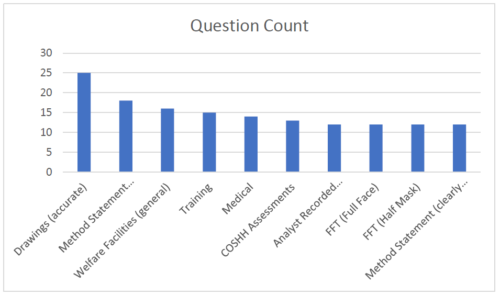
The top 10 list looks like this:
If we look at the numbers – three of these are clearly related:
· Risk Assessment – generic assessments
· Risk Assessments – whether the identified controls are reflected in the method
· Risk Assessment (vibration)
If we also consider that electrical isolation not being in place could also be connected to a lack of adequate risk assessment – we can see the attention to detail with respect to non-asbestos hazards is by far the most common issue at 27 instances.
Improved general H&S awareness and training for the contracts managers should be considered.
The most common issues for supervisors
Assure360 allows us to drill down and identify issues faced by supervisors. This allows the teams to address targeted issues within supervisor meetings, rather than allowing company-wide concerns to cloud the issue:
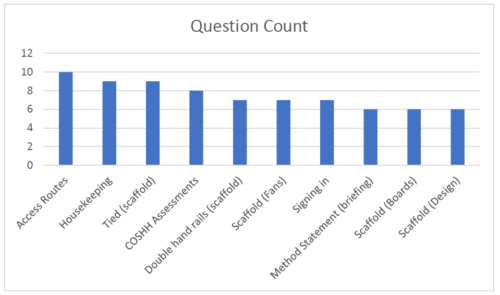
The top 10 for supervisors looks like this:
1. Access Routes
2. Housekeeping
3. Tied (scaffold)
4. COSHH Assessments
5. Double hand rails (scaffold)
6. Scaffold (Fans)
7. Signing in
8. Method Statement (briefing)
9. Scaffold (Boards)
10. Scaffold (Design)
Two main issue stand out for the site teams – housekeeping / safe access routes and scaffolding. Again, these are non-asbestos general construction issues.
Assure360 is not a dumb smart form or isolated tablet application – it is linked to a powerful cloud database. Its sophisticated system of automatic reminders and dashboards, ensures the right people deal with the issues at the right time. As Assure360 always asks – ‘what could we do to prevent this from happening again?’ everything is dealt with – root and branch.
How does this data compare with your own audits? Do you have a tool that can help you monitor and tackle these issues, saving you time and money and keeping everyone on the project up to speed?
Written by Nick Garland on Friday February 2nd 2018
In 2014 / 2015, the HSE carried out their Analyst Project – or to give it its full name ‘TheAsbestos Analyst Inspection Programme’. Its aim was to examine the performance of analysts in the removal process. At the BOHS roadshow last month, the HSE’s Martin Gibson revealed the initial findings and the first conclusions – perhaps the most surprising is how it might impact on the licensed contractor.
The HSE contacted all UKAS accredited labs and asked them to complete a questionnaire – the results were extremely enlightening.
Of the 145 UKAS accredited labs not everyone responded (obviously) – more than a third of them in fact. But if they thought they would stay under the radar, they were mistaken and the team targeted them for visits just the same.
Twenty 4SC visits were planned and in all cases the analysts were told to expect the HSE. Whilst this solved the issue of turning up when nothing is happening, it did mean that the analysts would be on their best behaviour.
I have broadly split the findings into the four stages of the process. I have also tried to highlight areas in the draft analysts’ guide that is intended to correct this. A copy of my white paper summarising the guide can be obtained on the Assure360 website.
One general point to be made is that wherever I mention photos – each has to be digital and date and time stamped to prevent forgery. And as usual there is a health warning with this post – this time from Martin Gibson – he stressed that the findings did not apply to all the analysts!
Whilst the analysts were checking that the asbestos had been removed, a detailed review of the surrounding area was a different matter. Whether the general site conditions were fit to start the inspection was often ignored. The worst example was this transit route – strewn with rubble and other non-asbestos material. It should have prevented failed at Stage 1.

The new draft guide has detailed the key inspection areas for the first stage of the process (including the transit routes and the areas surrounding the enclosure). Photographs are now required to demonstrate the adequacy of the situation.
The HSE’s view is that this is the critical part of the whole process, and raised the most number of issues in the investigation.
Analysts were observed moving randomly around the enclosure. Guidance (and logic) has always had it that a methodical pattern will help avoid missing something.
20% of the analysts wore domestic clothes underneath their overalls. This would have prevented them from decontaminating properly in case of a failure. Any of my regular readers will know that I believe that full decontamination via the DCU should be followed with every enclosure entry.
Formal failure certs were not always issued when an enclosure was rejected by the analyst. Whilst I can understand the instinct not to create paperwork, these failed certs are critical for addressing the root cause – that the LARC didn’t clean it sufficiently and the Supervisor failed to identify the issue. Clearer guidance on when to formally fail an enclosure is included in the new guide.
Two analysts arrived without overalls and two were unshaven. I don’t know whether these were the same individuals, but when you remember that the analysts were expecting HSE attendance – this kind of sloppiness is shocking.
What PPE and what to wear underneath is also detailed extensively in the new guide – the handy table is reproduced in my white paper on page 44.
There were also some startling implications over the amount of cleaning that analysts do – but I will leave that till later in the piece.
There were incidents that raised questions over basic competence namely calculating fibre concentrations incorrectly (decimal point wrong). This may just be the nerves of being overlooked.
More significant, in my eyes, is that one of the analysts forgot the brush for the disturbance test. Again, when you recall that the analyst knew the HSE would be in attendance, wouldn’t the instinct be to double and triple check your equipment? A photograph of the brush is now needed in the new look Certificate for Reoccupation.
Generally, the HSE found insufficient time was spent on reading the slides – one took just nine minutes to read three slides. This compares with the 10-15 minutes per slide in the current draft analysts guide and the 10-25 minutes in the old version! Just as I was forgiving to the analyst that got the decimal place wrong, to race through this phase of the process when observed by the authorities makes you wonder ‘what normally happens?’. The new look certificate with time and date stamped photos and time declaration at the signature stage should help this.
This is where the final checks are conducted post dismantling the enclosure, but I also include decontamination and PPE.
Frequently the analysts did not wear overalls when conducting the final checks. This is obviously unwise as dismantling the enclosure can reveal hidden problems. Mostly the analysts were entirely unprepared for these unpleasant surprises including not carrying RPE. Whilst the guidance is a little clearer in the new guide – Stage 4 is missed off the handy summary table, and the reader must go hunting in the Appendix. Hopefully the final draft will be amended.
The HQ visits established that practical training for decontamination was lacking. On site this was evidenced by analysts being unsure when to decontaminate and following the incorrect DCU entry/exit procedures when they did. Much more detailed guidance on decontamination procedures is included in the new guide – including training as a core skill.
No apologies for this section, though my regular readers might think that I am a broken record. The project established what we have been seeing with the Assure360 data. Most personals air tests were very short term and usually only 10 minutes. Further, they included no contextual information – just ‘removal works’. To compound this, the analysts often reported the calculated results which were below their own Limit of Quantification (LoQ). This is next to useless to the LARC who is attempting to improve their methods. They need long duration tests, with decent (low) LoQs and detailed information over what was happening during the test. Assure360 has analysed over 5000 personal air tests and even here we are finding that approximately 10% are for only 10 minutes.
This is what I hinted at earlier – something that all analysts will already know – analysts do quite a bit of cleaning as part of the visual. What makes it startling is the implications.
I am very aware that the LARCs have views on analysts and the ‘helpful’ ones are those that pitch in to get the enclosure through the clearance. I counted myself as one of those. In the Project, many analysts stated that they conducted minor cleaning. But what constitutes ‘minor’? Well in one case it was cleaning for over an hour!
The HSE’s view of this is that >15 mins cleaning constitutes licensable work and must not be done by the analyst. What’s more – any such breach is considered, at least in part, the LARC’s fault:
HASAWA
36. (1) Where the commission by any person of an offence under any of the relevant statutory provisions is due to the act or default of some other person, that other person shall be guilty of the offence, and a person may be charged with and convicted of the offence by virtue of this subsection whether or not proceedings are taken against the first-mentioned person.
Whilst the new analysts’ guide (still draft) has been written in such a way as to take some of these findings into account (get a copy of my white paper here), some last-minute changes have found their way in.
The new Licenced Contractor Guide which I understand was complete – just awaiting a slot in the HSE schedule to publish it – will now need a re-draft. Further guidance will be included on
“It is very rare that site supervisors carry out an inspection before the analyst arrives.” Analyst – Anon
My experience however is that the good supervisors take their role seriously and complete these visual inspections. However, the required declaration by the supervisor ‘time taken on visual’ may come as a bit of a shock.
The HSE’s view is that the visual inspection is by far the most important part of the whole clearance process. If the responsibility is primarily the LARC’s – a light touch / brief visual by the supervisor won’t be acceptable. The draft analyst guide gives us very detailed suggested times for these visuals.

This table indicates that a small boiler room should be inspected by the supervisor for 2-4 hours before the analyst can start stage 1 of the process. It also begs the question if the Supervisor is conducting a visual and therefore not supervising the rest of the team – does all activity stop?
There will have to be a sea change in expectations.
Written by Nick Garland on Monday October 23rd 2017
Essential reading to help you unpick the significance of the changes coming our way by Nick Garland, CEO of Assure360.
Here’s my summary of the draft of the new Asbestos Analysts’ Guide from the HSE. I’ve been publishing blog posts on this over the last six months, and this white paper is the complete set of articles on this with some updated additional analysis.
Download the Asbestos Analysts’ Guide White Paper [PDF]
The HSE’s new Asbestos Analysts’ Guide is coming soon or so we have been confidently told for the past year. When we do get it, it is designed to help both Analysts and their clients comply with the Control of Asbestos Regulations 2012 and its ACoP.
It’s the client I am particularly aiming this summary at, but those with technical backgrounds should also find it useful. It is also for this reason that I largely don’t cover the appendices – in of themselves a whopping 178 pages long!
This is obviously a summary and clearly not intended to replace the guide. In particular, the appendices contain a lot of important detail and should still be studied to gain the fullest picture. A further note of caution, this is a review of the ‘draft for consultation’ – there may well be changes before final publication. Publication of the consultation paper was a surprise when it was issued over Christmas, so stand by your beds.
I regularly write about this and other topics relating to safety and asbestos management. I’ve been working in the industry for over 20 years, so I have a fair bit of experience to share – the good, the bad and the ugly.
Why not connect with me at LinkedIn if you’d like to talk more about this. I’d be delighted to hear from you.
Written by Nick Garland on Monday October 23rd 2017
In the fourth part of my summary of the new draft Asbestos Analyst’s Guide from the HSE – I’m concentrating on soils.
For those of you who have read either of my other summaries – this stand-alone article is a continuation.
If you want to read the first three instalments:
Part 1 – Appointing the right asbestos analyst
Part 3 – Reoccupation certificates and clearances
You can download a PDF of the complete white paper on the new analyst guidance here.
This time I am concentrating on the age old, but simultaneously new issue of asbestos in soils.
It should be remembered the HSE’s interest starts and ends with protection of the worker and others directly affected by the project. There is a very real difference between HSE and Environment Agency take on asbestos in soils. Another much more ambitious and targeted document on this other angle is:
‘Asbestos in soil and made ground: a guide to understanding and managing risk’.
CIRIA 733 must be read to gain any proper understanding of the subject.
My usual health warning – this is obviously a summary and clearly not intended to replace the Guide. The appendices contain a lot of important detail and should still be studied to gain the fullest picture. Finally, this is a review of the ‘draft for consultation’ – there may well be changes before final publication.
Asbestos surveys are required under the duty to manage and the current Construction Design and Management (CDM) Regulations. Where there is ‘a reasonable expectation that asbestos would be, present and could present a risk to workers’– surveys must be completed. This is no different for the ground.
This is an area of asbestos analytical work that has been too long ignored, but growing dramatically. Historically – poor surveys and removal projects have failed to identify or remove asbestos containing materials (ACMs). Subsequent demolition would therefore create contaminated rubble to enter the aggregate supply chain. QED. Other than poor practices, there are other reasons:
The guide specifically states that speculative sampling should not be undertaken. We’re told only complete soil investigation if other (desktop) analysis indicates that there is a risk:
However, as I said in the introduction, the potential source of contamination is very broad and could be totally unrelated to the list given us in the guide. I agree – don’t do speculative sampling, but if there is planned ground works – asbestos surveys should be mandatory.
ACMs present in contaminated land can vary from whole sheets of asbestos or sections of pipe insulation to smaller fragments. Clearly, condition will deteriorate over time, leading to the presence of fibre bundles. When lying close to the surface and especially when the ground conditions are dry, fibres can be readily disturbed and released to the air. It is this interface with the air that brings the risk to the worker.
The desktop study and subsequent survey (if deemed necessary) should determine the risk to workers doing the digging. The risk assessment should establish the locations(s) of asbestos in the ground and identify the type, product, condition and amount (e.g. areas/depths). Soil type and moisture content are also key. Adequate controls can then be designed and implemented. Clearly discoveries during the project may require us to revisit the assessment.
The guide suggests a targeted approach.
Careful examination and picking of the area *. This would allow the surveyor to present the lab with larger pieces of ACMs (about 3-5cm2) and smaller pieces of debris and fibre bundles as distinct samples.
*Sieving may also help to separate the coarse fraction (stones etc.). Detailed procedures on decontaminating the sieve to prevent cross contamination of samples is needed.
The team’s task is to hunt out asbestos and only present suspect materials to the lab. To get any type of risk assessment, there would have to be an adjustment factor (suggested at ‘x 0.1’) – this would allow for the fact that the ACMs were collected over a much larger area.
This method has the advantage that a large area of the site can be covered more quickly. Its principal use is to establish if a main survey is needed. It will also allow a main survey to be better planned.
A note of caution – the naked eye, in site conditions, is especially vulnerable to fatigue. When you add the likely requirement for wearing safety glasses – the potential for missing ACMs must be acknowledged.
The guide indicates in the appendix that the targeted method is suited to the Preliminary Survey, but the Main Survey (if needed) would employ the traditional approach.
Select the sample points and carefully map the area (including depth).
The normal approach is to reduce (using coning and quartering) a 1m2 area of soil down to a 1-2 litre or 1-2kg sample. This is a method to reduce the sample size without creating a systematic bias. The technique involves mixing the sample, pouring it into a conical shape, flattening it out into a cake and dividing the sample.
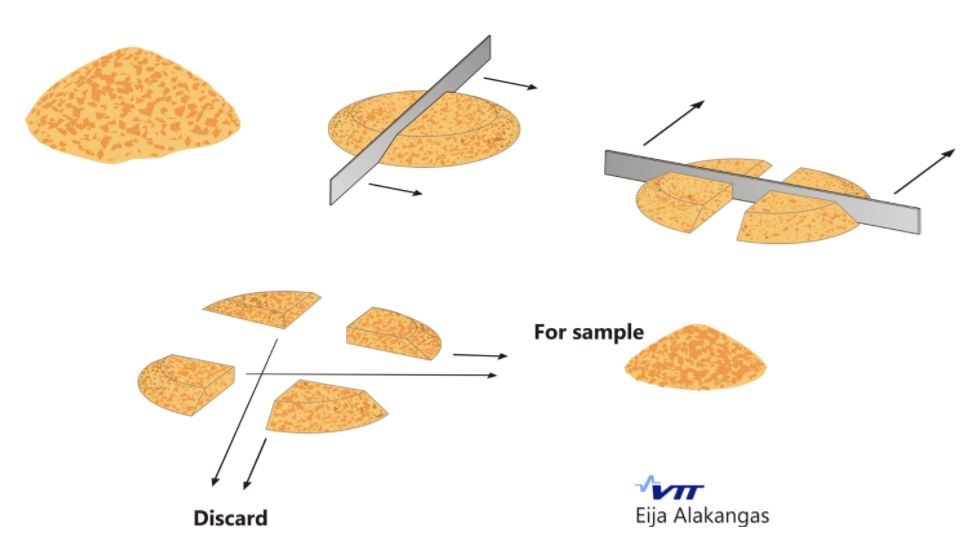
Image courtesy of Eija Alakangas, Technical Research Centre of Finland VTT Ltd.
The exercise should be repeated to get to the end sample size of approximately 1kg.
The soil type at the depth should be detailed to allow greater understanding (i.e. made ground, sandy, clay etc. will all have an influence on the final risk assessment). All should be logged on a site plan. This will allow not only a register of what has been identified – but can also be compared with previous site plans to better target further investigations. E.g. an old site plan indicates that a boiler room used to stand where a few positive samples were taken.
Whichever method is used, the guide highlights an important safety issue in that the activity should be done at the surface and the surveyor should not enter trenches or holes, unless properly shored up.
Laboratory identification of asbestos is obtained using the standard analytical methods. However, there is significantly more preparation required. Concentrations of dispersed fibres down to approximately 0.001% can be identified using the standard method – but I have found that this is very dependent on how long the analyst is prepared to look (20 minutes is suggested).
Quantification is critical to develop an assessment of risk; an appropriately accredited lab must therefore be selected. In such cases, results would be reported as a weight for weight (w/w) percentage of the matrix. Note the current rules for hazardous waste is 0.1% w/w, or (crucially) if any visible fragments of ACM are in of themselves >0.1%. This would mean (taken to extreme) a single 10p sized piece of AIB or cement in an otherwise clean load would render it hazardous waste.
I am not detailing too much that appears in the appendices in this summary – however, there is a table in appendix 2 which seems to contradict this:
The presence of ‘XXX’ indicates it is unfinished, but the guide seems to be adrift of what I understand is the hazardous waste rules.
These surveys, coupled with ‘near source’ and ‘far source’ air testing (see my second summary here), should be used to assess the risk and design the control measures.
As with all asbestos controls, the starting point is don’t disturb it, but as the land is due for remediation this is unlikely to be a solution. The guide states that where there is mostly bound asbestos in soils below 0.1% w/w, airborne levels are unlikely to exceed 0.001f/ml. However, where this is free fibre and especially in dry soils – the fibre release can be greater. Just like with standard asbestos removal suppression is a key element of any designed control.
The guide produces a flow chart to clarify the decision-making process, but I think it will get reworked before final publication. I will not reproduce it here, but the chart indicates that if samples identify asbestos that is buried and unlikely to be disturbed – it should be reported as ‘no asbestos found’ – certainly a typo. The principle will likely be that if the asbestos is buried and unlikely to be disturbed it will present no risk to the workers and therefore as the guide is only interested in these workers – we’re back to where I started – leave it alone.
Because of our historic failures, this whole area of remediation is where the future of the industry lies – as we strive for an asbestos free world.
Written by Nick Garland on Monday October 23rd 2017
With the shock of the Grenfell Tower fire still raw in our minds, Nick Garland look to echoes of the past for lessons to relearn.
“Grenfell Tower met all required building regulations – as well as fire regulations.” This is the statement from the contractor responsible for installing the cladding. The thing is, it might very well be true – but does that make it right?
In 1974, the year that the Health and Safety at Work Act (HASAWA) became law, the number of fatal injuries in British industry was 651, over six times higher than today. Pre-1974, the H&S framework had not been slack – in fact it had been highly proscriptive. The regulators set a list of targets, which industry would strive to achieve.
Simple.
The inevitable problem with this kind of approach to safety regulation comes where regulation is not drafted perfectly, so compliance to the letter of the law falls well short of what is needed. Problems that the regulator did not foresee will be missing from the guidance and therefore never complied with.
The Aberfan disaster in 1966 was a clear and horrific example of this. A previously unknown underground spring found the surface under the dramatically increasing slag heaps. The spring turned the foundations of the heap to an unstable slurry, and the whole lot slid down the hillsides killing 144 people, 116 of whom were children. The Coal Board had complied with the 1966 regulations because there had been no mention of what was required if underground springs appeared under your workplace.
Now take a look at the building regulations of today.
“External walls are elements of structure and the relevant period of fire resistance (specified in Appendix A) depends on the use, height and size of the building concerned. If the wall is 1000mm or more from the relevant boundary, a reduced standard of fire resistance is accepted in most cases and the wall only needs fire resistance from the inside.”
and
“… it is possible for some or all of the walls to have no fire resistance, except for any parts which are loadbearing.”
The Building Regulations 2010
It may be the case that the infamous cladding at Grenfell Tower was not approved as a fire proof panel. But it seems that the regulations are drafted in such a way as to suggest it doesn’t need to be. I am sure that it is more complicated than that and the height of the tower has a big influence – but the fact that cladding on dozens of tower blocks is now failing fire safety tests suggests that the regulations are at the very least easy to misinterpret.
Lord Robens, the much-criticised chairman of the Coal Board at the time of the Aberfan disaster, used this experience to revolutionise how we think about H&S. His report in 1972 directly led to the Health and Safety at Work Act 1974 and the creation of the Health and Safety Commission and the Health and Safety Executive.
This didn’t stop him from continuing to be unpopular. His most controversial idea was that those that own the hazards are best placed to assess them. This therefore is the core of the Health & Safety at Work Act (HASAWA): the simple goal to ‘create a safe place of work’. I believe this idea is ingenious because this twist harnesses the imagination and expertise of the hazard creator (the employer), allowing the regulator to stay ahead of the game.
Now comes the next touch of genius. ‘So far as reasonably practicable’ (SFARP). But what is ‘reasonable’? There is guidance to help the decision, but to a large extent it is down to the employer. But woe betide them if they fall short of SFARP, because the regulator checks, carry warrant cards and severely punish those not doing enough.
I loathe this phrase, it is lazy and misinformed. Billy Brag posted on Facebook recently – remember Grenfell Tower the next time you hear someone complaining about health and safety. Well done Billy.
‘So far as reasonably practicable’ is by contrast inspired. This clever phrase completes the circle:
1. Create a safe place of work;
2. Do all you can to achieve this and critically …
3. We will check that you do.
This harnesses the employers’ imagination, and in this age of private litigation – their fear too. ‘Is this far enough? … let’s just do that bit more…’.
The reality is – all the examples of seeming ‘H&S gone mad’ (including the famous conker ban), was the employer choosing to go the extra mile or two (rightly or wrongly). The legislation was written specifically to get this extra mile because ‘not far enough’ is just that.
If legislation can be beautiful – this is.
Dial forward to the 2014/2015 stats and the impact of the remarkable legislation can be seen. Fatal injuries in British industry have dropped by 85% and reported non-fatal injuries are down by 77% since the HSAWA became law.
This is the rub; the revolutionary legislation is the Health and Safety at WORK Act and has no bearing on domestic situations or appropriateness of design – unless it is to be a place of work. The main supporting regulation for construction that sits under HASAWA is the Construction (Design and Management) Regulations 2015. The main duty for designers in this document is:
…so far as reasonably practicable, eliminate foreseeable risks to:
Again, a gaping hole for us to slip through.
There are two saving graces: firstly common parts (areas of a building used in common – so the fire escape, foyer, lifts etc…) all count as workplaces. Secondly there are very detailed building regulations which everyone must comply with.
But now we are back to the shadow of Aberfan – if the regulators do not spot a problem and allow for it, then it is effectively invisible.
Today’s building regulations are just as, if not more, proscriptive than the legislation predating HASAWA. For those that are calling for the regulations to be reviewed – I could not agree more. The regulations should be entirely re-written, with Lord Robens’ vision at the heart – so that it is the employer, the developer – those that make the money out of our toil that have a duty to ensure that what they do is without risk – so far as reasonably practicable.
Written by Nick Garland on Saturday September 23rd 2017
In my regular feature, I take a look at the data collected by Assure360 to understand the issues our peers in the safety industry tackle during site audits and tech reviews.
Assure360 is the only community audit and compliance tool available for the asbestos removal and construction industry. With over a hundred safety professionals using the system – so far they’ve completed nearly 3000 audits and competence assessments – we are developing real insight into the challenges and issues our clients and peers face and overcome. As a result, Assure360 has the power to genuinely improve the construction industry.
The system not only incorporates site audits, but records tech reviews during the planning stage and . This allows managers to learn from common issues picked up by their peers – before the project goes live.
We regularly share the community’s findings with our army of independent auditors through our customer newsletter. Here is a taster of the most recent findings we shared covering audits and site reviews from August 2017.
If we look at the overall top 10 we see predominantly paperwork issues, that either are, or can be identified during peer reviews:

The top 10 list looks like this:
Whist the no. 1 spot is still held by the appropriateness of the method statements – there is a dramatic increase in the frequency (up nearly 40%). This may be an indication that new auditors are focusing more in this area due to these Top10s.
The next two are new to this month’s Top10 and reflect current forum threads. The former was an alarming situation:
A client of mine recently enquired why the hired DCU did not have a CO monitor in the clean end of the DCU. I think I suspected that they would say balanced flue, separate sealed unit, not needed… but they actually came back with ‘we took them out because they don’t work due to the humid conditions and the rapid airflow’.
Heres a summary of what they said:
Following an investigation into a CO poisoning case (2 operatives overcome by CO fumes within the shower system), the conclusion was that the CO alarm did activate using the test button but failed to activate when CO was emitted into the system. This malfunction was caused by the water ingression to the sensor field and simply blocked the sensor.
The BS 50292 (5.2.3.1) apparently states that alarms should not be installed next to doors, window, extractor fans or air vents – where significant air movement prevents the alarm from detecting CO.
Obviously a concern – a clear hazard (2 operatives overcome by fumes), but the detectors don’t work due to the configuration of the units. Just taking the alarms out doesn’t seem to be a solution.
Assure360 allows us to drill down and identify issues faced by supervisors. This allows the teams to address targeted issues within supervisor meetings, rather than allowing company wide concerns to cloud the issue:

The top 10 for supervisors looks like this:
Several new areas have been focused on this month with DCUs receiving significant attention. Double hand rails – whilst they have dropped a spot – actually went up in frequency (up 20%).
Similarly, contracts managers can focus on their challenges

The top 10 issues for contracts managers are:
Obviously the method statement issue dominates here – but if we look in more detail, there are three Welfare questions that are clearly linked. If we take Welfare – general facilities, canteen and provision of water together – they are in a clear second place with 16 instances. I think we are seeing evidence of our construction colleagues teaching us what to look for.
Written by Nick Garland on Tuesday September 12th 2017
You’ve heard about the benefits of using Assure360. You’ve heard what our customers have to say about Assure360. Now it’s time to find out for yourself by booking a demonstration.
We’re offering you the chance to demo the newly updated Assure360 app and win an iPad worth £500.
Assure360 brings asbestos and safety management innovation into the 21st century. It’s a complete safety management solution. Our customers tell us regularly that using Assure360 has revolutionised health and safety management and asbestos auditing in their organisations.
The MD of LAR, Bob Clarke, says: “Whilst initially skeptical of all such systems, now that we have been using Assure360 for a while I am totally converted. It is an incredible asset to my organisation.”
Would you like the opportunity to understand how Assure360 could do for you what it’s done for organisations such as Royal Mail Group, Breyer Group, LAR and Delta Services?
We’d be delighted to offer you a free demonstration of the platform. To book your demo just use the form on this page to contact us. If you’re coming to Expo2017, we’d happily host a demo at our stand C3150 – just let us know on the form. Or if there’s a better time for you, let us know via the form and a member of our team will be in touch to arrange a mutually convenient time for us to walk you through how Assure360 works.
Already a valued customer? You could still win – just book a demo for a colleague or professional contact and you’ll be entered into the draw as well as them.
As a thank you, everyone who has received a demo of Assure360 by 30 November 2017 will be entered into a prize draw to win an iPad 32GB Wi-Fi +Cellular. So why not get ahead with your planning for 2018 and book your demo today?
Once you try it, you may find that, like Andrew Le Marie, Group Head of Health, Safety and Environment at Breyer Group, you “couldn’t ask for any more.”
The competition closes on 30 November 2017 and the draw will be made on 4 December 2017. Entry is free and no purchase is necessary. Automated entries will not be accepted. There is one prize in total. The prize consists of an iPad Wi-FI + Cellular 32GB. The prize is as described and there is no cash alternative. The winner must have a UK mainland address to be eligible to receive the prize. Assure360 reserves the right to to disqualify entrants from outside of the UK mainland. Shipping costs are included to mainland UK addresses only. No other expenses, including travel, are included as part of the prize. The draw will be independently witnessed and the first name drawn at random after the closing date will receive the prize as detailed above. If the winner cannot be reached, Assure360 reserves the right to award the prize to a reserve winner drawn at random. For winner’s details, please email [email protected] within eight weeks of the draw date. The competition is not open to employees of Assure360, their families, agents or anyone professionally connected with the prize draw. To qualify for the draw, you need to have completed a demonstration of the Assure360 product by midnight on Thursday 30 November 2017. The winner will be notified by email or phone after the closing date. By entering this competition you are giving Assure360 permission to contact you at a future date. Entrants must be 18 years of age or over. Assure360 reserves the right to cancel the competition at any stage if deemed necessary. Entry into this prize draw is taken as acceptance of these terms and conditions.
Written by Nick Garland on Tuesday August 29th 2017
We’re exhibiting at Contamination Expo 2017 again this year. Find out why you should be going – and why you should come and talk to us on stand C3150 about your asbestos and safety management headaches.
The Hazardous Materials Expo 2017 is happening on 27 and 28 September at the ExCel Centre in London. Doors open at 10am. There’s more visitor info on the Expo website here. You can find a floorplan for the Expo here.
We’ll be hosting a stand ready and waiting to talk to your about your asbestos and safety management headaches. We’ve got more than 20 years’ experience in the industry so no matter what your challenge, you can pretty much guarantee that we’ve been there.
We’ll be holding consultation appointments on both days and offering demos of the Assure360 – our simple app that brings health and safety innovation into the 21st century. Everyone who books a demo while they’re at Expo will be entered into a prize draw to win an iPad worth £500.
We’ll also be launching our new whitepaper – ‘An Asbestos Analyst’s Guide’. This free resource offers our take on the HSE’s draft new analyst guidance. It’s essential reading to help you unpick the significance of the changes coming our way. Get your free copy when you come and see us at stand C3150.
Get in touch if you’d like to book a demo of Assure360 at the Expo
Written by Nick Garland on Monday August 28th 2017
In the third part of my summary of the new draft Asbestos Analyst’s Guide from the HSE – I’m concentrating on reoccupation certificates and clearances.
For those of you who have read either of my first two summaries – this stand-alone article is a continuation. If you want to read the first two instalments:
Part 1 – Appointing the right asbestos analyst
This time I am concentrating on the critical issue of reoccupation certificates, or for the layman – the final validation that an asbestos enclosure has been cleaned well enough.
The HSE have been running a well-publicised investigation into analysts and clearance practices, the findings have clearly informed Martin Gibson’s work here. Ordinarily I tackle bigger sections of the draft guide, but this area has so many changes and is of such significance that I thought it best to concentrate.
The latest heads-up on a release date for the finished guide, is that it should be back with Martin Gibson (the author) in September. Not sure how that translates to publication – but clearly the tanker is being manoeuvred.
Whilst I am still writing for the layman – this instalment reviews some dramatic changes that all professionals will need to prepare for.
My usual health warning – this is obviously a summary and clearly not intended to replace the Guide. The appendices contain a lot of important detail and should still be studied to gain the fullest picture. Finally, this is a review of the ‘draft for consultation’ – there may well be changes before final publication.
This is the legal phrasing used to cover the duties imposed when returning an area back to normal use – after some asbestos removal.
You might recall from the previous posts that the guide gives some pointers on when not to test. The one I repeat here is during the 4-stage clearance for external works. A common example would be soffit removal. Historically, this was an area that often confuses removal companies and analysts. External asbestos removal (i.e. no enclosure) still requires a 4-stage clearance (4SC), just not the actual air test section (Stage 3). The Certificate for Reoccupation (CfR) should be completed as normal – but this part would be struck through as N/A.
As an aside – the guidance on roofless enclosures to tackle domestic enclosures is so onerous that it is almost a statement – ‘don’t do it’. The requirement to place tarpaulin on the ground under the scaffold is virtually impossible to comply with. This should extend 2-3m beyond the footprint of the platform. It is a rare (possibly mythical) property that does not have bushes, trees, sheds or the neighbour’s property in the way of this. Guidance being guidance, you are not compelled to follow it exactly, but you must introduce something equivalent or better. Just because it’s hard to do – it can’t be ignored and the designer needs to get imaginative. I would suggest it is probably cheaper and easier to build a bigger scaffold and put a traditional enclosure on top.
The process by which an analyst passes off an asbestos enclosure is very familiar:
All 4 stages should be completed by a single analytical company (accredited to ISO 17020 and ISO 17025), and preferably the same analyst. To ensure the long since required independence it is now “strongly recommended” that the analytical company is employed directly by the building owner / occupier direct.
This is a much firmer stance on the issue and potentially marks time on the removal contractor rolling the clearance into the package and employing the analyst themselves. This has been the advice that all consultants have given for years (me included). I can hardly argue against it now – but it will have a cost impact – contractors always seemed to negotiate very competitive rates from analysts!
The requirement that all 4 stages must be completed and passed, with a failure at any point leading to the issue of an incomplete certificate remains. As does the requirement to carry out a separate inspection and clearance of the decontamination unit used by the asbestos removal workers.
The guide stresses that the analyst should plan the 4-stage clearance ideally at appointment stage, but certainly before work starts. This would involve specific conversations with the LARC about issues that could disrupt or impede the process. Sufficient time must be allowed for the 4-stage clearance and particularly the visual inspection. This last (for the layman) is the detailed hands-and-knees examination by the analyst that all asbestos and even visible dust has been removed.
There are some fundamental changes:
* With time and date stamp. The photographs required are quite extensive and would be a minimum of 12, plus one for the DCU. Substantially more for complex enclosures. The unspoken implication is that date and time stamped photos would prevent fraudulently forged certificates.
The guide includes a table in the appendices on suggested times for visual inspection:

If the difference between the estimated and actual visual inspection duration is >20% (longer or shorter), the reason should be recorded on the CfR. However, it does not state what should happen if the reason given is inadequate. I am aware that this was raised during the consultation process, so hopefully it will be clarified later.
The analytical company should build up a data set of estimated and actual times to enhance/improve their service in the future. This should also allow internal (or UKAS / HSE) investigation on the reasons stated for variance. Questions could be asked if significantly lower visual times are recorded. The date and time stamped photos would make massaging of these stats much harder.
Separate copies of the CfR should be provided to the building occupier / owner and to the LARC ‘promptly’ on completion of the process. This may cause issues for entirely electronic systems that do not produce completed certificates on site.
The clearance certificate for the DCU is a mandatory part of the process irrespective of who has employed the Analyst. i.e. if the contractor is not employing the analyst directly for the CfR, they do not have to pay separately for the DCU element of the test. Whilst this is a good improvement, it does raise some additional questions – there will be several variants, but I think this example sums it up:
** this number of clearances might not be possible anymore – see below.
Time spent on clearances has dramatically increased (a very good thing indeed!). When I started my career in Manchester in the early ‘90s, four and five visuals in a day were not uncommon. Given the recommended visual times – more than one would be unlikely.
The guide finally ends debate on correct use of PPE – more on this later, but as entry into enclosures for 4SC procedures:
carries a risk of exposure and contamination, the Analysts entering enclosure should only be wearing appropriate RPE and PPE. No other clothing should be worn.
It is not the analyst’s role to supervise or manage the above, but to validate that it has been completed successfully. Cleaning the enclosure therefore remains the responsibility of the contractor. The analyst should not start the 4-stage clearance until the contractor has conducted their own thorough visual inspection and is satisfied that:
Sealant / encapsulant should not have been applied at this stage.
I have heard talk that the time spent by the supervisor on this visual inspection should be the same as for the analyst. This was not detailed in the draft guide and I do not know whether this will be in the final version, inserted into the Contractor’s Guide when that comes out – or left out completely. If it is brought forward, it would of course prove to be a dramatic change. Supervisor visual inspections can often be quite cursory – the suggestion that this should increase to 1-2 days for a large complex boiler room, will probably be met in some quarters with incomprehension. Guidance on this key element of the job has been a long time in coming. Clearly it would have a significant cost impact.
The guide makes a brief foray into defining “Environmental Cleans”. I understand that this was met with such opposition in the consultation process that it will be dropped. Martin Gibson (HSE author of the guide), clarified his thoughts at a BOHS seminar. Areas with the occasional tiny spec of suspected asbestos debris should not be considered licensed work, and therefore wouldn’t require a 4-stage clearance. As I say this whole section is likely to be dropped or heavily re-written.
Much, much longer clearances, possible transforming changes to the role of the asbestos supervisor and a courageous definition for environmental cleans. A shorter chapter this time, but I think you’ll agree possibly the one with the most dramatic implications.
Find out more about how Assure360 can help you with asbestos management – book a demo and you could win an iPad.
Written by Nick Garland on Wednesday August 23rd 2017
The data we collect through the Assure360 app gives us unique insight into the issues our peers in the safety industry tackle during site audits and tech reviews.
Assure360 is the only community audit and compliance tool available for the asbestos removal and construction industry. With over a hundred safety professionals using the system – so far they’ve completed nearly 3000 audits and competence assessments – we are developing real insight into the challenges and issues our clients and peers face and overcome. As a result, Assure360 has the power to genuinely improve the construction industry.
The system not only incorporates site audits, but records tech reviews during the planning stage and . This allows managers to learn from common issues picked up by their peers – before the project goes live.
We regularly share the community’s findings with our army of independent auditors through our customer newsletter. Here is a taster of the most recent findings we shared covering audits and site reviews from July 2017.

The top 10 list looks like this:
Changes from last time is that accuracy of the drawings has dropped lower as has double handrails. Dropping out of the top 10 completely COSHH assessments, electrical isolations and firefighting equipment. A new observation – at number 1, is the appropriateness of the method. This is a new question in the App – where the auditor makes a judgement of whether a better, safer, more efficient method could have been designed.
Assure360 allows us to drill down and identify issues faced by supervisors. This allows the teams to address targeted issues within supervisor meetings, rather than letting company wide concerns to cloud the issue:

The top 10 for supervisors looks like this:
The two interesting additions to the list is double hand rails and housekeeping. Both are traditional H&S issues rather than asbestos specific, and might indicate widening expertise or awareness from the auditors. Also a new question in the system is Method Statement Briefing. This is where a supervisor has had to be moved or replaced – has there been sufficient hand-over and has the new site management taken full charge of the site?
Similarly, contracts managers can focus on their challenges:

The top 10 issues for contracts managers are:
HAVS and the associated vibration risk assessments seem to be an issue at the moment. Also the refining of the question set, with more options with regard to how a method statement is being written – has changed how issues are being recorded. This will help with more detailed root cause analysis.
Written by Nick Garland on Tuesday August 1st 2017
I’m always fascinated by the insight the Assure360 app gives us into the issues we’re all tackling during site safety audits and tech reviews.
Because Assure360 is the only community audit and compliance tool available for the asbestos removal and construction industry and there are more than a hundred safety professionals using the system we have the potential to really improve safety in the construction industry.
The system incorporates site audits and records tech reviews during the planning stage so managers can learn from common issues picked up by their peers – before the project goes live.
Here is a taster of the most recent findings we shared covering audits and site reviews from May 2017.
If we look at the overall top 10 we see predominantly paperwork issues, that either are, or can be identified during peer reviews:
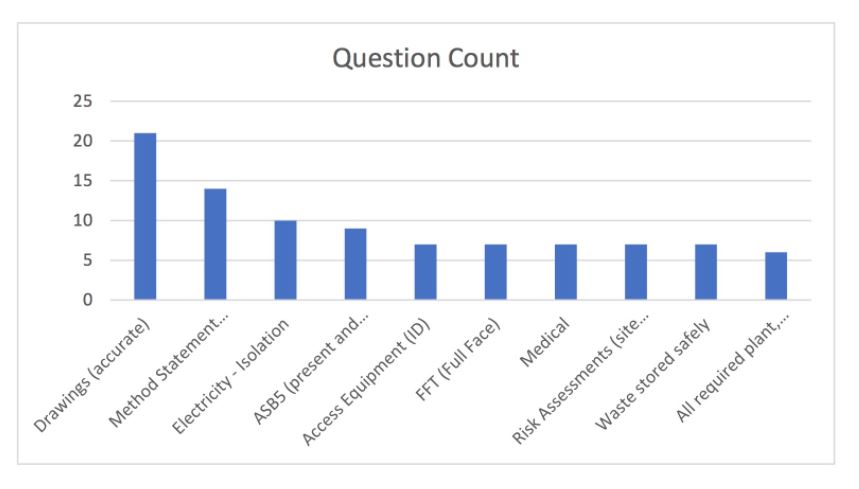
The 10 most common non conformance issues in May 2017
The top 10 list looks like this:
Compared to last time we published the data, we can see some differences:
Assure360 allows us to drill down and identify issues faced by supervisors. This allows the teams to address targeted issues within supervisor meetings, rather than allowing company wide concerns to cloud the issue:
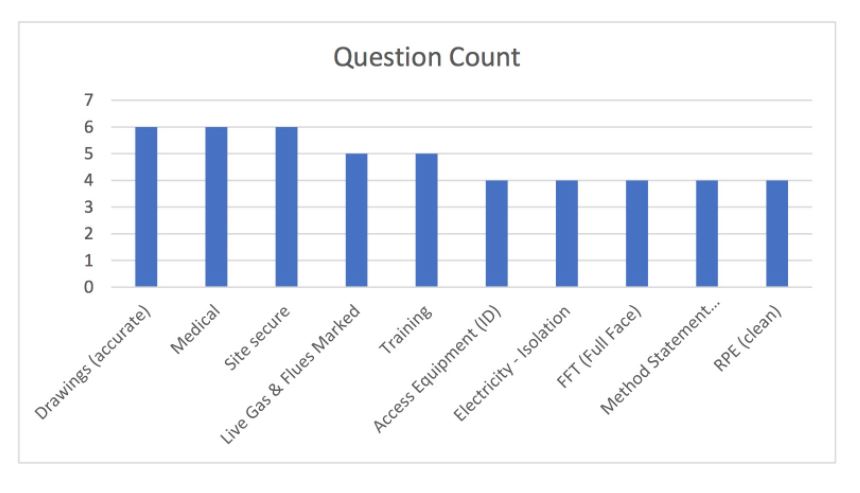
The most common issues for supervisors in May 2017
The top 10 for supervisors looks like this:
This last is normally the responsibility of the Contracts Manager, but we can see from this that the auditors are attempting to improve the skills at all levels.
Assure360 is not a dumb ‘smart form’ or isolated tablet application – it is linked to a powerful cloud database. Its sophisticated system of automatic reminders and dashboards, ensures the right people deal with the issues at the right time. As Assure360 always asks – ‘what could we do to prevent this from happening again?’ everything is dealt with – root and branch.
This month’s results would indicate that the approach is working.
How does this data compare with your own audits? Do you have a tool that can help you monitor and tackle these issues, saving you time and money and keeping everyone on the project up to speed?
Let us know what kind of data you’d be interested in seeing.
Written by Nick Garland on Tuesday August 1st 2017
In the second part of my summary of the Asbestos Analyst’s Guide from the HSE – I’m concentrating on asbestos testing (both bulks and air).
This is a stand-alone article, but you may also want to read the first instalment published earlier this year – New analyst guidance: appointing the right asbestos analyst.
This is a review of the ‘draft for consultation’ – there may well be changes before final publication. We still don’t have a release date for the final publication of the guidance, and we are already at the end of the promised June. However, the consultation was a surprise when it was issued over Christmas, so stand by your beds.
Whilst I am writing this for the layman – this instalment reviews some dramatic changes that all professionals will need to prepare for. It comes with my usual health warning – this is obviously a summary and clearly not intended to replace the Guide. The appendices contain a lot of important detail and should still be studied to gain the fullest picture.
The first section I will deal with in this instalment is analysis in bulk materials – or ‘bulks’ for short.
Simply put, this is where a small amount of a suspect material is collected on site and taken to a laboratory. Powerful microscopes are used along with special techniques to investigate the sample. This is the only sure fire way of determining whether a material contains asbestos and ultimately what risk it presents.
Bulk Sampling and asbestos surveys are required under the duty to manage (CAR 2012, Regulation 4) and under the current Construction Design and Management (CDM) Regulations.
Whilst HSG264 – Asbestos: the survey guide remains the best practice manual, the new analyst guide overlaps and takes things further in some areas. Both will need to be understood to remain compliant.
The guidance on single surveyor working has been significantly altered. It is now ‘strongly recommended’. The guide goes further by stating that some situations make it essential:
We should take note – as this is much more forceful phrasing than the ‘ideally’ in the Survey Guide. The need to work from height in most or all surveys would seem to preclude solo working completely. Clearly, if single ‘man’ teams are now officially frowned upon, it will have an impact on prices.
The guide gives specific direction on sampling strategy for some ACM types. Mostly the advice is consistent with HSG264, but again with some exceptions. The first significant change is in the recommended strategy for pipe insulation.
HSG264 tells us:
“In general, one sample should be taken per 3m run of pipe with particular attention paid to different layers and functional items (valves etc). ”
Whereas the Analyst Guide says:
“Valves or hatches or repaired areas near access routes are less likely to contain asbestos but discretionary sampling may be necessary.”
Clearly a totally different approach, which I am not convinced about. Only the other week I attended a site where all the asbestos had been removed, except near the valves.
Another key change in guidance is in dust sampling, which should be avoided except in ‘rare and specific occasions’. Dust sampling should not form a routine method or approach when surveying. Low numbers of asbestos fibres in dust are to be expected in buildings which contain or have contained ACMs. Due to the sensitivity of the method, very low levels of fibres can be detected. However, the guide tells us the random presence of low numbers of asbestos fibres in dust is not significant and represents “inconsequential risk”. It also tells us – in the absence of any ‘visible’ suspicious asbestos debris and fragments, extensive cleaning or abatement works will not be necessary
This is very welcome guidance indeed. Asbestos occurs naturally in the air of all our industrial cities. The sensitivity of the bulk analysis process is likely to find even the smallest trace. Because such testing merely determines presence and not risk, it is too blunt a tool. Random swab samples, where there is no visible evidence of contamination have caused no end of issues to clients. A report containing such information can cause considerable alarm and remediation costs, where the reality might be a single isolated fibre posing little or no risk. See the section towards the end of this article on SEM and ‘Real Risk Assessments’.
In traditional surveys, the number of samples taken will depend on:
The guide states that the number of samples should not be restricted by cost or contractual arrangements as this could lead to poor choices and false assumptions. This is much stronger guidance than previously published. I must stress that I fully support the increased emphasis, but it should be recognised that it will have an impact on costs.
Help can be obtained from original architect drawings, but will depend a lot on experience. The guide suggests ‘tells’ that will give a clue to a change in material:
None of the above can be used for positive identification, but they can give a strong indication as to when to take additional samples.
Consideration should be made where access makes sampling or post sampling clean-up impractical or hazardous. These areas should be discussed with the client. This is a continuation of the plan, plan, plan mantra of the survey guide.
On the sealing of the sampling point, the guide raises some important considerations. Specifically, it recommends that the chosen technique should be agreed with the client. Some issues to bear in mind:
Safety alert!
On this last issue, there was a serious safety alert on the asbestos forum where some foam sealant used in an enclosure spontaneously ignited via static electricity.
Spray coatings The guide suggests pre-injected with surfactant around the sampling area. It cautions against sampling damaged areas that show evidence of previous repair – whilst easier and safer, it may not be representative.
Pipe/thermal Full depth samples using a core sampler, but placing a wipe inside the tube before sampling and withdrawing the sampler through another wet wipe. This creates a plug at either end.
Insulating board/tiles The guide warns of proximity to live electrics, where pre-spraying might be hazardous. It also warns that a large sample is needed if the water absorption test is planned to determine AIB or cement (see below).
Asbestos cement Large samples are recommended (at least 5cm2) or where the water absorption test is required (9cm2). Asbestos cement is defined by CAR 2012 as a material, which is predominantly a mixture of cement and chrysotile and which when in a dry state, absorbs less than 30% water by weight. This leads to the Water Absorption test which is detailed in Appendix 3 of the draft guide.
Textured coatings Again large samples are recommended as asbestos is typically non-uniform (at least 20cm2). Areas of thicker material and/or ridges should be targeted. Two samples per surface or one per 25m2.*
Dust samples Avoid, but where they are taken to assess spread of a specific incident a minimum of one tablespoon of dust (not debris) should be collected. Scraping the dust layer into a pile and transferring into a suitable labelled container. Wipes, adhesive tape and filters should not be used.
* I have served my time in the bulk lab and can testify to how irritating small samples of textured coating are. However, I am not sure how a client would take to two 20cm2 sample from every ceiling. Certainly, something to discuss in the pre-survey planning.
In layman’s terms, air testing. For asbestos, it is the collection of a measured volume of air (litres) through a filter. A specific area is examined (number of ‘graticules’ – see below), and the number fibres counted. This allows the calculation of the concentration of respirable (again see below) fibres in the air.
As the guide was intended for the use of clients as well as analysts and the above is likely to mean nothing to most readers – I will start by explaining a few terms:
Respirable
In this case means not only breathable, but small enough that they can reach the lowest levels of the lungs where they can do the most harm.
Volume
Results are quoted in one of two ways – the first is by far the more dominant. f/ml or f/cm3 – i.e. number of respirable fibres counted for every millilitre or cubic centimetre of air drawn through the pump. 1ml is the same volume of air as 1 cm3.
Limit of Quantification (LoQ)
This is an oft used phrase that is little understood outside the analytical world. Results are often stated as less than the LoQ (e.g. <0.01f/ml). LoQ is a statistical way of determining what would be “fair to say”. E.g. if a given room had 100 fibres floating about and you sampled a small amount of the air – it would be pot luck whether you captured any of the fibres, but it wouldn’t be ‘fair’ to say that the air was asbestos free – just you didn’t detect anything. Similarly, if there were 1 million fibres floating about – you would be near certain of catching some. Therefore, LoQ is a statement that:
we don’t really know exactly how much asbestos is in the air, but it is less than ‘this’
Any clearer?
Graticules
This is the round ‘target’ that the analyst can see when analysing the filter through the microscope. The target is moved randomly a set number of times and the number of fibres falling within that target are counted. The graticule is a specific area, and so if we know how many targets have been inspected, we know the precise area of the filter that has been analysed. Clearance tests would include 200 of these random movements, personals can have less. Therefore, if only 100 graticules are used this means ½ the time to analyse the sample but double the LoQ.
The guide details the two main types of air testing – personal and static.
Where we test the fibre levels near to an individual’s face. The asbestos approved code of practice tells us what we should use this type of test for.

Whilst measurement against the control limit requires a 4-hour sample, there is allowance for shorter activities. It must be noted that when the time to access the enclosure and decontaminate following completion of a morning’s shift is factored in, a 4-hour task is a rare beast indeed.
In my opinion, all the above are important, but the last three have the most practical use. The removal contractor should be aiming for higher standards than the control limit to help drive performance. But only a test with a low LoQ can have any real utility. Therefore, the 10-minute test should be avoided in favour of one that can give a LoQ of 0.05f/ml or better.
My Assure360 database is designed specifically to deal with these three critical areas.
Clearly high risk activities should be prioritised – this may be related to the ACM, its condition or the individual’s role in the method. So, if a single test is to be completed it should be the operative scraping the pipe, not the one doing general spraying duties.
The analyst must record detailed observations about the operative during the testing:
The guide specifically states that if any of this information is missing, the sampling will be deemed inadequate. Now this is a very strong statement indeed. I think it is intended to compel analytical companies to comply, rather than suggest to a contractor to ignore them.
Just like any asbestos worker, the analyst themselves should have personal monitoring conducted on them particularly:
A ‘summary’ of personal sampling should be kept for 5 years. There is no guidance on what this summary should contain. But the data should form part of the health records, which must be kept for 40 years.
My Assure360 database tracks the exposure, compares it against the anticipated level and allows the employer to review methods on a regular basis to improve standards. Whenever the anticipated levels are exceeded, this is treated just like any safety incident spawning an investigation and root cause analysis. These new-look certificates would come into their own at this stage – perfect evidence for the investigation. Upload them as a permanent link to the record. With nearly 4000 personals on the system now – it gives users a great deal confidence when setting and reviewing levels.
This is the large traditional air test, where we establish the fibre levels in a general area. Used in several different situations:
There is no specified flow rate for static tests, but total volume of air tested should 480litres or more. The number of graticules (targets) counted must be 200+. However, the recommendation is that high flow rates (e.g. 16L / min for 30 minutes be used to limit the effect of settling and increase accuracy. The exceptions to this are background and perimeter monitoring – where low flow rates and very long durations are preferred.
The guide gives some pointers on when not to test.
I have my doubts over the wisdom of the last two. We are mandated to reduce exposure so far as reasonably practical, therefore not testing because we don’t think exposure will be too high – or we already use good RPE – seems to miss the point. You should always conduct the test to ‘support current and future risk assessments’ and ‘check the effectiveness of control measure’.
This is the name of the standard technique used to calculate airborne fibre concentrations. Paragraphs 5.10 & 5.11 give a great deal of detail on this, which I do not intend to reproduce here.
The technique has its advantages and disadvantages. Probably the key plus is that the test is quick (within an hour or two when conducted on site) and by comparison to the alternatives – inexpensive. Disadvantages are that high dust environments (e.g. wire-brushing, ‘blasting’ or removal of ceilings) can overload the filter making it unreadable (occluded). As it can’t easily differentiate between asbestos and non-asbestos fibres, it can overstate asbestos concentration.
These must be recognised and factored in when designing the sampling strategy. Careful selection of sampling periods/volumes or sequential samples (i.e. multiple tests run after each other, adding the results) should be considered. Another important strategy (where results may be skewed by non-asbestos fibres) would be the retention of half the filter prior to standard analysis. In the case of a ‘high’ result from the first half, the duplicate can be sent for a much more accurate Scanning Electron Microscopy (SEM) test – see below.
Caution should also be observed when interpreting the results from post incident air tests. The time gap between the incident and the test will be affected by natural dilution.
Whilst the guide details the option of using SEM analysis. It does not suggest it as a first option, but only as a check if PCM fails. However, in the case of blasting, where occluded filters are near certain, or very low LoQs are desirable, SEM testing should be considered. SEM can obtain LoQs as low as 0.0005f/ml and are much less vulnerable to overloaded filters.
One interesting service that is beginning to be available is ‘Real Risk Assessment’. The phrase was coined by Charles Pickles of Lucion referring to long duration air tests in normal (occupied) areas. Analysis by SEM would give very low limits of detection. Results could then be directly comparable to the World Health Organisation lifetime risk levels. This would finally measure chronic low level exposure and allow a genuine understanding of the long-term risks. Such accurate results could validate existing management techniques and prove that occupants are not being exposed, or, used to improve the plan.
In the case of 4-Stage Clearances (4SC), the guide indicates that the original floor surface should not be covered at the time of the air test. It does say that there are exceptions, but the only examples given is scaffolding or when the floor is an ‘intrinsically dusty surface’. This could be interpreted as meaning – floors sheeted out before removal must be uncovered for the 4SC air test. Hopefully clarification will be in the final version as many simple projects may become more complex and costly if this is the case.
The guide states that daily leak testing is required where there are other personnel near the asbestos work. Key areas to be tested are:
Testing should be a combination of short and long duration – short just after removal commences, with longer duration following on after.
This is very clear direction that was lacking in the original 2006 analyst guide. Currently leak testing (certainly daily ones) is considered an optional extra. The new emphasis is unarguably a good idea – but the cost impact on projects will be significant.
Other than the PCM and SEM, two other sampling techniques are discussed in the guide:
In my next feature I’ll be looking at how we can start preparing for new legislation.
Written by Nick Garland on Friday June 2nd 2017
We’ve just released an updated version of the Assure360 app – here’s how it helps to turn auditing into meaningful improvements in safety.
Our app was born to help companies manage asbestos removal projects (the most regulated UK industry after nuclear), so compliance is critical. But the structure also encourages the auditor to examine ways to improve. The app identifies good innovation on site as well as allowing the user to record aspirational best practice identified elsewhere. The combination of the app and the cloud database, instantly links audit findings with actions. Whether the observation is something that has gone wrong, innovative best practice, or a lesson learned from external sources –the sophisticated workflow process makes sure no one forgets.
The audits completed on the free app are the most comprehensive available, developed by myself over the past decade. They are uploaded directly to a database in the cloud, where the system interprets them for you. Non-conformances are presented to the designated managers for them to close out. It even reminds them if the due date expires. The high-level dashboard not only shows the immediate information required to spot trends, track close-out and develop strategies for improvement, it also allows a structured walkthrough so that you can showcase how you go about managing H&S to clients and regulators. A warts-and-all approach, where ‘challenged’ sites are discussed, becomes real evidence of proactive management.
Multiple organisations can participate in the process. The company themselves will obviously take the lead – but customers and trade organisations can also complete audits on the free app. The cloud structure can be designed so these 2nd and 3rd parties can view their audits and relevant internal inspections too. As all the audits are on the same system, close-out of non-conformance and learning from best practice is streamlined.
With the help of the army of auditors who use it, Assure360 has been evolving since its creation. As findings are anonymously shared on the central cloud database – this means that users constantly and automatically learn from others in their own sector and beyond.
Assure360 now covers safety auditing in every workplace and is so flexible it can be tailored to any industry, language or country. This flexibility was a key demand from our users who have been an integral part of the research and development. Continuous feedback, active participation, innovation and plain bright spark ideas have allowed us to design the experience to match not just what users need, but what they want.
We are still very close to our roots, but now the asbestos industry can start to learn from other sectors.
Read my feature on LinkedIn to find out more about what needs to change in safety auditing.

Written by Nick Garland on Tuesday May 30th 2017
For decades, the HSE’s requirements have not been well communicated, or have been described in terms frequently misunderstood by the industry. The license holder (or the prospective one) has too often been left to work it out for themselves.
It takes a courageous removal company to stand their ground when presented with the opinion of the inspector on the spot. To be fair, there is no manual that the HSE can pull off the shelf describing the perfect asbestos removal company. But this ad hoc, local, opinion-led approach has produced a host of different solutions:
Whilst some of these questions are new to the last few years, exposure monitoring has been causing licence holders problems for my entire career.
But why is this so difficult? The LARCs – licensed asbestos removal consultants – do manage health and safety, producing method statements and documentation far more detailed and considered than their construction counterparts. They spend vast sums on training staff, and ensure levels of supervision beyond what other industries would even consider. Exposure monitoring has been a challenge, but the tests are done in line with guidance and by skilled analysts, perhaps just not frequently enough – but done.
So why do these questions become so difficult to answer in a licence renewal meeting?
First, there is no 100% right answer and nowhere to look for advice, beyond asbestos specialised health and safety consultants (like myself). The trade organisations can also pitch in with this, but the independents are too few and far between to help everyone. However, as all industries can tell you, parachuting in a consultancy to ‘identify and solve underpinning problems’ sometimes leads to superficial solutions. The way I have always approached it is to become embedded in that company – almost as a part time H&S manager or officer. This degree of understanding is vital for crafting solutions.
Second, the nature of licence renewal is often adversarial, with the future of the company on the line. This does not lead naturally to a relaxed environment where ‘business as usual’ can be showcased.
So, how can Assure360 help?
Firstly, all reputable asbestos removal companies conduct audits. These are sometimes conducted on Excel, or iAuditor (an interface with Excel) but often on paper. The problem with these solutions is that they tell you little beyond high level non-conformances and it can be challenging to extract meaningful trends. The paper version (or a PDF) is often a cul-de-sac, with non-conformances trapped on the paper, hidden in a file.
When asked – ‘How do you manage H&S?’, too often the answer is a jumble of files, hard to decipher Excel spreadsheets, and in worst case scenarios un-actioned paper audits.
Not so with Assure360. The audits completed on the free App are the most comprehensive available, developed by me over the past decade.
A warts-and-all approach, where ‘challenged’ sites are discussed, becomes real evidence of proactive management.
One client, Rob Wasson from Delta Services, recently contacted me after a licence renewal. He told me: “When I demonstrated the Assure360 system to the HSE, it made me proud of all that we had achieved.”
That degree of confidence and enthusiasm can only be massively influential at renewal time.
The new question that the HSE can nail us with is how do you ensure the competenceof your workforce?
Competence is a tricky customer and can be a complex thing to measure – after all, just showing them the training certificates is not enough. I’ve written previously on our blog about what to look for in a good competence scheme. Assure360 however does it all for you. The same comprehensive audits are just interpreted in a different way.
The beauty of this is that you have already done the work. So instead of one more job that your overstretched team are asked to do – it is a matter of moments.
In my experience when helping a licence holder prepare for the HSE, the one thing that they are least confident with is exposure monitoring. Often there has been plenty of ‘personals’ done (though sometimes not). Sometimes these are compiled into an Excel spreadsheet, though often not. When asked ‘how are these used?’ it is frequently met with a pregnant pause.
In some ways, the LARCs have been led up an exposure monitoring blind alley. People in asbestos removal often only have a vague understanding of what exposure monitoring is for (you can read more on this in my earlier article here). They get provided with dozens of 10-minute ‘personals’ that tell us next to nothing. The feeling of ‘what is the point of this beyond keeping the HSE happy?’ has some justification.
The approach that Assure360 has transforms every personal monitoring test into an assessment of how successful the method was.
With 360, ‘the point’ is clear – it has a direct impact on the improvement of methods.
Assure360 is specifically designed to address all the challenges I have identified in my nearly 25 years in the industry. For the past two years, it has been helping LARCs improve themselves and with that, the industry.
Ken Johnson from Delta Service recently told me: “The moment I saw the system demonstrated I knew it was an absolute must for us. It ticked so many boxes – all the areas that the entire industry seems to struggle with.”
The central theme is simplicity, Assure360 is a system, one that you follow, implement and operate yourself. Just by doing so you gain greater understanding of the management of your company. You operate it yourself (no expensive consultants) and everyone contributes – this simultaneously saves money and strengthens your health and safety culture.
To find out more how we can help, contact us today on 0845 226 4318
Written by Nick Garland on Thursday May 25th 2017
Here’s Nick Garland’s summary of the draft of the new Asbestos Analyst’s Guide from the HSE and what it suggests for hiring the right analyst.
The HSE’s new Asbestos Analysts Guide is coming soon or so we have been confidently told for the past year. The current tentative publication date is June 2017, but I have heard that even this is likely to slip. When we do get it, it is designed to help both Analysts and their clients comply with the Control of Asbestos Regulations 2012 and its ACoP.
It’s the client I am particularly aiming this summary at, but those with technical backgrounds should also find it useful. It is also for this reason that I largely don’t cover the appendices – in of themselves a whopping 178 pages’ long!
This is obviously a summary and clearly not intended to replace the Guide. In particular, the appendices contain a lot of important detail and should still be studied to gain the fullest picture. A note of caution, this is a review of the ‘draft for consultation’ – there may well be changes before final publication.
The early stages of the guide cover the critical areas of how to appoint an analyst and what quality control measures should be implemented by the consultancy.
This is the first time we have been given strong guidance on this subject, though it has long been the perceived best practice. This contractual relationship is critical to ensure independence and the control you will need
With this starting point, the HSE then require you to discuss the project in detail with the consultancy. The aim is to ensure that the consultancy understands what you the client wants and for you understand what you are going to get.
Areas to address:
The wording for this last point is particularly interesting. Reports should be designed to satisfy the client’s needs, not just perceived UKAS requirements. The frustrating ‘our reports have to look like this, it is part of our UKAS accreditation’ or ‘no we can’t give the data in that format, because…’ should all be a thing of the past.
The whole appointment and subsequent planning phase is intended to mimic the changes first introduced in the Surveying Guide in 2012. Planning (especially between the client and the surveyor) has become the major route to success. It is intended to get around the issue of “why do I never get what I asked for?” – the answer normally being “you didn’t ask for it…”
Underlying everything in CDM15. Asbestos removal projects are covered by CDM, this is a long-accepted fact. However, the analysts guide gives us a new twist. Contrary to the wording in CDM15, the guide specifically states that the analyst will be treated as a separate contractor. This has dramatic implications, as all asbestos removal projects – even the smallest ones – will therefore require the appointment of a Principal Contractor (PC) and a Principal Designer (PD).
Many of the asbestos consultancies have upskilled to take on the PD role, but the smaller ones may not accept the additional liabilities. This then is another duty for the client – appoint a PC and a PD to the project – and be confident that they have the skills to do it. This could be an asbestos consultancy that can accept the wider duties or a specialised PD that has the expertise in asbestos.
A key client responsibility in CDM15 is to ensure that the project is being run safely. Without this engagement and contractual control, ensuring safety would be largely impossible. Even then, without some expertise, you replace ‘ensure’ with ‘hope’.
The advice I always give clients is simple – become an educated one. Either train someone in your organisation or appoint a consultant independent of the asbestos project teams to be your expert advocate.
Employers must prevent or minimise exposure and as with all guidance, the phrase ‘so far as reasonably practicable’ is used. It also suggests that ‘live’ enclosure entry should be avoided – as this could lead to exposure above the Control Limit and with it, mandatory asbestos medicals.
I take two things from this: firstly, the pre-visual, much loved by contractors, is being officially frowned upon, and secondly the guide is suggesting that not all analysts need medicals. In my experience, site analytical work (clearances, leak air testing and so on), inevitably leads to exposure above the Control Limit at some point. I have two examples from my past, both seemingly very low risk that led to high personal exposure. The first, a contractor was removing a cement flue with hidden pure fibre in the flanges – a surprise failure at stage 3. The second was a straightforward Asbestos Insulating Board (AIB) job, where the High Efficiency Particle Air (HEPA) filter failed in the Negative Pressure Unit (NPU). Consequently, I believe all analysts should have medicals.
The guide makes clear that two copies of the Certificate for Reoccupation (CfR) must be issued – the building controller and the licensed contractor.
Personal exposure for analysts should be air tested (personals rather than static). The purpose of personal monitoring is not ‘merely’ duty of care and the data must be used for:
It gives direct guidance that personal monitoring should be performed in ~10% of case, targeting:
Whilst the control limit is highlighted, I find the other element more interesting. Minimise so far as reasonably practicable, risk assessment and effectiveness of controls drives the responsibilities of the employer much, much lower than just the control limit. There is therefore no ‘good enough’ and we should be striving for ever lower exposure. This has an impact on how long we run the tests for and what Limit of Quantification / Detection we set.
Whilst the number of required audits has stayed roughly the same, other checks to be recorded and studied have increased:
Approximately 5% should either be shadowed or blind inspected immediately afterwards:
During the consultation period, I know that there was some call for making the audits more specific – i.e. what type of clearance was it? This would bring it into line with survey audits.
The last bullet will be new to those that have not read the draft guide. The new 4-stage clearance process must include photographic evidence to support the decisions taken along the way. These will include such things as proof that the enclosure was free from gross contamination and dry before the visual inspection took place. The time and date stamp on the photos is intended to evidence the stated durations of each stage.
Maintain individual logs of all work completed by your analysts. These logs should record:
Six monthly auditing of Analysts’ performance (including a review of the above detailed logs).
Essentially the guide is calling for audits to record significantly more detail. Once we are collecting more we will have to do more with it. This will drive assessment of competence and training to new levels.
The difficulty is that a huge amount of data can be very time consuming to process. Just as the removal contractors found with the drive for competence on their side of the fence – the consultancies will have to develop new sophisticated systems to collect, analyse and present the data in meaningful ways.
The guide immediately highlights something that has been clear to me for a long time. What we ask of our analysts often strays from the standard UKAS requirements into other areas:
The guide also highlights the need for H&S training, in my opinion – critical basic training for any analyst.
We must also recognise that the very act of passing or failing a 4-stage clearance is a potentially stressful and intimidating situation. Consultancies should therefore provide support mechanisms and procedures to mitigate or eliminate. This will help ensure that analysts’ actions and decisions are impartial and independent. Personal qualities of ‘resilience’, ‘determination’ and ‘integrity’ will be required.
The guide covers the UKAS recognised proficiency training modules. Also highlighted is the requirement for sign-off by senior manager before any unsupervised work. However, the regulations tell us that Competence is not just a matter of a training certificate – we must ensure an employee is competent to do the job. But as I cover in my competence blog pieces – we can’t just leave it at that – just because I was signed off as competent last year doesn’t mean I still am.
The required participation of the client in the plan, plan, plan process is likely to expose a longstanding industry misunderstanding. When a client hears ‘Project Management’ they expect:
Initiating, planning, executing, controlling, and closing the work of a team to achieve specific goals and meet specific success criteria. The primary challenge of project management is to achieve all the project goals within the given constraints.
However, in most cases, Analytical Consultants mean:
Specify the project, review the method, supply an analyst to run air tests, provide a report after the clearance
The client sees the latter as a given, and assume that the asbestos consultancy’s definition of project management is the same as for other areas of construction. This disconnect from expectation and delivery leads to much of the dissatisfaction in the industry.
So how common are these skills:
It is a rare analytical company that even has these as categories on the skills matrix, never mind measures or audits them. They tend to be what we assume an analyst can do, without training. Managers have often described it to me as a ‘gut feeling’ about an analyst that leads them to promote them to a more senior role.
The guide’s focus on soft skills and project management presents a challenge to labs. Most companies currently do not even identify these soft skills in their competence matrix, never mind measure them.
The clear steer is that to be ‘competent’ (i.e. knowledge, skills and experience) an analyst needs to go far beyond just the ability to operate within a UKAS environment. We see far reaching implications for training and competence – a consultancy’s approach in this key area should form a key part of the selection process.
Get in touch with us to discuss how Assure360 can help with:
Written by Nick Garland on Wednesday May 24th 2017
The Assure360 app collects a huge amount of data and this gives us unique insight into the issues our peers in the safety industry tackle during site audits and tech reviews.
Our app is the only community audit and compliance tool available for the asbestos removal and construction industry. With more than one hundred safety professionals using the system – so far they’ve completed more than 2000 audits – we are developing real insight into the challenges and issues our clients and peers face and overcome. As a result, Assure360 has the power to genuinely improve the construction industry.
The Assure360 system incorporates site audits and also records tech reviews during the planning stage. This allows managers to learn from common issues picked up by their peers – before the project goes live.
We regularly share the community’s findings with our army of independent auditors through our customer newsletter (you can sign up to this at the bottom of this page). Here is a taster of the most recent findings we shared covering audits and site reviews from January 2017.
If we look at the overall top 10 we see predominantly paperwork issues, that either are, or can be identified during peer reviews:
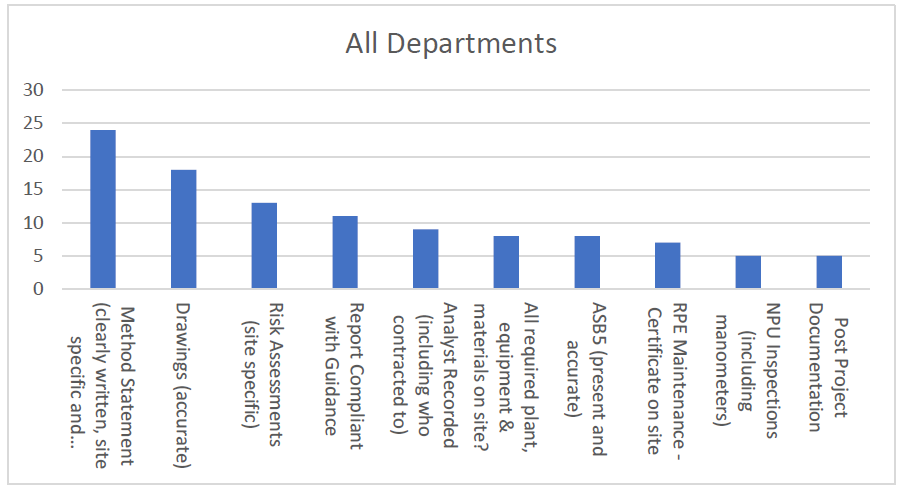
The top 10 list looks like this:
Whilst there are some favourites here, Risk assessments (site specific) indicates that the auditors are trying to come to grips with that age-old problem of generic risk assessments. Assure360 will automatically record this with an action to identify and resolve the underlying issues.
Whilst on the surface – ASB5 (present and accurate) seems alarming, I am aware that this is being used to track when teams are not on site when they should be.
Assure360 allows us to drill down and identify issues faced by supervisors. This allows the teams to address targeted issues within supervisor meetings, rather than allowing company wide concerns to cloud the issue:
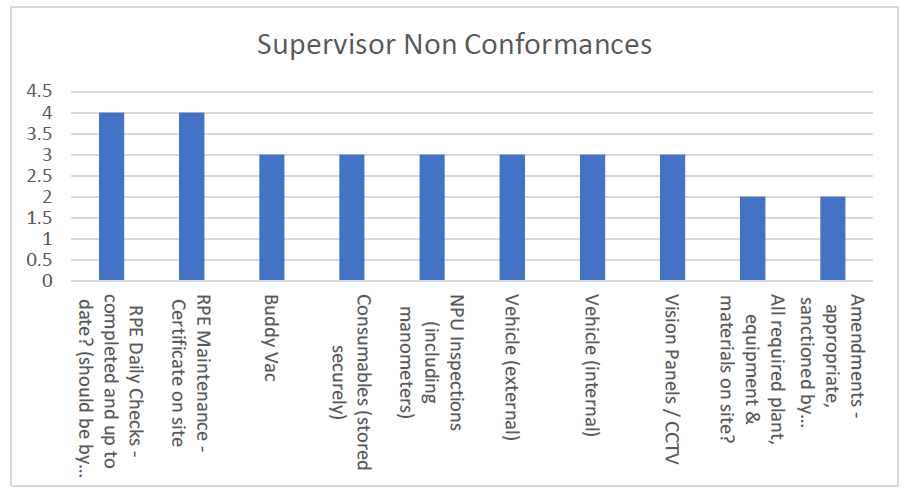
The top 10 for supervisors looks like this:
Again, for supervisors there are some familiar hurdles to overcome. But some surprising issues are being targeted as well. Vehicle inspections – when taken together – is the most common issue.
Similarly, contracts managers can focus on their challenges:
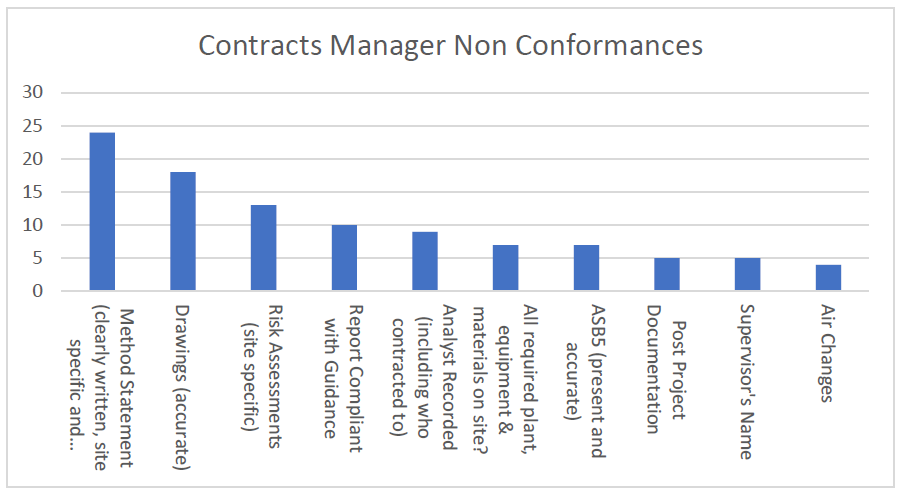
The top 10 issues for contracts managers are:
How does this data compare with your own audits? Do you have a tool that can help you monitor and tackle these issues, saving you time and money and keeping everyone on the project up to speed?
Let us know what kind of data you’d be interested in seeing and book a demo.
Written by Nick Garland on Tuesday May 23rd 2017
Breyer Group has over 400 employees and more than 60 years’ experience specialising in roofing, construction, responsive repairs and maintenance. They are one of the industry’s leading principle contractors, operating from their headquarters in Romford, Essex and a network of locally based offices.
As a large company with multiple offices, more than 400 members of staff, working on many sites with different clients, Breyer needed an intelligent system which could provide a single centralised platform to monitor all aspects of construction H&S. Breyer historically audited their sites using a bespoke tool. However, the system did not extend to tracking accidents and incidents, which had to managed separately. Significant development costs were becoming an obstacle to improvement. The support contract for the internal system also expired in two months, meaning the solution needed to be implemented quickly.
Assure360’s approach of configurable cloud database gave the best of both worlds. Working right out of the box, it was implemented within weeks, bespoke questions following very shortly after. Not only did it replace all of the functionality that the in-house system had, it went further bringing in accident and incident tracking too. The tried and tested audit tool meant that actually recording observations became quicker. Reporting via the Cloud platform – instead of being time consuming and labour intensive – was speedy and intuitive. The Cloud approach also gives visibility to all those that need it – site managers all the way up to the board.
“Assure360 has been a breath of fresh air since we started using it. The system is very easy to use, but at the same time powerful and comprehensive. We were able to create our own bespoke questions, so even though it is an off the shelf solution – working right out of the box, it has been configured to what we need.
“360 allows us to quickly and easily audit sites along with report, track and investigate H&S incidents. The cloud database lays all of the information I need to do my job – on a plate. I can instantly understand what our findings are telling us. Reporting to the board is no longer something I have to take weeks to prepare for – everything is at the touch of a button. What is even better is that the system is so easy to use, it is no longer me and my team that ‘do H&S’ – all of the contracts managers and directors participate.
“Assure360 allows me to do my job – manage H&S and improve the safety culture of the company. In short – we couldn’t ask for any more.”
Andrew Le Marie
Group Head – Health, Safety and Environment
Written by Nick Garland on Thursday April 27th 2017
The data shows that the licence terms awarded to asbestos contractors have reduced year on year. But in my view, standards in our industry are improving. So what’s going on? And is there a a better way forward for asbestos licensing?
A phrase every LARC will be familiar with, as it seems to be in all letters written by the HSE. One of the principle purposes of such a regime is:
“…maintaining and improving standards of health and safety”
The Health and Safety Commission permissioning regime policy statement
Maintain and improve standards of H&S, presumably by weeding out the incompetent and promoting best practice. But why then are average licence terms shorter now than they were? I have been in the asbestos industry since the early 1990s, and I’ve definitely noticed the change. Can we infer that the HSE’s opinion is that the industry is less safe and less competent than it was?
Licence assessments can be a very unpredictable time. All of the companies that I work with have heard of, or experienced extremely intense assessment interviews, but at the same time hear of laissez faire ones with very little detailed examination. Requests (demands) from the ALPIs is often insightful but can also be bizarrely arbitrary, with little practical application. One licence assessment ended up insisting that filing cabinets be used (rather than the perfectly acceptable system the LARC already had) – resulting in the conversion of the one and only meeting room into an archive room.
We all know anecdotally that it has become harder and harder to get the ‘full’ three-year licence from the HSE, but the latest figures are quite stark.

ALG figures, supplied by ACAD.
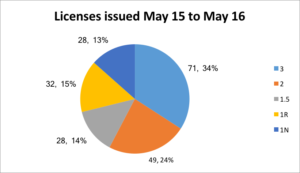
ALG figures, supplied by ACAD.
Excluding new licences (always one year) there has been an alarming drop of 23% in three-year licences issued in that period.

ALG figures, supplied by ACAD.
In my experience the industry, whilst there are some bad eggs, is getting much better. When I think back to the beginning of my career, where it seemed everyone had a three-year licence – the differences are remarkable. Now projects consider the wider job and recognise non-asbestos hazards. In fact, it seems a different industry with most of the stories of astonishing individual poor practice in the past.
So, if we are not getting any worse and the principle aim of a permissioning regime is to drive standards, why are the licence terms going down?
Could it simply be that there are less licensed contractors out there and the HSE want to exert more control. A tighter leash if you like? Certainly, the tone of some licence assessments and HSE visits indicate this.
The HSE tell the wider construction industry (and clients) that they shouldn’t use the licence term as a tool for selection. If the company has been given a licence (any licence) that indicates that they (the HSE) are satisfied and this should be good enough. The clients however (quite reasonably) take the view that well if you are concerned enough that you won’t give them a 3-year licence, then we are concerned too.
A licence holder can’t notify a project that extends beyond the licence expiry date.
We add then that the HSE publish the expiry date of licences – so if you track these things, you can plot a company’s standing. A client also instantly sees which companies can notify the project that they are considering. This might not seem a big concern, but very complex major works, might require 2+ years to complete – knocking out 65% of contractors.
With this in mind – are the HSE less inclined to reduce the term for a huge company? Do they back away when a downward tweak might stop a multi-million £ job in a power station? Certainly ‘the word’ is that they do.
The licence term is certainly a commercial driver.
In my opinion the HSE should remove the fixed term licence. The HSE should assess a company and give, or withhold a licence based on the interview and past performance during site visits. These licences should not expire (I hear howls of outrage).
What should replace it is a tailored review schedule for that specific contractor. Essentially, ‘Yes we are content for you to work with asbestos, but we want to see you again in 6 months, or 12 months or 3 years, just to make sure things stay on track’. A structured plan could therefore be put in place on what improvements must be implemented before the next monitoring visit.
The monitoring schedule would not be published and would not appear on the licence itself. This therefore could not be used for contractor selection. The pressure would be released from the HSE to grant 3 year licences for commercial reasons. There would be no issue of notifying jobs beyond the end of the licence expiry date – as there won’t be one. The HSE can concentrate on maintain and improving standards and do so in a much more structured way.
As I say this is an opinion piece, and I would welcome everyone’s thoughts and feedback.
I have been in the asbestos industry since the early 1990s, helping licensed asbestos removal contractors stay at the forefront of the industry.
Let me know what you think. Drop me a line using the email at the bottom of this page.
Written by Nick Garland on Monday January 23rd 2017
The Romford Group provides a comprehensive refurbishment and maintenance service including the removal of asbestos and re-insulation covering the Home Counties and Central London. The Group now has an annual turnover of approximately £5 million.
The Company is renowned for it’s friendly hands-on management approach and we are committed to giving our clients a good quality finish, on time and competitively priced.
All of our labour and specialist sub-contractors are carefully selected and maintain the Company’s personal approach when working in occupied premises.
The Romford Group operates across London and in various UK counties and uses a range of different teams of operatives and subcontractors for onsite project delivery.
The company needed a way to synchronise the management of client projects between their in-house employees and outsourced onsite teams. The company also needed a system that presented all of the employee training and competence information easily and clearly.
With the changes in requirements from the HSE, the company needed to increase the data it routinely monitored to maintain its reputation for high health and safety standards.
The Romford Group began using Assure360 in 2015 and now consider it an absolutely integral tool for the successful functioning of their business. Not only has it improved communication and progress tracking between in-house and outsourced teams, it has also provided a means of tracking their employees’ training in order to shine a spotlight on areas of potential weakness and transform them into strengths. The Assure360 system also helps the Romford Group to track the competency and effectiveness of their outsourced teams, helping to ensure they are collaborating only with others who meet their own high standards.
The dashboard approach focuses attention on high level trends and allows a proactive approach.
“We have been using the Assure360 system since early 2015 and have found it to be invaluable in developing the business. Nick and the team were able to quickly implement the system for us and whilst it took us a little while to get the hang of things it is now an integral part of our business. It is flexible enough to bring out our strengths but at the same time shine a light on our weaknesses – and help resolve them. The Assure360 System really helped with our recent license renewal, and whilst the HSE made some suggestions on ways to improve it even further, it clearly impressed them. We had no hesitation in renewing our contract.”
Jim Marling
Divisional Manager
Written by Nick Garland on Monday January 23rd 2017
Horizon Environmental Ltd is a private, independent company led by a management team with many years of providing asbestos removal and environmental services to the domestic, commercial and industrial sectors. Horizon has grown rapidly over the past five years, routinely undertaking very large complex projects. Horizon is dedicated to maintaining the highest standards in all dealings with employees, customers, suppliers and the public. It believes in upholding practices that create long-term value, and which enhance Horizon’s reputation for honesty, integrity, and safety.
With the rapid growth of the company, came a demand for increased management control and supervision. The traditional approach of auditing on paper did not allow the company to identify trends, understand competence or even close-out non-conformances in a timely fashion.
The management team at Horizon needed a faster way of tracking, recording and sharing their data. The company had also built a reputation for its high standards of delivery and wanted to be able to track the effectiveness of their subcontractors to ensure this reputation continued to grow. Being able to demonstrate to its clients maintenance of these high standards was critical.
The Horizon team have found the use of the Assure360 system transformative. It provides a simple, centralised place to manage their audits effectively and has huge time-saving benefits for busy senior staff members. It is also simple enough that staff new to computer systems can also quickly master it. This has allowed senior supervisors to participate fully in the H&S management system.
The app also provides easy tracking and reporting data, helping to ensure the company can spot and resolve any issues early on and remain on track with targets and deadlines.
“We have now been using the Assure360 system to manage our audits for nearly two years and I must say that it certainly does everything we need – helps us accurately manage competence, close out audits, measure trends and highlight re-occurring non conformances. The audit app is so easy to use that even my busiest contracts manager completes reports – as does my senior supervisor. The home page gives an instant health-check and reports are all done at the touch of a button. When you factor in the time saved – it has been a bit of a no-brainer”
Ben Ives
Managing Director
Written by Nick Garland on Monday January 23rd 2017
Woods was originally formed in 1994 to provide high quality asbestos remediation services across the South East of England. It now operates nationally across five offices located in Harlow (HQ), Milton Keynes, Wellington, Pontyclun (South Wales) and Rhyl (North Wales) delivering asbestos solutions to a broad range of market sectors procured through competitive tender, sole source arrangements or long-term frameworks.
To evolve with the rapid expansion of the business, Woods needed a system which would allow their managers – based at five different UK locations – to easily track and monitor all aspects of their client projects, from health and safety record keeping to competence assessments. Senior management based at the head office also needed to spot company-wide trends and be able to support and assist the regional teams in a proactive manner.
They needed a single system reading from one dataset, but accessible across the country – allowing both a regional and national approach when needed. And they needed to track overall success rates in order to highlight any areas which could be improved and ensure overall effectiveness of the teams.
The Assure360 system was rolled out to Woods management staff across the board, and has proved to be indispensable in allowing managers an easy and efficient platform on which to record, share and track the the H&S success of their projects. The ability to measure all aspects of H&S, exposure monitoring, competence monitoring and training needs analysis has saved significant admin time. It also reduces the chance for human error with its reporting functionality. This helps managers to easily provide accurate reports to senior managers, which in turn give a great overview of where the company is succeeding and where it can invest time and energy in improving.
“In my role as Compliance Manager I use Assure360 all the time. I find it invaluable, simplifying every task from health and safety recording, competence monitoring, close-out of audits, exposure monitoring and reporting to senior management. The Assure360 Support Team are very responsive and actively encourage feedback. I feel as though the system is continually improving and evolving to match exactly what I need.”
Louise Morley
Compliance Manager
Written by Nick Garland on Friday December 23rd 2016
Royal Mail have been collecting, processing and delivering letters and parcels in the United Kingdom for over 500 years. It’s the UK’s pre-eminent delivery company. The workforce of 139 thousand postmen and women and support staff delivered some 17 billion items in 2015-16, using thousands of vehicles and operating from more than 2000 buildings across the UK.
The buildings vary greatly in size from the smallest of vehicle workshops to huge mail centres. As well as varying in size there is a broad age range for their sites.
It’s a huge infrastructure, and coordinating suppliers and contractors to safely remove asbestos from the Royal Mail Group’s more than 2000 locations was a very daunting task for Asbestos Compliance Manager, Richard Bennion. Coupled with this, there was a requirement to protect Royal Mail Group’s good name and reassure the huge workforce that asbestos and asbestos removal was being managed safely.
Royal Mail Group required a system that would allow a very detailed look at how safely its asbestos specialist suppliers were operating, whether their work adequately protected the workforce and properties, and simplify the KPI measurement process.
Assure360 allows a layered approach to auditing so that internal managers can audit as well as getting its external asbestos consultants to inspect. The result is a large number of inspections and training sessions for the Royal Mail Group team – effectively making them an expert client.
The dashboard gives access to everyone that needs it – including the contractors themselves, who can view their own audits at the touch of a button.
The audit findings drive Royal Mail Group’s KPIs and the contractor assists with the close-out of non-conformances. They are therefore participating in their own KPI process – making contractor review a straightforward, conflict free process.
Not only this, but Assure360 also tracked competencies at an individual contractor level, making it easy for Richard to confidently choose a high-quality contractor that he knew was up to the task.
“The Assure360 database allows us to take a top level view of all of our asbestos removal contractors, directly comparing and contrasting them against each other. The audits are detailed but at the same time easy to complete. Inspections can be carried out by our own team, or selected partners – so we aren’t tied to a single consultant. Reports can be produced at the touch of a button. Assure 360 is the solution that provides a robust approach to compliance audits of our suppliers.”
Richard Bennion
Asbestos Compliance Manager
Written by Nick Garland on Friday December 23rd 2016
LAR are a HSE licensed asbestos removal contractor operating on both a national and international scale. The award winning company is at the forefront of the UK industry with regards to health and safety, training and industry best practice.
As a business LAR work extremely hard to ensure they remain at the forefront of the industry with regards to H&S, quality and performance. The company continues to invest heavily in staff development and training and has been recognised as being one of the industry’s front runners with regards to operatives, supervisors and management completing the ARCA Competency Scheme. In line with new guidance LAR have also moved the business to a more proactive approach to staff development and have invested a significant amount of effort in developing an industry leading Training Needs Analysis system. The efforts the business puts into its own development has recently been recognised by its Trade Association ARCA by being awarded with the Gold Training Award, the National Training Award and ARCA Gold Site Audit Award, where special recognition was achieved by securing this award for the 2nd consecutive year.
LAR’s heritage is major construction, but has specialised in asbestos removal for the last 30 years. LAR have been part of the growth of the asbestos industry and have evolved with it.
LAR work in all sectors of the built environment including:
As an established company with national and international clients, LAR knew their product was top quality, but success brings its own problems. With approximately 100 site staff the amount of auditing that is required to keep on top of quality and safety is enormous.
A new system was required to gather the information simply, process the data and create a suite of reports that allow the management of H&S to be integrated seamlessly with the operations and the quality management system.
LAR began using Assure360 in early 2016 as a way of keeping all their compliance and auditing data in one easy-to-access place which could be updated by all staff members involved by the project at any time. The system now drives most of the quality management functions evidencing and supporting BSI compliance.
Since LAR started to use Assure360 it has grown – helping with more departments, in particular the exposure monitoring, competence and training needs analysis.
“Whilst initially skeptical of all such systems, now that we have been using Assure360 for a while I am totally converted. It is an incredible asset to my organisation. All the tools and reports allow me and my team to really understand safety in our company, helping us drive through improvements. If licence renewal was brought forward to tomorrow – it would hold no fears for me. I would be 100% confident that Assure360 would make showcasing LAR’s high standards easy.”
Bob Clarke
Managing Director
“LAR have been utilising Assure360 since the start of 2016. The system has streamlined the way in which we work from both collecting data and also a reporting perspective.
We have showcased the system to a number of clients during tender interview/presentations and they have been impressed with the information we are able to report on. The most notable feedback we have had to date was from the BSI assessors who were undertaking a two day audit of our quality, environmental and H&S management systems, they made a specific reference within their close out report, noting the improvements the Assure system had made to our business from previous years. I would also note that when we have approached the Assure360 team with ideas or improvements, they have been quick to make changes to meet our businesses requirements.”
Steve Hannah
Development Director
“Assure 360 is simple to use, yet the output of information that links the competency, audit and health and safety has provided us with valuable data that has assisted LAR in improving various aspects of the business. At the press of a button, the visual reports are effective and give real time information button that LAR Senior Board and external auditors have found useful, effective and easy to understand. We find the Status/Actions Required/Due Dates useful tools in ensuring that the correct staff members are notified of, and deal with issues – ensuring effective and timely close off that can all be managed centrally. A real time saver that produces valuable information that assists in improving health, safety and competence that would benefit any business.”
Alison Brooks
Quality & Audit Manager
Written by Nick Garland on Friday December 23rd 2016
East Coast Insulations (ECI) was one of the first licensed asbestos removal companies in the country, starting operations at the same time as the regulations in 1983.
As the largest company in the region ECI provides asbestos removal, management, surveys and thermal insulation throughout Norfolk and Suffolk. ECI is by far the longest established asbestos licensed firm in the area.
ECI is a family-run business and continuously invests in its staff training and development program, priding themselves on keeping up to date with the latest regulations, guidelines and Approved Codes of Practice from the HSE to provide top quality service.
H&S management has changed dramatically over ECI’s 34 year history and managing the continual development and training of a large team comes with its own challenges. It was becoming increasingly time consuming and difficult to manage training records and subsequently, to manage whether training budget allocations were being maintained or used effectively.
Maintaining the close knit family approach and yet stay cutting edge was the brief.
In 2014, ECI was one of the founder members of the the Assure360 system. Our training-needs-analysis reports were integrated into the company, allowing delivery of training courses to provide in-depth understanding of the team’s strengths and weaknesses. Not only has this allowed them to invest in training in the right areas to round out their business, the staff training tracking also eliminated wasted time as they now only invest in the training courses which are needed. The detail that it provides, also allows the company to internalise training – getting operatives with particular strengths to help those with weaknesses. This allows the company to make a saving in recouped working hours and unnecessary training course fees.
“We’ve been using the Assure360 system for over two years and whilst it took a little time for us to exploit its full potential it is now an invaluable tool in helping us manage the company.
The audit tool is very easy to use and gives us an extremely detailed understanding of the jobs and how they are running. The staff competence system paints a clear picture of our team’s strengths and weaknesses (operatives, supervisors, contracts managers, stores and admin), allowing us to react accordingly. And the exposure monitoring solution is remarkably powerful but still easy to use. It saves us time and effort. The HSE’s response at our recent license renewal was that they had never seen such a powerful and comprehensive system.”
Jason Boast
Managing Director
Written by Nick Garland on Friday December 23rd 2016
Delta Services is one of the leading asbestos removal contractors in the UK. With over 22 years experience in asbestos removal, Delta Services provide asbestos abatement services to a wide variety of clients ranging from NHS Trusts, universities, hotels and large retail chains to small businesses and private individuals.
As a prominent member of ACAD they value their reputation in the industry.
As a large company with staff members who frequently work remotely on different sites with different clients, Delta Services needed an intelligent system which could provide a single centralised platform to monitor their asbestos removal processes in one place.
Like all asbestos removal contractors the administration of exposure monitoring and audits is a constant labour intensive problem that required a solution.
Managing Director of Delta Services, Ken Johnson, had not been expecting to find a tool that could reliably manage all the company’s clients workflow in one place, allowing his staff access to universally up-to-date client project data wherever and whenever they needed it. After seeing a demonstration of Assure360, however, he knew he had found a tool which could do this, and much more.
With Assure360, Delta Services employees could access client data in one place at any time, wherever they were, keeping workflows up to date and seamlessly managed from start to finish. This also dramatically reduced the risk of important information being lost or duplicated. .
The system has streamlined all of the processes that most removal contractors wrestle with on a daily basis – making doing business so much easier.
“The moment I saw the system demonstrated I knew it was an absolute must for us. It ticked so many boxes – all the areas that the entire industry seems to struggle with. Nick and his team fundamentally understand the challenges and has designed a product specifically for us, allowing my company to improve and showcase our strengths. At our recent license renewal, the HSE inspectors were amazed by the power of the system and couldn’t believe everyone wasn’t using it.”
Ken Johnson
Managing Director
Written by Nick Garland on Friday October 21st 2016
Amazingly it is now a full week after the inaugural Contamination Expo – I don’t think any of us knew quite what to expect – and that included the organisers! 200 Exhibitors, 3000 registered delegates and rumours that the HSE were going to attend (I know at least one inspector was there, because he came to see us…).
Whilst I have been around the asbestos and H&S industry for nearly 25 years, the Assure360 solution is very new – so it did actually feel like the right place for us to be.
Not only did we exhibit, but I presented a seminar – ‘Competence Systems, the Good the Bad and the Ugly’. The 30-minute tutorial outlined what competence means within the asbestos industry and why we should care.
We were also up for the asbestos innovation award. Shortlisted from the 200 exhibitors – the judges came to the stand, and I had to convince them on the uniqueness of the system. We nearly got over the line first – but in the end still delighted to get the runners up slot.
For those of you that are not familiar with Assure360 – it is a solution for the asbestos removal, analytical and training community. It takes existing tasks that everyone does already, makes them easier and transforms them so that they solve multiple needs.
From the single audit application, the cloud database allows the user to comprehensively manage H&S from an HSE licensing or UKAS point of view. It provides Competence Assessments, TNAs and it even transforms exposure monitoring from just a duty of care exercise to a technique that actively improve standards. All at the touch of a button.
For the trainer – it provides incredibly detailed TNAs – ensuring that time is not wasted on the initial exam at the start of the course. Allowing a truly bespoke offering.
Our many customers extol its virtues with such comments such as:
“At our recent license renewal, the HSE inspectors were amazed by the power of the system and couldn’t believe everyone wasn’t using it.”
Ken Johnson, Managing Director, Delta Services
“Assure360 is now integral to how we work. Our BSI assessors were really impressed by the system, noting all of the improvements it allowed us to introduce.”
Steve Hannah, LAR
As I say – an exhausting but rewarding experience and we have already booked our stand for next year.
To learn more or book a demo call us on 0845 226 4318.
Written by Nick Garland on Thursday September 15th 2016
Assure 360 uniquely allows you to audit asbestos projects, measure competence, complete Training Needs Analysis, and record exposure monitoring in one, time-and-money saving cloud based system.
We’re pleased to announce that not only will we be exhibiting at the exciting Contamination Expo 2016, but we have been shortlisted for the Asbestos Innovation award.
The expo is to be held at London’s Excel arena and Nick Garland, our founder will be giving a seminar ‘Competence Systems, the Good the Bad and the Ugly’. The 30-minute seminar will outline what competence means within the asbestos industry and why we should care (including the regulatory imperative). It will cover the various ways to observe and measure it, the pitfalls and the benefits that can be gained from a well-designed system. It will close with a short demonstration of how Assure360 ticks all the boxes and why we get testimonials like this:
At our recent license renewal, the HSE inspectors were amazed by the power of the system and couldn’t believe everyone wasn’t using it.”
Ken Johnson
Managing Director
Delta Services
It’s a must for all senior management in the asbestos industry wanting to make a difference.
Nick will also be on our stand, to answer any questions. It is well worth popping by the stand, where Nick will be able to demo the highlights of the system
Our many customers extol its virtues with comments like:
“The home page gives an instant health-check and reports are all done at the touch of a button. When you factor in the time saved – it has been a bit of a no-brainer.”
Ben Ives
Horizon
“Assure360 is now integral to how we work. Our BSI assessors were really impressed by the system, noting all of the improvements it allowed us to introduce.”
Steve Hannah
LAR
“The HSE’s response at our recent license renewal was that they had never seen such a powerful and comprehensive system.”
Jason Boast
East Coast Insulation
Visit our website to learn more, or book a demo.
Get your free tickets HERE and visit us at stand 854.
Written by Nick Garland on Monday June 27th 2016
The draft guidance that was doing the rounds last year on blasting techniques (whether that is Quill, Torbo or ice) has now been released as ALG meeting minutes, rather than a full ALG Memo. I am not too sure on where that places it in the regulatory framework, but it is clearly guidance that shouldn’t be ignored. There a few changes to the February 2015 draft that prompted my original summary.
The following piece is an update on the main points to be aware of.
The memo starts with the recognition that blasting may be required in a few rare occasions, but also declares that the process should only be considered as a last resort and not a go-to silver bullet. It also insists that the use of the process (above other more traditional approaches) must be fully justified by the licensed contractor, with evidence in support. What this translates to is that the method must not merely address and mitigate the significant additional hazards, but that the reasons for introducing them in the first place are declared and justified:
Clients are normally the main driver as to why blasting is being considered (“I want an asbestos free building”). It would therefore be wise to involve them in the decision process, explore whether the reasons for that desire outweigh the added hazards and ultimately justify why it is required. The guidance states that robust processes should be in place to ‘prevent misuse’. Or put another way – review of the justification and sign off by senior management. The technique must also be declared on the ASB5.
The guidance suggests the following controls:
** Wet Vacs may be problematic guidance as they do not typically have HEPA filters but the moisture in the ‘garnet’ will damage a standard vac.
These controls will considerably increase time, plant and materials and with them costs. It is difficult to imagine a client stomaching the substantial increase.
I can almost hear the echo of ‘It’s only guidance’, which it is, but the imperative is to implement something equivalent or better and the suggested controls are quite specific and difficult to argue against. As it must be declared on the ASB5, the likely increased chance of an enforcement visit will mean that Ignoring the document will be a high risk card game with your license as the stake.
Find out how we can help you with asbestos waste management – call us on 0845 226 4318
Written by Nick Garland on Tuesday November 17th 2015
This is a summary and critique of the brand new guidance produced by ARMI on Competence in the Asbestos Industry. I will try to reduce the 28 pages into something more concise and give my spin on the wording to help clarify. Reading this summary would hopefully allow you to fully implement ARMIs suggestions, and/or help navigate the full document if you want to read more (available at http://www.armi.org.uk/Download/ARMI_Competency_Guidance.pdf).
The guide starts with an explanation of what competence is and a statement that most contractors will be assessing it anyway. However this existing assessment may be entirely informal and subconscious (a vague understanding of – you wouldn’t ask John to do X because of Y).
‘The ability to perform a task to a specified standard’
‘The skills, abilities, knowledge and behaviours that lead to successful performance.
Understanding what skills are required, what skills are held by an employee and whether there is a gap between.
As the roles and duties you expect of an employee change, the skills (or Competencies) also change. Similarly Competencies also change if we change the way the job is to be done. Due to a variety of reasons, an employees’ Competence will change as time progresses – in either direction.
Consequently Competence assessment must be continuous to identify shortfall and inform training.
It must be remembered that training here does not mean set piece refresher courses, but a variety of tools to bridge the skills gap identified. It could be a formal training course, but equally it could be:
The guidance goes on to identify the clear regulatory basis that requires employers to conduct a structured Competence system. The document explains that you can get external assistance in performing some or all of these duties. However before you rush to an expensive external consultant – it states correctly that the duty can’t be delegated. Essentially what this means is that if a largely external system fails to deliver, it will be the employer in the dock.
As you are already at the Assure360 site – just click on Home tab to see how we can provide a simple, cost effective solution. Assure360 allows an employer to run an internal Competence system without creating extra work or recourse to expensive consultants.
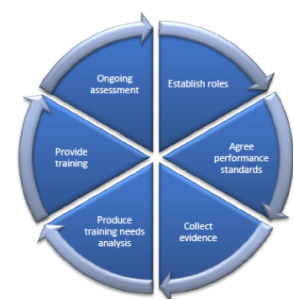
Image taken from the ARMI Guide
Steps 1 & 2 establish the skill set required and agree the standards have almost certainly already been completed. Your company H&S Policy and Standard Procedures, if correctly written will be tailored to your precise circumstances, describing the precise duties you expect of those individuals.
The ARMI’s guidance document goes into some detail on what could be seen as a standard set of Competencies for the industry. However, unless we all rewrite our H&S Policy and Standard Procedure documents to match ARMI’s guidance they are unlikely to ever be the ‘standard’ Competencies. They do however broadly map out what you would expect.
The guidance raises two important points that I would wish to echo and highlight. Competencies are role based not title based, recognising the fact that employees are often a blend of roles. i.e. a senior Operative might have some Supervisory duties. Similarly in a small removal company a lead Supervisor might have key Management duties. This is a key point and useful to stress.
Secondly the guidance recognises how critical teamwork and communication is at all levels in the organisation, going some way to identifying what this looks like at different levels in the organisation:
Core duties – i.e. Competencies that everyone from the operative to the MD should have):
Supervisory duties – as above, plus:
Management duties:
This aspect of teamwork and communication as a Competency is largely overlooked by the majority of removal companies and could contribute enormously. Strategies on how to promote these should be sought, but the guidance does not help with this.
Step 3 (Collect Evidence) and to a lesser extend Step 4 (Produce Training Needs Analysis or TNA) are the ones that will cause most issues with Licence Holders. Unfortunately other than tell you of some sources for gathering the required information the guidance crucially falls short:
However, other than little more than these bullet points there are no clues on how to:
In fact just adding these tasks to an already full workload may be an ‘ask’ to far.
To be fair the guidance does repeatedly say, ‘many of these tasks are already being done by licence holders’, the problem is existing measures typically do not gather the kind of information needed to create a detailed understanding of an employee. The trick remains – to transform the tasks that are already being done into an exercise that automatically provides the competence assessment.
An employee must be deemed competent to do a task and until they are, they need to be supervised. This has most impact with new starters (including agency); whether this is an experienced supervisor/manager or someone fresh to the industry – they will have little idea on how you as an organisation do things and you will have no idea of their Competence. Induction into company H&S policies and procedures is therefore critical and a high level of supervision must follow.
Next on the cycle comes produce TNAs. TNAs are an old problem, and as most training organisations know actually getting a TNA for an employee is a rare event, getting one long enough in advance to plan appropriately has until recently been almost unheard of. Nowadays I do know of several companies that complete TNAs in advance and submit these to the training providers.
The guidance seems to suggest that creating TNAs is an additional exercise over and above Competence Assessments. It identifies who assessors should be and what competencies they should have. Essentially this comes down to Supervisors and Line Managers as the in-house experts best placed to do this. Having TNAs as an extra task, added to a busy workload, will have the almost inevitable result of it not happening at all.
Again the trick is to make the process automatic. Direct observation should produce a competence assessment, which by its nature (looked from the other side) is a TNA. But the guidance does not tell us this bit.
This is obviously the act of closing the gap. We’ve identified the strengths and weaknesses (competencies), we’ve developed the training requirements (TNA), and this is merely the delivery of that plan. What the guidance makes clear though is that training is not just the annual refresher and can take the form of toolbox talks, practical sessions and even informal chats.
Essentially what this means is that; once we know (in detail) what weaknesses an operative, supervisor or manager may have, we can be much more imaginative in addressing those needs:
Many of these are issues, which if we recognise them, can be dealt with internally.
A senior operative; if he excels in the skill to be imparted can deliver training. Supervisors can become key mentors, contracts managers can learn from each other.
Equally if you understand the weaknesses on site, you should know your strengths, the industry has an awful lot of expertise and this is by no means restricted to training organisations. Good ideas, innovation and excellent performance should be identified, reinforced and shared.
Increased supervision is effectively ‘on the job training’. An identified slip in performance in an experienced operative or a new starter can be tackled by mentoring. Just because a new employee comes to us qualified and experienced, we do not know their level of Competence. Equally we should be near certain of their lack of competence in our own company procedures. This support can be seen as simultaneous training and assessment.
Or rather – start again. It should be noted, though, that the guidance correctly identifies that ‘establish roles’, and ‘agree performance standards’, won’t normally need to be returned to on a regular basis. As the collection of evidence and consequent identification of training needs is continuous, the cycle should just keep rolling. The guidance document does note that infrequently completed tasks may need to be tested via simulations to ensure competence is maintained. A good example of this could be emergency procedures or fire drills.
There should also be a formal review (minimum annually) – or employee appraisal. The competence, and TNA assessments that have been completed throughout the year, should be used as part of this exercise. Events that should trigger reviews:
The guidance is an effective definition of what competence is and gives pointers to how Licence Holders (LHs) can design their own systems to fulfil the requirements. It also identifies many tasks typically already done by LHs that can provide evidence of Competence and therefore inform TNAs and training.
Essentially as a guide to creating a competence system it does work. However the process it describes is a colossal amount of work.
The ARMI guide starts by creating separate performance criteria and matrices for every role. In of itself, this could be a few weeks work. It then describes a host of evidence sources that (admittedly companies do at least some of). However it gives no guidance on how to streamline the process of analysing the ‘big data’ this would produce. All H&S managers in the asbestos industry know that a PDF audit report can be a dead end and is lucky to be closed out, never mind trends identified. iAuditor can produce Excel exports but these are incredibly labour intensive to analyse. Typically the ‘degree of granulation’ achievable is to supervisor level and no further, leaving the majority of the staff un-assessed. Essentially to administer the competence system as described would require a dedicated full time individual.
As I say the guidance does explain the concept, gives sound guidance on where to start. But it leaves us hanging with the slight echo of ‘pick the bones out of that’.
However, there is help beyond the guidance. New commercially available systems streamline this process into a ‘click-of-a-button’ solution – my assure360 database and app is one.
Written by Nick Garland on Monday September 28th 2015
Transiting is the simple process that operatives follow to exit an enclosure. It is the moment where they remove PPE and if they get it wrong, expose themselves to increased asbestos. It is therefore critical. However, when I audit removal projects in the UK, I often come across an almost wilful disregard of this guidance. The poor procedure is reinforced by large training providers (I am thinking of one in particular) that actively train incorrect procedure to delegates.
The guidance is clear:
So why do over 10% of audits completed by myself and others (using my Assure360 system), record instances of PPE removed in the dirty stage or even in the enclosure itself?
The reasons we hear from the individual operatives, supervisors and their management, typically include ‘well you wouldn’t want to take all that contamination to the outside’ or ‘well the middle stage is a buffer’ or most common of all ‘well I went on a training course last week and they told me…’. All of these demonstrate a fundamental lack of understanding as to why the guidance was written as it was.
Correct risk assessment at the moment of transiting should tell us quite clearly who is most at risk – the operative. Therefore what is transiting for? The primary purpose is to ensure that an operative exits a hazardous environment safely. It has a secondary purpose – to ensure that in exiting, – that hazardous environment stays confined. The dirty stage (it’s nick name is such for a reasons) is the most hazardous part of the airlock system, so why should we be asking operatives to remove any PPE here? Removing PPE in the enclosure is clearly slightly insane.
If we lose sight of who is most at risk, it would allow us to think that the secondary purpose is the main one. On the shaky foundations of this ignorance and with the confidence that ‘well it’s only guidance’ brings, we get the poor procedures we so often see.
If the primary purpose was indeed keeping the hazardous environment confined, whilst allowing workers to exit – then a buffer zone or sacrificing PPE early to keep ‘us civilians’ safe, seems sensible.
My frustration, as a professional, comes when major training companies, who frankly should know better, actively teach removal of overalls in the dirty stage of the airlock, sometimes they even council throwing them back into the enclosure. This is directly apposed to guidance and demonstrates a lack of understanding and competence in the trainer. I know of several examples where the employer has designed the correct (guidance led) transit procedures – only to find that their employees have been de-trained at great expense. This misleading training undermines the company’s efforts to protect its workers and potentially induces enforcement action.
I therefore challenge the industry as a whole and training providers in particular to reconsider transiting in light of what it is actually for – protecting the employee.
Find out how we can help you with asbestos waste management – call us on 0845 226 4318
Written by Nick Garland on Monday July 13th 2015
This article is the second in a series of three, following on from my earlier piece “Why the Brits are best at H&S?”. I demonstrate in more detail the case for a Risk Assessment approach; but go further to explore where we can look for improvements. The final article will be a case study of two infamous and catastrophic incidents. I have taken a more academic approach this time – with a few references thrown in to show my sources.
The UK approach to H&S pre H&S at Work Act was highly prescriptive and targeted at specific industries, embodied in the Factories Act (Vermico, 2009). If government failed to predict and legislate, significant accidents could occur without any breach of regulation. The number of fatal accidents in the first half of the 20th century had steadily declined. However, during the 70’s, the rate had plateaued and then increased (Dalton, 1998, p. 2) – Lord Robens was tasked with creating better legislation. Realising that the workplace was getting more complex and faster paced, he didn’t believe that the established system of regulation was up to the task.
An horrific incident in the UK that deeply affected everyone was Aberfan. In 1966 a previously unknown underground spring found the surface under the dramatically increasing slag heaps. The spring turned the foundations of the heap to an unstable slurry and the resulting landslide killed 144 people, 116 of whom were children in the local school. Robens in his role at the National Coal Board, would have been aware that no regulations had actually been breached, because the regulators hadn’t predicted the risk. The impotence of the status quo would have been painful.
Robens believed that the traditional approach of ever-increasing, detailed statutory regulation was out-dated, over-complex and inadequate (Safety and Health at Work, 1972, p. 151).
The Robens report was trying to achieve a broader coverage, to all employees, not just specific industries or work place types. The reports main thrust, was those that own the hazards are best placed to assess them. This therefore is the core of the proposal, a simple goal based system (create a safe place of work), supported by guidance would allow the hazard creators to be flexible enough to control them.
However, in the decades after the publication of his report many aspects of how he saw the world of work were going to change. The effects of the information age, globalisation and the raw geographic distance between management and site require greater flexibility and a higher degree of autonomy for the front line workers.
Supervisors in particular have been transformed by the new management approach. Local responsibilities, especially in sites remote from head office, ensure that supervisors deal with strategic decisions. Effectively supervisors are no longer seen as workers and are now a key level of management (James Lowe, 1993).
Small and medium sized businesses are on the rise, providing the majority of all private sector employment.
The 70’s and 80’s were the peak of the union membership and these began to fall dramatically in the years to come.
With the reducing numbers of union members their authority has also declined, limiting influence over safety management.
In other words, the modern world of work is effectively built up of cells, either multiple independent organisations working together, or semi-autonomous teams. The role the unions once played in tying these organisations together and enforcing a good H&S culture is weakening.
Robens realised in the mid 20th century that roles and responsibilities had drifted apart (between policy makers and policy doers). In the 70s this was to say that the government could not keep pace with industry, was not aware of the risks and therefore could not legislate in advance. So it has continued in the late 20th and into the 21st century, where the policy maker is largely the company management team and the policy doers are the operatives and Supervisors on site. Management design H&S Policy, but the workers are asked to interpret and implement it.
Whilst this new flexible management style is better able to cope with the demands of the modern world, Robens did not envisage it. He saw that rigidity and hierarchy could tightly control a safe system. Decision making imposed on front line supervisors undermine Robens’ central belief of who a worker is.
Over the past 30 years, the simplification process that was the other element of Robens’ plan has started to reverse. The flat structure of a single Act with supporting approved codes of practice (ACoP) and guidance is now more a labyrinth of regulation (Pomeroy, 2010, p. 3). It is widely believed that whilst law has got simpler how to comply with that law (due to the supporting regulations) has got increasingly complex (Cullen, 1996, p 9 and Vermico, 2009).
Part of this reversal is due to the influence of European legislation. Once enacted, a member state has no choice but to introduce an EU directive into domestic legislation. The Control of Asbestos Regulations (CAR) 2012 was introduced as a direct response to the Considered Opinion. The HSE were effectively informed that the risk based approach that they had taken when introducing CAR 2006 was not in keeping with the letter of the European Asbestos Worker Protection Directive (AWPD). Consequently they were instructed to change it.
In addition EU law is by tradition more prescriptive. In Lord Cullen’s speech to the Royal Academy of Engineering (1996), he says:
When one looks at the six pack of regulations it is clear that they are more prescriptive than the earlier regulations under the 1974 Act and certainly more prescriptive than Robens would have envisaged.
And
… their language seems to go too far down the road of telling the duty holder exactly what to do.
He gives an example taken from the Workplace (Health, Safety and Welfare) Regulations 1992 where approximately 80 words are used to specify the seating arrangements that are required on a site.
For many, many years the UK asbestos industry has used wetting techniques to damped down the material before removal – this prevents the fibres from being released into the air and therefore breathed in. This is so embedded now that we can not envisage a job done in any other way. However in Holland, fully compliant with the AWPD, they still remove asbestos dry and damp removal is a revelation. I believe this is a direct result of complying with prescriptive regulation rather than aiming for a goal – ZERO worker exposure.
The following figures were taken from the HSE’s European Comparison report (2011). Whilst accident rates have fallen, we can see the fatal accident rates remained largely flat in the 8 years following the introduction of the Six Pack.
Standardised incidence rates (per 100 000 workers) of fatal injuries at work in GB and the EU, 1998-2007, and GB 2008 estimated incidence rate (Eurostat).
The Six Pack was introduced in 1999, which was immediately followed in the UK by a sharp rise in in the fatal accident rate. The Revitalising Health and Safety initiative was introduced by the HSE in 2000 to tackle the stagnation in the UK accident figures (HSE, 2000).
These statistics suggests that the increase in the prescriptive nature of the legislation was incompatible with the goal based regulation of the UK. Cullen suggest that the increase prescriptive nature of the European Union legislation is contrary to the systems generated by HSWA 1974 (Cullen, 1996, p. 6). The Revitalising Health and Safety strategy could be seen as extra support for the British companies, effectively as a patch to rectify the effects of the Six Pack.
The US has a similar proscriptive approach to H&S. In fact going further to pull the teeth of the regulator. The Voluntary Protection Programs (VPP) introduced in the mid 80’s. VPP is a process whereby companies can introduce certain controls and systems including a cooperative agreement between management and workers, an active occupational health and safety management plan and to pass an OSHA audit every three years. In return they are free from unannounced visits, effectively un-policed self-regulation.
James Pomeroy wrote in his SHP article International Safety Systems – Workin’ USA, (2010) that Mr. Michaels returned this damning assessment on the OSHA:
OSHA is constrained by both budget and legal authority. The ratio of workplaces to inspectors is more than twice what it was when the organisation was set up. Most OSHA standards are ancient and inadequate, and the organisation lacks the resources, or political clout to issue an adequate set of new ones. Many injuries and fatalities occur in the absence of violations of existing standards. Consequently, changes in the number and type of inspections are unlikely to have more than a minor impact on OSHA’s mission.
The US model, so far as they can be compared to the United Kingdom has produced starkly inferior accident figures. James Pomeroy (2010) compares the fatal and non fatal accident rates in the USA with the UK. In 2007 the US reported figures of 3.8 fatalities per 100,000 employees. This compares with 0.8 in the UK. In addition the non-fatal accidents were reported as six times greater. Indeed the fatality rate of 3.8 is worse than the figures reported by Poland and Bulgaria in 2008 (European Comparisons Report, 2011).
With so many similarities to the discredited Factories Act, taking lessons and elements from the US system is in effect drawing from the UK’s own past.
But – we can’t escape the fact that many of Robens’ assumptions have been weakened. The rigid hierarchical management structure and the strong influence of the unions has gone. The UK governments control over its own domestic H&S legislation is no longer absolute. Even the concept of who is a worker and who is management has changed. But the central core of the proposal, those that create the hazard are best placed to understand and control it, remains a powerful argument.
How therefore do we improve? Other than the US and EU model of prescriptive legislation, there is another alternative approach to the UK’s – the Canadian Resposibilization.
The Canadian Criminal Code states that individuals who undertake, or have authority, to direct how another person does work have a legal duty to prevent bodily harm to others (Gray, 2009, p. 327). This key shift in emphasis makes individual employees responsible for their own H&S.
Ontario has introduced a H&S ticketing regime (similar to parking tickets), these are directed in the main at workers and supervisors found not to be taking personal responsibility for their own H&S (Gray, 2009, p. 330).
The system has flaws and has been criticised as unfairly targeting the worker. The tickets available to the inspector are predominately aimed at the operative and the Supervisor (Gray, 2009, p. 331). However it quite clearly re-enforces the tenet that the employee has a responsibility to act safely and it is not just the management’s problem.
This, if used alongside the existing UK system of management, would adjust Robens proposal that safety was a function of management and only required the cooperation of employees. Employees wouldn’t just need to cooperate with employers, but help enforce good safety.
The main problem that Robens identified was that hazards were changing too rapidly for government to regulate. His solution was essentially simple; give the goal, create a safe place of work, to the individuals who understood the hazard the most, give them help to do this and police the system to ensure that it was done. He effectively predicted the shift in management theory, allowing decisions to be made closer to where they would have effect.
However he did not appreciate that the change that he was witnessing was only the beginning. Nor did he realise that his assumption that a supervisor was a worker and not management would be questioned.
In addition, Robens could not have predicted the influence European legislation would have on the future UK legislative framework. Whilst the law, is simpler at its core, compliance is increasingly complex. With the umbrella responsibilities of HASWA 1974 looming over companies, we get a system that is trying to be both goal based and complex.
To tackle the dramatically changed landscape, Robens needs to be strengthened at the same time as evolving.
Where regulation cannot be further simplified due to the influence of Europe, the regulators need to return to the collaborative and supportive vision Robens had originally. This will assist companies to comply with legislation.
The largest influence on H&S is management. However, the belief that an employee only has to cooperate is unhelpful. H&S management should recognise flatter company structures and supervisors as the first rung in management. This would involve taking lessons learned in Canada with the Responsibilization strategy and blending it with Robens. The ticketing system could be used to bring about a shift in the view that H&S is mainly the responsibility of senior management. Employees and especially frontline supervisors would recognise that if senior management create an unsafe environment, cooperating with this, is in effect condoning the procedure.
The flaws of the Canadian system, that it unfairly targets the worker, would be removed if the fines attached to the employee tickets were comparatively low and the fines attached to the employer ticket high. The existing system of enforcement notices available to the HSE would ensure that the focus remains on management.
The duties enshrined in the Health and Safety at Work Act 1974 should remain. These ensure that Robens’ core statement that H&S is principally a function of management continue to be our focus. The addition of the ticketing regime would expand the duty holders all the way through the organisation, ensuring the policy makers remain connected with the policy doers.
Find out how we can help you with asbestos waste management – call us on 0845 226 4318
Lord Cullen. (1996). The Development of Safety Legislation. Paper presented at the 1996 Royal Academy of Engineering and Royal Society of Edinburgh Lecture
Dalton, AJP. (1998). Safety, Health and Environmental Hazards at the Workplace. London: Cassell.
European Comparisons. (2011). Retrieved from the HSE website: www.hse.gov.uk/statistics/european/european-comparisons.pdf.
Gray, G.C. (2009). The responsibilization strategy of Health and Safety – Neo-liberalism and the reconfiguration of individual responsibility for risk. British Journal of Criminology, 49, 326–342.
HSE (2000). Revitalising Health and Safety Strategy Statement. London: Department of the Environment, Transport and the Regions.
Lowe, J. (1993). Manufacturing reform and the Changing Role of the Production Supervisor: The Case of the Automobile Industry. Journal of Management Studies, 30 (5), 739-758.
Pomeroy, J. (2010, March). International Safety Systems – Workin’ USA. Retrieved 13 March 2012.
Safety and Health at Work (1972a). Volume 1. Report of the Committee 1970–72. Chairman, Lord Robens. Cmnd. 5034. London: HMSO.
Vermico, P. (2009, July). Time to Act?. Retrieved 13 March 2012.
Written by Nick Garland on Tuesday June 16th 2015
First of all apologies for the title, it is intended to be a humorous one and I believe we can learn a lot from Europe. However, British H&S regulation has a not so secret weapon that gives it absolutely the right foundation and a huge advantage when it comes to the ‘league tables’.
So we must be doing something right.
At the recent European Asbestos Forum, Dr. Herm Zweerts of Arcadis presented a fascinating piece on the approaches to asbestos and the supporting legislation across Europe. His analysis showed that:
The control limits set for asbestos exposure across the continent varied dramatically.
The underlying regulatory controls also seemed to show differences in approach.
We in Britain should definitely learn from our European colleagues and in particular the areas of openness and transparency. France’s requirement for an asbestos survey to be conducted prior to any domestic property sale would in theory eliminate accidental asbestos exposure in the home. The fledgling NL mapping process that details known asbestos containing public buildings onto a cloud-based database with geographic map is also fascinating. In my experience it is often ignorance that leads to poor management of asbestos and ultimately exposure. Not knowing there is asbestos in the house, results in the artwork being positioned unwisely, or the ambitious removal of a wall leading to massive exposure. However, couple the French absolute requirement to survey domestic properties before they’re sold with the NL cloud database would give real transparency and the prospect for a roadmap to an asbestos free world.
Whilst we are still in this imperfect contaminated one though, ignorance remains our enemy. Asbestos is a scary subject, like the Plague or Anthrax just the word is often enough to strike terror. At best the world seems to know enough to be worried but not nearly enough to be considered knowledgeable. In this fertile ground of fear and ignorance, disreputable organisations can exploit us. I have heard of many projects large and small that are much much larger than the actual asbestos problem warranted. The German approach of independent experts may help this, but I believe we need to go further. Everyone that has any involvement in asbestos whether they are an asbestos operative, construction worker or property manager needs to understand asbestos better. Let me be clear – I am not attempting to minimise the problem, but calling for us, all of us to become educated clients.
Rigorous qualifications for the UK asbestos worker – like ACAD’s NVQ coupled with genuine competence and TNA assessments such as the ones that Assure360 can provide will transform the workforce into a professional one. Asbestos awareness courses for all (construction worker, tradesmen, teachers and even the general public) will give a level of knowledge that will dispel the fear. Those that commission asbestos removal projects or manage buildings should have advance courses in asbestos such as the UK’s P405 – shining a light on shady practice.
A central exposure database (like the Spanish one), could help fuel innovation. My Assure360 system centrally collates all exposure monitoring data in the cloud in an attempt to transform a duty of care task into this driver for innovation.
I started the piece asking ‘why are the Brits best at H&S?’, this was meant to be humorous, but there is a single reason for our practical regulation and my lack of concern over our high asbestos control limit. This is the foundation to all UK H&S regulation – The Health and Safety at Work Act (HASAWA). HASAWA came into force in 1974, is over 50 years old, and will in all likelihood be with us for at least another 50 – a near perfect piece of legislation. The authors understood that regulators do not have any hope of keeping pace with innovation. They will never be able to understand evolving industries sufficiently to implement adequate safety rules. So with a stroke of genius, they turned the whole framework on its head. The basic principles are:
The last phase is crucial – do what you can to eliminate or mitigate the risk. If we believe you could have done more, you WILL be prosecuted. Later guidance and regulation helps the employer in this task, but it remains their responsibility to assess the risk and eliminate it. The regulator no longer has to keep pace – all they have to do is make a qualitative judgement – “has the employer done enough?”.
The employer must constantly innovate to minimise the affect of his activities. This is the driver to the practical rules that Herm identified. The (embarrassingly high) figure set by the UK government for exposure is in reality a nominal one. As (due to HASAWA), the employer must reduce exposure as far as they can. The reality of UK asbestos worker exposure is somewhere between the French and German levels.
If legislation can be beautiful then HASAWA in its simplicity is just that.
The US legislative framework is very prescriptive, as is much of Europe. In essence if you can tick the requirements laid out for you, you’re in the clear. A graphic (and hopefully extreme) example of why this is a very poor approach is this:
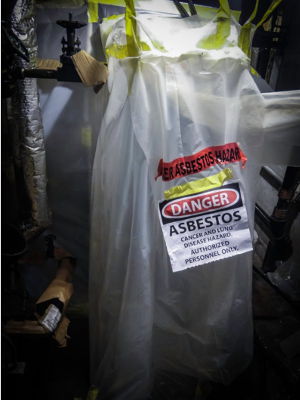
Photograph kindly provided by Tony Rich of Asbestology LLC (in the USA)
It may take you a little while to work it out, but this is apparently a ‘technically compliant’ airlock in the US. It has three stages, separated by flaps. Ticks the boxes laid down in regs, but I’m sure you would agree – wholly inadequate. If the US had a Risk Assessment based approach like HASAWA, rather than a prescriptive one, an enforcer would be able to take one look and start building his / her prosecution.
It is because of HASAWA that we are very unlikely to see a Gulf of Mexico oil disaster in the North Sea. BP and it’s US subcontractors followed all of the rules, squeezing protocols and procedures until the relevant boxes could be ticked – with tragic and catastrophic results. In the North Sea, with a different approach, it would have been obvious that they could go a lot further than they did.
The one big weakness in the UK is that HASAWA is the Health and Safety at WORK Act, and therefore has no bearing on domestic situations. This is where I believe we can lean from France and NL, eliminating ignorance and fear.
Therefore my call is this one – the UK legislators should learn from the best in Europe. A good start to this would be by engaging in the European Asbestos Forum and in particular contribute to the 2016 conference. Secondly the world should recognise the fundamental flaw in trying to keep up with industry and lay the responsibility where it should be – with those that create the risk.
Find out how Assure360 can help you with asbestos health and safety compliance – call us today on 0845 226 4318
Written by Nick Garland on Monday June 1st 2015
The very first European Asbestos Forum conference was held in Amsterdam last week and I was lucky enough to attend. The stated aim was to improve professional networks and promote the exchange of knowledge. With the ultimate goal of helping our industry grow into a collaborative one.
I was asked to attend to share my expertise on Competence. My talk was entitled Using Technology to Deliver Competence with the case study of the Assure360 system as a demonstration on how it can be done – more on that later.
The highpoint of the morning session was a very powerful speech by the ex US Assistant Surgeon General Dr. Richard Lemen where he comprehensively debunked the claims from the asbestos producers that chrysotile is non hazardous.
Particular points from his speech to highlight would be:
The WHO figures just released indicate 125,000,000 people are exposed to asbestos every year. It is also estimated that 107,000 preventable deaths are attributable to asbestos. That is one person every five minutes. Even more shocking Dr. Lemen revealed that this figure is about to be revised UP to 194,000 per annum.
Very sobering.
The backdrop of his speech was the fact that many countries do not have a universal ban on asbestos (including the USA!). Some of this is down to commercial and political lobbying by the asbestos producers (notably Russia). Russia produces 2 million tonnes of asbestos annually, half of which it exports.
Whilst deaths from asbestos in the developed world appears to be plateauing, In developing countries it is skyrocketing. I read a stat the other day that India has overtaken China in GDP growth, add to that the fact that they are also the biggest asbestos importer.
He went on to debunk the myth that chrysotile is non hazardous, showing source after toxicological source confirming its carcinogenic nature. The final eye-catching proof was that over 30 times more chrysotile than amphibole fibres have been found embedded within mesothelioma tumours.
As I said, the reason for me attending was to share my expertise on Competence, in short the key points to any good competence system is:
If a scheme misses any of these pillars it will fall over.
This amount of direct observation takes a great deal of time. Obviously I went into more detail but the solution that makes this practical and achievable is a cleverly designed tablet application synching with a powerful cloud database.
Innovation and the asbestos industry for many years hasn’t seemed to sit side by side. However, the technology session in which I took part, was exciting. Inventions and developments showcased were:
There was also a comparative study on the pros and cons of EU national approaches to tackling asbestos. I will do a separate piece on this next week.
The aim of EAF2015 was to improve professional networks and promote the exchange of knowledge. Certainly Dr. Lemen’s speech set the tone – we’re all in it together. The collaborative approach of the subsequent sessions re-enforced this message.
Find out how we can help you with asbestos waste management – call us on 0845 226 4318
Written by Nick Garland on Monday April 20th 2015
This is the first of a series of short LinkedIn articles I will run identifying legislation that might have passed under the radar.
The Confined Space ACoP was amended in December last year and its impact on asbestos removal works is more than expected.
There are now two official triggers for categorising a work area as a confined space. The first is the obvious – is the area largely enclosed – is the access / egress restricted? These would be good examples:
However the ACoP now specifically adds asbestos enclosures to this list. Any such area will require a specific escape / evacuation procedure and a means of communicating.
What makes one of these ‘largely enclosed’ work areas a Confined Space is the addition of the foreseeable risk of one or more of the following proscribed hazards:
Confined spaces therefore represent varied and very hazardous working environments. However, for the asbestos project, it is no longer just stale or bad air within a subterranean duct that qualifies – the two others I wanted to highlight, increase the number of potential Confined Spaces dramatically:
Selecting grinders or burning pipes is, fumes aside, hot works and will therefore trigger the confined space regs because of fire. In addition that hospital boiler room where isolation is impossible will also qualify because of heat stress…
The following should be the approach taken in every case:
Is the area substantially enclosed (if it’s an asbestos enclosure – then yes).
What are the hazards? Are there any on the proscribed list? If so, does the job really need to be done? Can the hazard be removed (e.g. using recips, rather than grinders, isolating pipes etc…)
If the proscribed hazards are present and can’t be removed, then the Confined Space regs will apply.
If the enclosure does not involve one of the proscribed hazards, it is not a Confined Space, but it will still require a specific escape / evacuation procedure and a means of communicating.
Find out how we can help you with asbestos waste management – call us on 0845 226 4318
Written by Nick Garland on Monday March 16th 2015
Many in our industry mistakenly believe that the the Construction (Design and Management) Regulations do not apply to asbestos removal projects. Contradictorily, it is also often believed they only kick in when the notifiable triggers are exceeded. With CDM 2015 just round the corner, the following piece is a summary of the changes and how they pertain to the asbestos removal industry.
CDM either applies or it doesn’t. The extra duties imposed by notification, are just that – extra duties, for when the project is officially large. So the first question to answer is – do the new regulations apply to asbestos removal projects or not?
Regulation 2 states that:
“construction work” … includes:
(a) … de-commissioning, demolition or dismantling of a structure;
(d) the removal of a structure, or of any product or waste resulting from demolition or dismantling of a structure…’
These two clauses (incidentally also there in 2007), make it clear that asbestos removal projects are indeed covered and the duties it specifies flow from there.
CDM 2015 makes some sweeping changes, one role disappears, another arrives, client duties are expanded and some duties are taken on-board whether you like it or not.
There are five defined roles:
The main changes surround the Client and the new Principal Designer role. However, despite remaining largely unchanged the Designer might have the biggest impact on asbestos projects.
CDM 2015 takes implied responsibilities from the 2007 regs and adds liability significant phrases such as ‘must’ and ‘ensure’. The main changes are as follows:
With the exception of domestic clients**, the regs therefore no longer make the allowance that Clients don’t know what to do and now insist that they must, or employ competent advice so that they can.
** Note the duties of domestic clients are assumed by the Principal Contractor or in the case of very small jobs, the single Contractor.
Whilst this is not a new role and the duties are not tremendously different from before, it is worth understanding who a designer is and what duties they are committing to when they take it on. The regs tell us a Designer is an organisation or individual who
prepare or modify a design for a construction project (including the design of temporary works)
It goes on to say this includes, writing specifications, project management, drawings and anyone that design and modify work are included. It is therefore clear that the familiar role asbestos consultancies take on – is unarguably that of a designer.
The following key duty is therefore assumed by anyone in the role:
Must identify foreseeable risks to health and safety and apply the principles of prevention (avoid, reduce or where you can’t, control)
… identify foreseeable risks… this is where the problem comes in, whilst a good analytical consultant fully understands the issues presented by an asbestos job, our industry is often guilty of being blinkered to the host of other hazards that surround it. Therefore when specifying a removal technique, the Designer must consider if that manual handling issue can be tackled in any other way? Do the operatives really need to be exposed to vibration and noise to remove the last minuscule traces of asbestos (blasting techniques)? Does the average Asbestos Consultant have sufficiently broad H&S knowledge to identify all ‘foreseeable risks’ or the understanding of them to apply the principles of prevention? My guess is that most don’t even know what they are.
As an aside – an interesting sentence in the ACoP states that statutory bodies (e.g. the HSE?) who stipulate design changes outside of strict legal requirements, take on Designer duties.
Any project that involves more than one contractor e.g. LARC, Scaffolder, Electrician (for isolations) etc… must have both a Principal Contractor (PC) and a Principal Designer (PD). If the Client fails to appoint them, they assume the duties.
The two main changes for the PC is that the notification bar is higher. A project now needs to be notified if > 500 person days or if >30 working days AND >20 workers at any one time. The HSE believe this will halve the number of projects to be notified. However a Construction Phase Plan is now needed on ALL projects, not just notified ones. The significance of this on asbestos projects where the LARC is the PC or sole Contractor is that they must produce a Construction Phase Plan (CPP) as well as their method statement. For the small removal project most of the detail required in a CPP is already present in a good quality method Statement. But in any case the HSE are planning on providing a template.
Whilst the PC is largely unchanged, the PD is the new role on the block, replaces the old CDM Coordinator, takes on all of those duties and more. The duties are:
Remember, unlike the Designer where your can sleepwalk into the role, you can’t accidentally become a Principal Designer. Both a PC and a PD must be appointed in writing.
The role is essentially an organisational one, plus:
From experience I have found that next to nuclear, asbestos is by far the most complex hazard facing construction projects. It is therefore less of a challenge for a specialist in asbestos to up-skill in general H&S, than a generalist trying to master asbestos. In this, help and advice is available – the old CDM Coordinators are busily rebranding themselves as advisors to Designers. The asbestos consultant is therefore ideally placed to own this role. Rather than something to avoid, with the right skill set and advice this is genuine project management, which can be charged for appropriately.
In summary, it is not just the Contractor that should be concerned over high temperatures in a boiler house, or the introduction of unnecessary noise and vibration hazards (blasting techniques). We all need to become more educated and aware of areas outside our specialisms. Asbestos Consultants need to recognise the fact that they are Designers and the responsibilities that come with the role.
With Clients, the Designers have a duty that a project is completed without risk to those affected. They are mandated to get actively involved. Rather than just make design requirement, they must look at all of the implications. As this is the most liability significant duty and is automatically assumed by most consultants, the short hop to Principal Designer no longer seems onerous. But ignoring the issue will leave you badly exposed to regulatory and legal action.
Written by Nick Garland on Monday February 16th 2015
My experience is that personal monitoring is much misunderstood and therefore underused tool in the box. Often given lip service, ignored completely or done in a huge rush in the 6 months before license renewal. When it isn’t overlooked it is rarely used in a way that is of much practical use. Certainly the asbestos management databases that I have seen out there don’t seem to handle the data in any meaningful way.
Exposure monitoring should not be seen as another regulatory requirement that must be complied with, but rather an excellent way of auditing removal techniques and therefore designing better ones.
Other than ‘Error’ (test results representing something other than what was stated), measured exposure significantly above or below that anticipated indicates one of the following:
All of these events should be investigated – 1 & 2 as something went wrong, 4 & 5 because there is good practice to pass on. In fact 1 & 2 should be treated as an accident/incident and closed out as such. Measured exposure ‘at’ the anticipated level could be viewed as a near-miss.
A well constructed Excel sheet can process this data adequately, but a database would make the extraction and investigation a smooth joined up process.
Obstacles to the process that I have come across are – actually doing the personal monitoring with regularity and enough spread to cover all activities, the site team (‘we’d get in trouble if we gave them a high reading’) and the analyst themselves (too high limits of detection and vague/non-existent description of the activity tested). The last two can be solved by education.
Properly collected and collated data could then inform better research (at company or industry level) in areas that might make a big difference to the lads in the enclosure. This isn’t meant to be a shameless plug, but it’s worth mentioning that we designed the www.Assure360.co.uk system to help with this. We felt the most important elements to design in, must cover:
So that was our attempt at scoping a solution, aided by anonymous benchmarking tool to compare your results against the industry. That way, the exercise becomes a pro-active tool to improve standards, rather than just to predict exposure more accurately.
Written by Nick Garland on Monday January 12th 2015
Last time, I laid out where the change was coming from and why; now for what form the change is taking – unless we’re very careful.
On the basis of these few nebulous ‘competence’ phrases, licence assessments now focus on a company’s ability to demonstrate the competence of its workforce. Some organisations are rushing in to fill the gap with “come to us and pay ~ £800+ per person and we will prove competence for you”. These are exams branded as competence schemes and none of the main offerings entirely fit the bill. In addition, some of these new offerings are marketed as replacements for traditional learning.
Regular readers will be familiar with the three pillars of a good scheme:
Critically you then train the weaknesses away, and repeat the process.
An NVQ (very expensive unless through ACAD) fulfils 1 and 3. The old Open College Network exam from IATP (inexpensive) would satisfy 1 and if delivered by a responsible trainer would also bridge the skill gap (3). Neither however say anything of the subsequent years of the employee’s career. ARICs (very expensive) tests the competence at an instance in time but doesn’t give guidance on precise training needs. If a scheme is missing one pillar (never mind two) – it will fall over.
If you rely on these offerings exclusively, at the extreme, you could double or triple your training outlay, and still not demonstrate compliance with Reg 10. So if not one of the new breed of set piece exams or traditional training, what does compliance with Reg 10 look like?
Genuine compliance is a detailed knowledge of your workforce and a corresponding bespoke approach to training. If Bob is great at enclosure building, removing AIB (etc…), but can’t get his head around taking the overalls off in the middle stage – then his training course should focus on that. Barry, however, can’t roll a cube to save his life, so his training course needs to focus on that. George (Supervisor) never seems to enforce correct transiting and in addition he is weak on the correct protocol for making changes to the POW – his training needs to nail that.
The good news is that this kind of knowledge is only built up by the employer. Paying someone to ‘sort out competence for you’ is both eye-wateringly expensive, and ultimately a waste of money. Any decent removal contractor is making these observations routinely, there will be an unconscious recognition of ‘don’t send Barry on the domestic job, where he needs to roll 6 cubes before lunchtime’. The trick is only to get a system that records and presents them in a useable way. Articulating this knowledge, IS a Training Needs Analysis, armed with this – training can actually change for the better.
Once you know the precise weaknesses (and strengths) of Bob, Barry and George – the off the peg approach becomes a waste of everyone’s time and money. What is required is an overall catch-up session of changes in the industry, followed by masterclasses for individuals covering their individual needs. Supervisor and Operative training could overlap if the skill gap dictates. If you have the ability in house, some of these practical sessions could be led by your star employees. Both IATP and ACAD would advocate this approach – genuine TNAs driving quality training.
The trainer for the next decade would therefore be one that designs bespoke modular courses. One that will work with you and your competence system to create a tailored approach. The set piece annual one day refresher would disappear, replaced by a several 1-2 hour sessions.
The challenge for the training industry is to move from the rigid large scale, pack them in approach, to a smaller individualised service. As mentioned earlier, some of the smaller independents seem to have an advantage here, with the ability to provide a personalised course. The larger providers who produce a single course for multiple employers have the most to do.
The danger of the trainers not changing is that traditional learning will still fail to fit the bill and the rush to ‘comply with competence’ will leave them behind. Without genuine TNAs the only way for misguided souls to fake compliance with Reg 10 will be the exams and an awful lot of money would have been spent without actually improving anything.
Written by Nick Garland on Tuesday January 6th 2015
The asbestos training architecture is fixed by legislation, but with the new year upon us, is this going to remain the case? For those of us with possibly too much time on our hands it is becoming increasingly obvious that huge changes are coming our way and it is all being done by stealth.
Everyone is familiar with how it is at the moment:
Three day New Operative/Supervisor course followed by an annual refresher every year. This is mandated by Regulation 10 of the Control of Asbestos Regulations and it has been ever thus. However the standards of the training courses are often less than we would like.
Single class refresher training by large providers for multiple clients can not possibly provide the tailored approach required and can degenerate into an off the peg approach that most can sleep through and still ‘pass’.
Then there are the corrupt organisations that we’ve all heard about – where if you turn up to collect your certificate you are the star pupil.
Some of the smaller independents make a good stab at a bespoke course, but are hampered because they are never provided with detailed Training Needs Analysis (TNAs) by the client.
With some considerable justification the HSE are dissatisfied with the quality of training that has been churned out over the years. Where do we go from this not very satisfactory state?
Whilst change is needed, the drive for change is producing unfocused solutions and a great deal of vested interest.
The method by which change is coming about is the root of the problem – the vexing phrase ‘competence’. This has been a commonly used but little understood phrase in the industry for a decade or more. It is now being used to sneak in the transformation with precious little consultation and less representation by those affected. And because it is little understood, the solutions could be missing the mark.
Lets first explore where the change is coming from.
The Approved Code of Practice (L143 – the ACoP) tells us:
Para 40
Any reference in this document to competence, competent persons or competent employees is a reference to a person or employee who has received adequate information, instruction and training for the task being
Innocuous enough.
However;
Para 226 extends this with the following:
… and can demonstrate an adequate and up-to-date understanding of the work, required control measures and appropriate law.
“And can demonstrate” – leads an employer to ask how can the employee demonstrate this, when must they demonstrate it – all of the time? Annually? … And how can we as employers be confident that they can demonstrate it?
Para 227 then hits us with – ‘A training course on its own will not make an employee competent’.
Where on earth does that leave us? A situation where the only guidance available is for formal set-piece training courses, but then the ACoP tells us that it isn’t good enough – and then doesn’t help us with how!
Big changes are coming that without careful planning may cost a lot of people a lot of money. Licensed Contractors, employees, clients and trainers themselves will all be affected. The shifting landscape may very well destroy the latter.
Next time – what form the change is taking – unless we’re very careful!
Written by Nick Garland on Tuesday December 9th 2014
What makes a good competence scheme – or indeed a bad one? What we first have to ask is ‘what is competence?’ and ‘what is a competence scheme for?’
The HSE state that competence is sufficient knowledge of the tasks to be undertaken and the risks involved and the experience and ability to carry out their duties. Competence develops over time. Individuals develop their competence through a mix of initial training, on-the-job learning, instruction, assessment and formal qualification.
Europe has a big influence on all things, not least H&S. The conclusions of the European Council in March 2000 shifted focus of education policy towards lifelong learning:
is no longer just one aspect of education and training; it must become the guiding principle for provision and participations across the full continuum of learning contexts
European Commission, 2000, p. 3
Lifelong learning is seen as the common umbrella under which all kinds of teaching and learning should be gathered and it calls for a fundamentally new approach to education and training.
To put it another way, Competence is the behaviour, skills and knowledge needed to undertake a task. A Competence Scheme is a mechanism that allows the employer to understand this framework as it applies to his employees. In other words define the behaviour, skills and knowledge (competence) required to undertake a set of tasks (a job) and measuring against it. This allows us to understand the difference between desired and demonstrated competence and therefore develop a plan to close the gap (training).
Therefore a good Competence Scheme has three pillars:
Conversely a bad Competence Scheme is one that misses any one of these.
If a scheme ignores behaviour (or any other founding element) it will not recognise the difference between an employee that knows what to do, but chooses not to (due to poor choices), one that is not aware of a weakness or is aware, but doesn’t have the skills to rectify it. Clearly the response to each of these would be very different.
If a Competence Scheme is a one-off exam – it might tell you the capabilities of that individual at that snap-shot moment, but it will tell you nothing of the evolving (and devolving) skill-set.
If a system does not quantify the skill gap – or put it another way, develop a Training Needs Analysis, it will not inform the training and all of the efforts to that point would be for nought.
After all of this – what do you do with it? The answer is train. When we say train – this no longer means just a classroom, but can be a combination of toolbox talks, classroom, practical training, mentoring etc….
Then, we start the whole process again…
Find out how we can help you with asbestos waste management – call us on 0845 226 4318
Written by Nick Garland on Thursday December 4th 2014
The Asbestos Liaison Group (ALG) have just released some draft guidance on how to design a competence scheme, and whilst it contains some sensible pointers, there are also several areas of inconsistency and blind allies. It also weighs in at a massive 24 pages, making accessibility difficult in our busy lives.
The document is still out for consultation for a little while longer, so in an attempt to improve it – here are some of the highlights:
It specifically casts doubt on the ability of the employer to conduct adequate competence assessments on temporary (agency) staff.
Rather than guiding us to all of the qualifications available, it only promotes two that are championed by the trade organisations.
In what appears to be a contradiction, it indicates both that there should not be degrees of competence and later that different levels of performance can exist (experienced vs newly qualified operatives).
The guidance states that competence is only achieved when ALL standards are met, partial competence – say excellent removal techniques but poor airlock construction would equate to ‘not yet competent’.
Despite it being a crucial part of the whole exercise, the guidance is very brief on actually how to produce and interpret Training Needs Analysis (TNAs).
Encouragingly it does recognise that the best assessments and assessors are first line managers or supervisors, conducting direct observation. Therefore internal continual monitoring systems are king and snapshot exams (e.g. ARICS) have a limited roll. The problem is how to do it. If you follow the guidance to the letter it leads inevitably to a new 100-200 page competence document that you would have to write.
There is hope however, competence schemes are available commercially and can be found either via ACAD, IATP or internet search engines (look for “asbestos Competence Scheme”). Good practical guidance on TNAs can be obtained at IATP, but the same commercially available competence systems by their nature produce TNA reports.
Find out how we can help you with asbestos waste management – call us on 0845 226 4318
Written by Nick Garland on Monday December 1st 2014
Is how we deal with asbestos waste about to change for ever? For decades the answer in the UK has been to transport it to licensed tips and bury it. Clearly this can not be a long term solution as the available space by definition is limited.
In addition there is a significant increased legal imperative to finding an alternative. EU Directive 99/31, introduced 3 classifications for landfill (hazardous, non-hazardous and inert). Asbestos waste is now only permitted to be disposed to hazardous waste sites or non-hazardous sites where separate engineered cells have been constructed exclusively for this use. Therefore ground contaminated with asbestos to very low levels, might not qualify as Hazardous Waste, but it wouldn’t be inert either.
Some EU countries have gone further and introduced legislation which paves the way for landfilling of asbestos to be banned. I’m not aware of any dates having been set, but a future ban on asbestos landfill presents a significant risk.
A commercially viable technological answer has therefore long been sought. Vulcanisation, the heating of the asbestos fibre to the point where it effectively melts seems like the ultimate solution. However, as asbestos is known for its excellent insulation properties, the process can take up to two hours even at temperatures as high as 1200oC. Commercially viable and reasonably practicable do not seem to apply.
An alternate method called thermochemical conversion technology (TCCT) has been available in the US for some years. This is essentially where a chemical flux is added to the high temperature, massively increases the efficiency of the heating process. The required temperature remains the same, but the heat transfer is so efficient, treatment of the asbestos is complete in approximately 20 minutes. The end result – non-hazardous and inert waste – or put another way, a material that is totally safe to re-use as a low grade aggregate.
ARI technologies, who own the patent, have been successfully using the process for thousands of tonnes of asbestos waste in the US since 2004. Now Windsor Waste has bought the global intellectual property and is bringing it to our shores.
With the requirement to reduce waste wherever possible, commercially viable and reasonably practicable solutions are required.
The cost of treatment appears to be approximately £100 per tonne and therefore in line with the standard cost of disposal. It also offers a solution to low level asbestos contamination in existing contaminated land projects – which would ordinarily rapidly fill the designated asbestos cells in non-hazardous sites. And it provides a tantalising way to reclaim the old asbestos landfill sites.
So the answer to asbestos waste?
Find out how we can help you with asbestos waste management – call us on 0845 226 4318
Written by Nick Garland on Monday September 15th 2014
My experience is that personal monitoring is a much underused tool in the box, often given lip service, ignored completely or done in a huge rush in the 6 months before license renewal. When it is not overlooked it is rarely used in a way that is of much practical use. Certainly the asbestos management databases that I have seen out there don’t seem to handle the data in any meaningful way.
Exposure monitoring should not be seen as another regulatory requirement that must be complied with, rather an excellent way of auditing removal techniques and therefore designing better ones.
Other than ‘Error’ (test results representing something other than what was stated). Measured exposure significantly above or below that anticipated indicates one of the following:
All of these events should be investigated – 1 & 2 as something went wrong, 4 & 5 because there is good practice to pass on. In fact 1 & 2 should be treated as an accident/incident and investigated. Measured exposure at the anticipated could be viewed as a near-miss.
A well constructed Excel sheet can process this data adequately, but a database would make the extraction and investigation a smooth joined up process.
Obstacles to the process that I have come across are – actually doing the personal monitoring with regularity and enough spread to cover all activities, the site team (‘we’d get in trouble if we gave them a high reading’) and the analyst themselves (too high limits of detection and vague/non-existent description of the activity tested). The last two can be solved by education.
Properly collected and collated data could then inform better research (at company or industry level) in areas that might make a big difference to the lads in the enclosure.
Written by Nick Garland on Thursday July 17th 2014
Here at Assure Risk Management, we pride ourselves on being able to provide you with a number of differing services, all of which encompass health and safety, or the dangers of asbestos. We offer professional Health and Safety advice to the asbestos and construction industry.
We specialise in audit and competence schemes, outsourced health and safety management, legal expert witness services and asbestos consultancy and training.
Our risk analysis based approach to providing audits combined with the wealth of experience we have gathered over the years allows us to bring a unique holistic edge to our health and safety management schemes.
Having been in this industry for over 20 years, we are also extremely proud of the reputation we have gained from continually satisfying our customers and clients, whilst always hitting high standards with the quality of our work. This ensures you can be assured of not only expertise but a sound practical approach.
We do offer some services that may come in useful for you in your workplace setting, which we will inform you of here.
With changes to the licensed asbestos training environment, the asbestos industry will have to understand its workforce in much more detail. Our Health and Safety Management system gives you the correct understanding of the Asbestos Removal Competence Scheme.
A powerful online database, married with our Audit Scheme, allows the most comprehensive analysis of the asbestos removal process available. Uniquely, the system allows you direct access to the data and all of the reports.
We also have an iPad application that allows you to compete internal audits independently, which means you don’t need to rely on any external consultants. However, it does allow you to use third party auditors to expand your coverage. This synchronisation of both internal and external audits allows for a larger data set, and therefore more accurate data analysis.
Our ability to provide both generalist health and safety expertise and detailed forensic understanding of the asbestos hazard gives all of our clients the assurance they need.
We provide specialised expert advice in support of licensed contractors either applying for their first HSE licence or at the time of renewal.
We can also provide the following services – amongst others – to many licensed asbestos removal clients, aiding them to build a streamlined, well managed company:
And these three are just examples of what we can do, there are other areas we get involved in.
Here at Assure Risk Management we understand that training is not just presenting facts to a group of delegates; asbestos awareness training is about saving not only the lives of the staff you are responsible for but also safeguarding their families. It also ensures work stoppages are kept to a bare minimum allowing you to meet your deadlines
Our training is tailored to each client, offering operative and management focused courses to ensure you have asbestos competence. We also provide duty to manage bolt-ons for managers with a responsibility for buildings.
Our final bespoke training service is the provision of high quality e-learning packages for larger clients. These interactive presenter led courses incorporate broadcast quality filming and innovative techniques to deliver the most effective e-learning experience.
If you have any questions or would like to find out more about how we can help you, call us on 0845 226 4318 or email us [email protected]