I’m a strong supporter of the Health and Safety Executive (HSE), and its work is normally excellent. Last year, however, I raised a concern about its revised hand-arm vibration syndrome (HAVS) calculator, which you can download from the HSE website.
To recap the issue: the field for tool make and model includes a drop-down selector. You can ignore this and type in the precise device you are using, but drop-downs have a habit of drawing people in. If you use it, you are presented with a broad category of device (for example, a reciprocating saw) and a corresponding vibration magnitude range. This range is based on extensive HSE testing across a wide variety of tools and activities, and they have even calculated a “typical” vibration magnitude – the 75th percentile.
The intention is sound: this data allows users to critically assess manufacturers’ claims. So far, so good.
The problem is that the spreadsheet automatically selects this “typical” value and inserts it into the calculation – in the column labelled HSE. Unless you actively override it with a value based on your own assessment of the actual tool and task, the exposure calculation will be carried out using the HSE’s recommended figure. Without understanding why the dataset is provided in the first place, it would take a very confident user to select an HSE value and then deliberately replace it with their own.
That matters, because if the tool you are using happens to sit at the upper end of the range, the worker could be significantly over-exposed.
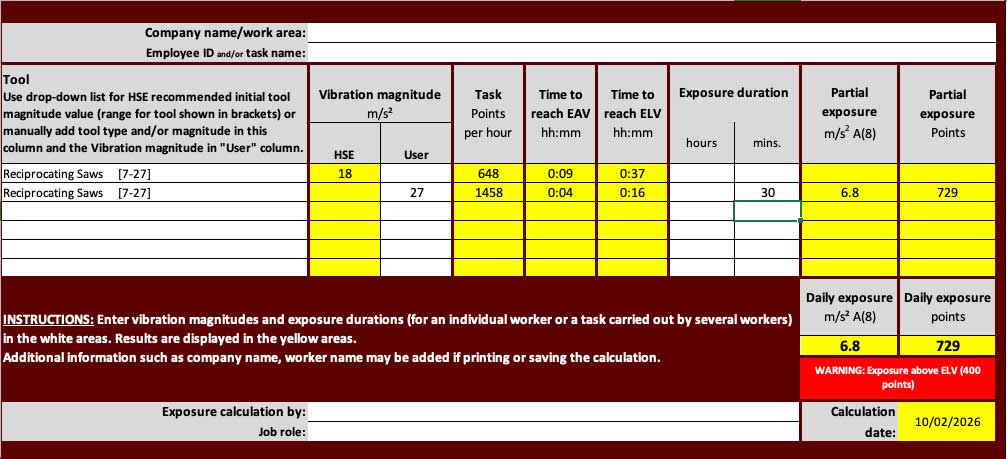
The image I use illustrates this with a worked example for a reciprocating saw. It shows what happens if the typical HSE-measured value of 18 m/s² is accepted, but the actual tool and task had a vibration magnitude at the top of the range – 27 m/s². On the calculator, a 30-minute trigger time would appear comfortably below the exposure limit value (ELV). In reality, it would represent a breach by almost a factor of two.
There has been a change since my initial observations when the spreadsheet first went live: the HSE now provides brief guidance on how to use it. The most relevant section states:
Click on the white areas and enter a representative vibration magnitude (in m/s²) and an exposure duration (in hours and/or minutes). You can do this for up to six different machines or processes. Information on tool types may be entered directly into the tools/process names columns, or selected from a drop-down list of common tools with HSE’s recommended initial value.
There is now at least an acknowledgement that the HSE figure should be treated as an initial value – a starting point rather than a definitive one. That said, the message is subtle rather than explicit, and it needs to be firmed up.
I don’t enjoy criticising the HSE, which, as I’ve said, usually does an excellent job. But this spreadsheet still feels like a well-intentioned tool that remains flawed in its execution. For now, I would recommend using it with a good deal of caution. The HSE’s measured values should be treated as a guide only – a way to challenge your own assumptions and the manufacturer’s claims, rather than a figure to be adopted uncritically.
Tweet Share on Facebook Share on Linkedin