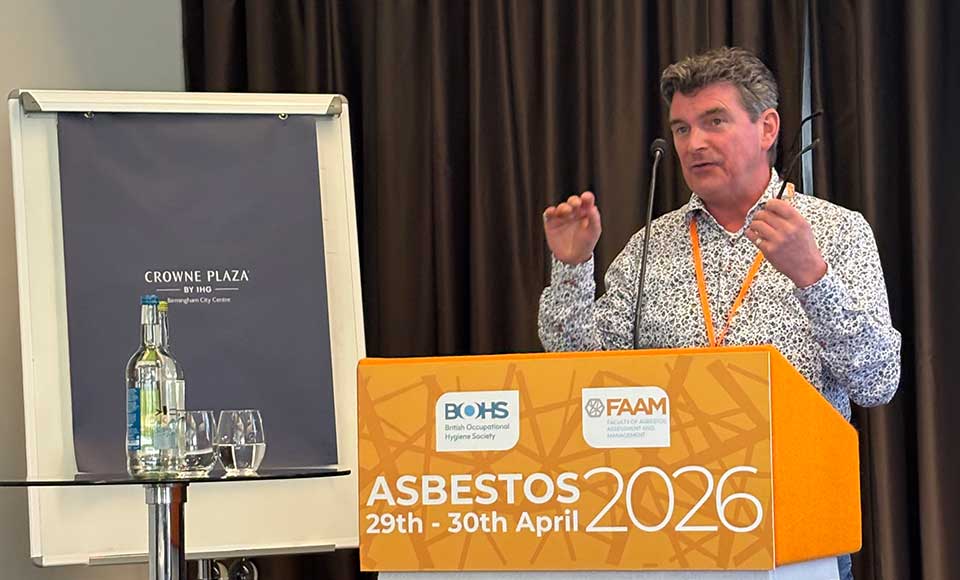
The 2026 FAAM Asbestos Conference returned to Birmingham at the end of April, bringing together researchers, regulators, consultants, analysts and practitioners from across the sector. Together they examined some of the biggest scientific and technical questions facing asbestos management today. As regular readers will know, I believe the conference is the most important forum in the UK for challenging assumptions, sharing emerging research and debating the future direction of regulation and practice. This year’s programme covered everything from exposure modelling and disease trends to AI, fibre analysis and the hidden consequences of low-level environmental exposure.
Three presentations in particular stood out for me. Not because their presenters agreed, but because together they painted a far more complicated picture of asbestos risk than the industry is perhaps comfortable with. Andrew Curran, Director of Science at the Health and Safety Executive (HSE), presented a measured and cautiously reassuring view: mesothelioma deaths appear to have peaked, historic exposure has reduced significantly, and the overall trajectory broadly follows the models that the regulator predicted years ago.
Professor Daniel Murphy then challenged whether we are interpreting those statistics correctly at all, arguing that asbestos-related lung cancer, particularly linked to chrysotile exposure, may be dramatically underestimated. Professor Jukka Takala widened the lens further still, arguing that global and UK asbestos mortality remains persistently high, with trends among women potentially revealing something deeply uncomfortable about how we understand low-level exposure.
Taken together, the talks left me thinking that the central issue may not be whether the asbestos problem is improving or worsening. It may be that we are using the wrong framework entirely to understand what modern asbestos exposure now looks like.
Andrew Curran’s presentation was an important reminder that the HSE’s position is not complacent. The regulator continues to invest heavily in asbestos research, and Curran described the considerable effort going into understanding changing exposure patterns, non-licensed work, asbestos degradation over time, behavioural factors and predictive modelling.
Some of the data he presented was genuinely reassuring. Mesothelioma mortality overall appears to have passed its peak – particularly among men historically associated with heavy occupational exposure. Lung burden studies examining asbestos fibres in tissue samples also indicate that exposure has reduced significantly over time.
But even within this broadly positive picture, Curran highlighted several warning signs that the HSE now believes warrant closer examination. Cases are appearing in occupational groups not historically associated with direct asbestos handling, including teachers, nurses and administrative staff. More worryingly, there appears to be a small but noticeable uptick in mesothelioma cases among people born between 1980 and 1984. The numbers remain small and require cautious interpretation, but they are sufficient to justify further research.
Curran left us with a single obvious thought: asbestos is a complex problem. Exposure, regulation, behaviour, building management, removal practice and health outcomes all interact in ways that are extraordinary. That systems-thinking approach became increasingly important as the later talks unfolded.
Daniel Murphy’s presentation was probably the most provocative of the day. He accepted that male mesothelioma mortality appears to be declining overall, but argued that population-wide statistics are potentially masking important underlying trends. Looking at specific occupational cohorts rather than the population as a whole, statistically significant increases remain visible in several groups, particularly construction-related trades among men, and educational, professional and secretarial occupations among women.
Murphy’s central argument was that the continued presence of asbestos within buildings remains an active exposure source, both directly and indirectly. Maintenance workers disturbing asbestos-containing materials are one part of the picture. But he also pointed towards long-term passive exposure within occupied buildings, and situations where occupants remain present during maintenance activities despite asbestos disturbance taking place nearby.
His most striking argument concerned chrysotile asbestos. Historically, chrysotile has often been treated as less dangerous than amphibole fibres in relation to mesothelioma. Murphy did not dispute that distinction entirely, but argued that chrysotile’s role in lung cancer may have been significantly underestimated. Given that chrysotile represented the overwhelming majority of asbestos imported into the UK, this matters enormously.
Murphy highlighted an important technical problem: chrysotile fibres are far harder to identify reliably in post-mortem tissue analysis than amphibole fibres. Unlike the straight, needle-like amphiboles, chrysotile fibres curl and fragment. Murphy argued that this may have created a misleading impression that chrysotile “disappears” harmlessly from the lungs, when in reality it may simply be much harder to detect.
From there, Murphy introduced what I found one of the most compelling analytical approaches of the conference. Rather than trying to estimate asbestos-related lung cancer using fixed ratios against mesothelioma cases, he instead treated mesothelioma geographically as an indicator of asbestos exposure intensity. Looking across Scottish health boards, areas with high mesothelioma incidence also showed high lung cancer rates. Areas with low mesothelioma rates showed lower lung cancer rates. Other cancers did not show the same pattern.
Murphy’s argument was not that asbestos alone explains all lung cancer. Rather, it was that the geographic relationship between mesothelioma and lung cancer strongly suggests asbestos is contributing far more substantially than current official figures recognise.
My own view increasingly aligns with elements of this thinking. The traditional approach of treating mesothelioma and asbestos-related lung cancer as existing in a broadly fixed ratio may simply no longer be the right way to understand the disease burden. In the UK, this approach broadly underpins the familiar estimate of around 5,000 asbestos-related deaths annually. But if chrysotile fibres are inherently difficult to identify post-mortem, and real-world UK exposure has almost always involved mixed fibre exposure rather than neat laboratory categories, then any rigid ratio starts to become highly questionable.
A much more meaningful approach may be to treat mesothelioma itself as a geographic exposure marker. If areas with elevated mesothelioma incidence also consistently display elevated lung cancer rates, then that relationship may tell us far more about the true burden of asbestos disease than attempting to force the problem into fixed mathematical assumptions.
In that sense, mesothelioma stops being viewed solely as the disease of concern, and instead becomes a marker for wider asbestos-related harm across populations living and working within asbestos-containing environments over long periods of time.
Jukka Takala’s presentation then took this thinking even further. His argument was blunt: asbestos-related disease globally remains substantially underestimated, particularly lung cancer. Mesothelioma may be the most recognisable asbestos disease, but lung cancer is the larger burden numerically, and often disappears statistically because smoking dominates the clinical narrative.
Takala repeatedly returned to the interaction between smoking and asbestos exposure. The two do not simply add risk together; they multiply it. Yet once a patient is identified as a smoker, asbestos exposure is often no longer properly explored.
What I found particularly striking, however, was his focus on women. Takala showed that while male trends may flatten or slowly decline, female asbestos-related disease continues to rise in several countries, including Sweden and the UK. His explanation centred on long-term environmental exposure from buildings and urban environments rather than traditional heavy industry exposure.
My own reflection is that the female statistics may actually be telling us something broader than female exposure alone. Historically, women were less likely to experience the heavy industrial exposures that dominate historic asbestos datasets. As a result, female cases may effectively provide a cleaner signal for understanding long-term, low-level environmental exposure.
If that is right, then this is not fundamentally a “women’s issue” at all. It may instead represent the clearest evidence yet of what prolonged low-level exposure looks like across whole populations: women, men, children and adults exposed over decades through the continued presence of asbestos within the built environment.
Viewed through that lens, the apparent rise in female cases becomes deeply significant. It suggests that once the statistical “noise” of historic high-dose occupational exposure begins to fade, a different exposure model starts to emerge beneath it. And that possibility fundamentally challenges the comforting narrative that the asbestos problem is now simply winding down with time.
None of this means that Andrew Curran’s reassurances were wrong. Historic heavy occupational exposure probably has reduced substantially. Mesothelioma among traditional high-risk male cohorts may indeed have peaked. But Murphy and Takala’s work strongly suggests that this may no longer represent the whole picture.
The possibility exists that we are transitioning from one asbestos epidemic to another: from visible, high-dose industrial exposure to diffuse, low-level, long-duration exposure embedded within ageing buildings and infrastructure. If so, the real challenge for the next decade may be recognising that the shape of asbestos exposure itself may already have changed.
For me, the presence of these three speakers – and the ability to evaluate their positions against each other on the day – underlines the value of the FAAM Conference. Going back to what I said at the start of this post, the conference is a place for challenging assumptions and stimulating debate. Those discussions, and the reflections that come afterwards, can be pivotal in forging links and building a deeper understanding that benefits us all.
Tweet Share on Facebook Share on Linkedin