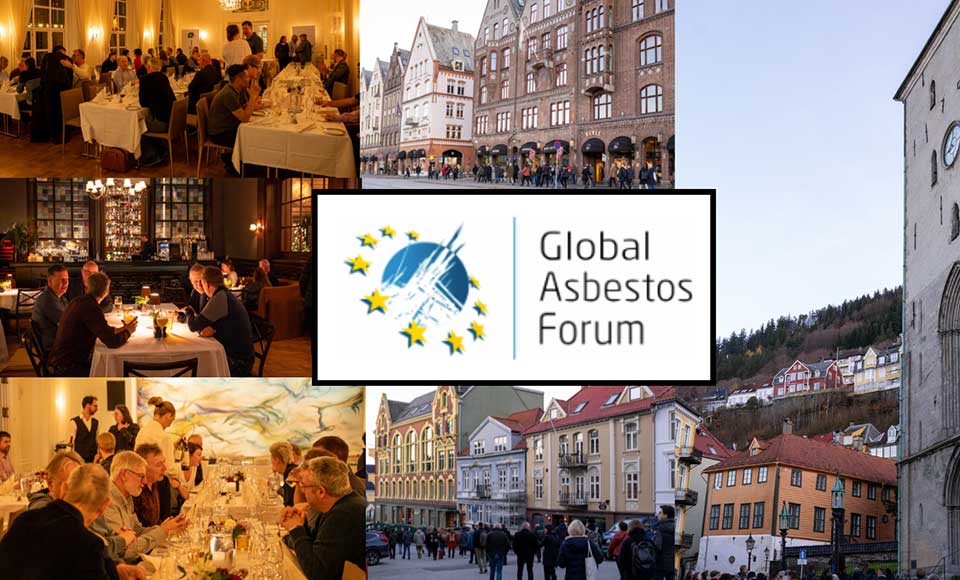
There is a particular atmosphere that accompanies any event shaped by Dr Yvonne Waterman: a blend of quiet confidence, understated class and an unshakeable sense of community.
The Global Asbestos Forum this year was no exception. From the very start of the first day, where we were thrown straight into a group activity (this time a walking tour of Bergen), delegates felt a mixture of welcome and solidarity that carried through the entire event. I wanted to share my reflections of another memorable forum.
Sean Fitzgerald opened with an incredibly detailed review of the science and geology of asbestos. Chemically identical to many other minerals, it can be just a quirk of a geological left or right turn that might result in something being asbestos or for example talc.. Sean’s talk left me with the distinct impression that the only honest definition might be that it’s “a state of mind”, rather than anything strictly scientific.
Jonathan Grant of the British Occupational Hygiene Society (BOHS) followed with an update on the UK regulatory position. The Work and Pensions Committee had produced clear, evidence-based recommendations for the previous government, yet very little progress has been made. With Sir Stephen Timms – former Chair of that committee – now in government, and the minister responsible for the Health and Safety Executive (HSE), expectations were high. Yet Jonathan’s frustration was clear: only three recommendations have made it into the consultation so far, and in two cases the HSE appears to favour minimal action that essentially just clarifies guidance.
Kari Mørk of the Norwegian Labour Inspection Authority then outlined the scale of their challenge: 750 staff overseeing 223,000 companies, 400 asbestos-licensed contractors, and 2,500 notifications (for comparison, the UK has roughly 350 LARCs and 38,000 notifications). I found myself wondering how 400 companies, averaging six projects a year, can realistically maintain competence.
Matt Werfel of the Asbestos and Dust Diseases Research Institute (ADDRI) in Australia spoke next. Behind his role sits a deeply personal reality – he is himself an eight-year mesothelioma survivor, a remarkable achievement in its own right. He described the scale of the task in Australia, giving the example of a recent flood that destroyed 4,000 homes, many containing asbestos, with the debris washed along the Murray River. Australia’s national strategic plan has now entered its third stage, with every state endorsing a unified approach grounded in the URBIS socio-economic analysis. That work exposed the true cost of asbestos to the economy and, crucially, the cost of doing nothing.
The findings were stark. If governments actively intervened through grants, tax incentives, compulsory buy-backs and proactive removal, every dollar spent could return around $1.97 of benefit. Yet even with that commitment, asbestos would remain in the built environment until 2057. At the current rate of removal, a million tonnes would still be present by 2100. Considering most of the material is already 30–70 years old and well past its useful life, that projection is astonishing.
Matt explained that the plan is agreed, the framework exists, and the targets run to 2030. What remains is funding – around two billion Australian dollars, which in the context of national infrastructure terms feels almost like a rounding error. The challenge now is for state and federal governments to deliver the action they have signed up to.
A moving interview followed with Paul Sandanger, a Norwegian worker living with asbestos-related lung cancer. He eventually won his case for recognition and compensation, and the validation mattered to him, but the award – just £8,000 – felt wholly inadequate.
Adam Harding of UKATA and Tom Eriksen of Eriksen HazMat Survey AS then offered a sharp contrast in approaches to training and regulation. Tom described a largely hands-off Norwegian system, which has virtually no requirement for competent trainers or structured training, and little expectation that surveys should be carried out unless work is already planned.
But the day’s real impact came later. The evening of day one was, in true Waterman style, something special. A gala dinner built on elegance rather than extravagance, where conversation took precedence over spectacle. The food was excellent – a detail Yvonne is famously meticulous about when selecting a venue – and each course came with thoughtfully paired wine – almost unheard of at any “normal” conference!
The Covent Garden String Trio returned from last year’s European Asbestos Forum, this was no subdued classical background act; as with last year they were exuberant, weaving through the room as they played, shifting from classical pieces to film themes. It added a lively, unexpected energy to the evening.
Day two opened with a noticeable change in pace and perspective. I’m not attempting to cover every session – particularly with three parallel breakout streams in the afternoon – but it’s worth acknowledging the breadth of the program before focusing on the talks that truly stayed with me.
Torunn Ervik of the National Institute of Occupational Health in Norway began with sobering data on real-world fibre release during removal work – figures that sit uncomfortably alongside the assumptions embedded in our regulations. Professor Arthur Frank followed with his customary clarity, reminding us that asbestos remains a global problem, with disease burdens still rising in regions yet to restrict its use. Markus Sommer then provided a timely warning about the unintended consequences of rushing to replace asbestos with substitute materials that may bring their own hazards, including the emerging issue of Chromium-6 in insulation products.
Phil Hazelton brought the global picture into sharp focus. He spoke of Asia, where 80% of the world’s asbestos is still consumed, and of the extraordinary challenges faced by those advocating for bans. The industry’s tactics were laid bare: intimidation, bribery, misinformation, infiltration and political pressure.
Yet there were signs of progress – Cambodia’s movement towards a ban, Malaysia’s forthcoming full ban, and the Asian Development Bank’s push for regional restrictions. Phil’s message was blunt: asbestos eradication will not be achieved through polite conversation. It demands solidarity, strategy and the courage to confront a well-funded, highly motivated opposition. It was advocacy at its best – clear-eyed, evidence-based, and morally grounded.
Heather’s story stopped the room. Diagnosed with pleural mesothelioma in 2005, and given a prognosis of 15 months, she stands here twenty years later. Her journey – from the shock of diagnosis as a young mother, through pioneering surgery under Dr David Sugarbaker, chemotherapy, radiation, complications and recovery – was told plainly and without embellishment.
Her account cut through the policy-heavy discussions of earlier sessions and brought the focus back to the lived reality of asbestos disease. This work is not about regulatory clauses or abstract statistics; it is about people living with the consequences. As she finished, the room fell quiet before rising to a standing ovation.
Robin Bennett’s session was both exhilarating and unsettling. He showed how AI can already identify asbestos in photographs – even without explicit training. It can check reports, summarise information, read emails, cross-reference data and act semi-autonomously.
The speed at which AI is moving into tasks once considered the exclusive territory of trained professionals is remarkable. Robin did not overstate the implications: if the technology is accurate, fast and consistent, what happens to the surveyor’s monopoly on expertise? His message was clear – organisations must adopt an AI-first mindset or risk being overtaken. The room understood the significance.
Although delivered earlier in the programme, I’ve held Professor Jukka Takala’s keynote until the end because it struck at the foundations of many UK assumptions. He presented data showing a troubling rise in mesothelioma among women, which may in fact point to the genuine “next wave” of sufferers.
For years, countries have predicted a peak and then a sharp decline in mesothelioma incidence: regulate asbestos, ban it, and – after the expected latency – you see a bell-shaped curve mirroring historical import volumes. In the UK we are beginning to see that pattern, with a marked drop-off in recent years.
But that pattern is based almost entirely on high-intensity occupational exposure among an overwhelmingly male workforce: manufacturing, installation, and trades inadvertently disturbing materials. What if the next wave is instead driven by low-level, long-term, environmental or secondary exposure?
Do our current controls contemplate that? Do our risk models? Do our regulations?
The uncomfortable answer is: not really. Moreover, echoing Jonathan Grant’s reflections on the UK’s regulatory direction, there is little sign of meaningful change.
Jukka’s argument – that female exposure is underestimated, under-recognised, and increasing – felt like something long sensed but rarely stated. If the rise in female cases is viewed not as an anomaly but as evidence of a new exposed cohort, the trend becomes clearer once the “noise” of the historic high-dose exposures is filtered out. It casts any sense of self-congratulation about being past the peak as premature, and suggests that those neat downward curves may be heading for an upward turn.
He called for changes in measurement, recognition, compensation and regulatory focus. It was one of the most important talks of the conference – not because it offered reassurance, but because it challenged the complacency built into our system. And all of it delivered with the openness and rigour that has become a hallmark of Yvonne’s events.
Across two days, the Global Asbestos Forum was technical, emotional, political and deeply human – often all at once. The talks by Robin Bennett, Jukka Takala, Heather Von St. James and Phil Hazelton formed the backbone of the narrative for me: future technology, emerging epidemiology, the lived reality of disease, and the global struggle for justice.
Threaded through it all were Yvonne Waterman’s touches. Her ability to curate a conference that challenges and uplifts, confronts and connects, is something rare.
As we left, the feeling was not closure but momentum. This was not an event that ends when the lights go down. It was a clear call to keep pushing – technically, politically and ethically – towards a future where stories like Heather’s become history rather than the experience of another generation.
Tweet Share on Facebook Share on Linkedin