
Enclosure air management is a critical part of controlling risk to workers during asbestos removal. Despite significant research by the Health and Safety Executive (HSE), however, it’s still an area that causes a degree of head-scratching among some asbestos professionals.
Our understanding of airflow in the enclosure is informed by two key pieces of HSE research:
This article aims to bring some clarity to the practical application and management of airflow: explaining why enclosure air management matters, and providing a practical way to think about it. I won’t be discussing the use of anemometers in this article, for my investigation on these devices and the underpinning regulations see my previous articles on enclosure airflow.
Let’s start with the basics.
An enclosure is constructed around the work area and one or more negative pressure units (NPUs) are installed. These draw air out of the enclosure, pass it through a HEPA filter that removes 99.97% of asbestos fibres, and then discharge the cleaned air to the atmosphere.
This extraction process has a second critical effect. By continuously removing air from the enclosure, the system creates negative pressure inside it. Nature abhors a vacuum – the principle was famously described by the ancient Greek philosopher Aristotle around 320 BC – but the physics is straightforward: if pressure inside a space drops, air will try to flow in to equalise it.
For asbestos removal, this is exactly what we want. If air is always moving into the enclosure, fibres cannot escape into the surrounding environment. Specifically, HSE guidance instructs us that a minimum level of negative pressure that we are looking for is five pascals (-5 Pa).
However, this creates another challenge. If air is being extracted, it must be replaced. If the enclosure were completely sealed its polythene walls would simply collapse inward. Controlled routes for incoming air therefore have to be provided. These usually take the form of:
There is also a second air management requirement. Enclosures must achieve at least eight air changes per hour (ACH) – although in practice the industry commonly designs for more than 10 ACH. This ensures that the air inside the enclosure is continuously cleaned and that airborne fibres are removed efficiently.
So the system has two simultaneous objectives:
If met, these objectives mean that outside the enclosure we remain protected from fibre release, while inside the enclosure the air is constantly being filtered.
At this level the concept is relatively straightforward.
The design target is a minimum of –5 Pa of negative pressure. HSE research — particularly RR988 and the associated enclosure ventilation studies — also gives us useful practical benchmarks. For example, the research shows that a standard one-metre airlock typically allows approximately 1,500 cubic metres per hour (m³/h) of make-up air to enter the enclosure, and that ~250mm of flap deflection in the airlock equates to approximately –5 Pa.
In simple terms this means that if an NPU is extracting around 1,500 m³/h, and the enclosure has a standard one-metre airlock, the system will usually sit in roughly the right operating range.
The complexity arises when we move from the research environment into the real world. Real enclosures are rarely perfect. They may:
At that point the air management problem becomes a calculation. We need to determine both the airflow required to achieve at least 8–10 ACH, and the amount of make-up air required to maintain stable negative pressure. Too much incoming air will reduce the negative pressure. Too little incoming air will throttle the NPUs.
A simple analogy helps illustrate this. Imagine sucking air out of a crisp packet. If there is no hole in the packet, it will get harder and harder to extract more air, eventually you cannot remove any more at all and the bag will collapse. The same thing happens with NPUs if insufficient make-up air is provided.
The HSE research gives useful approximate airflow values for common controlled air entry points:
These figures allow us to estimate how much air can enter an enclosure.
For example:
In practice, enclosure design also needs to consider airflow patterns within the enclosure. In the example below we can see several good design principles:
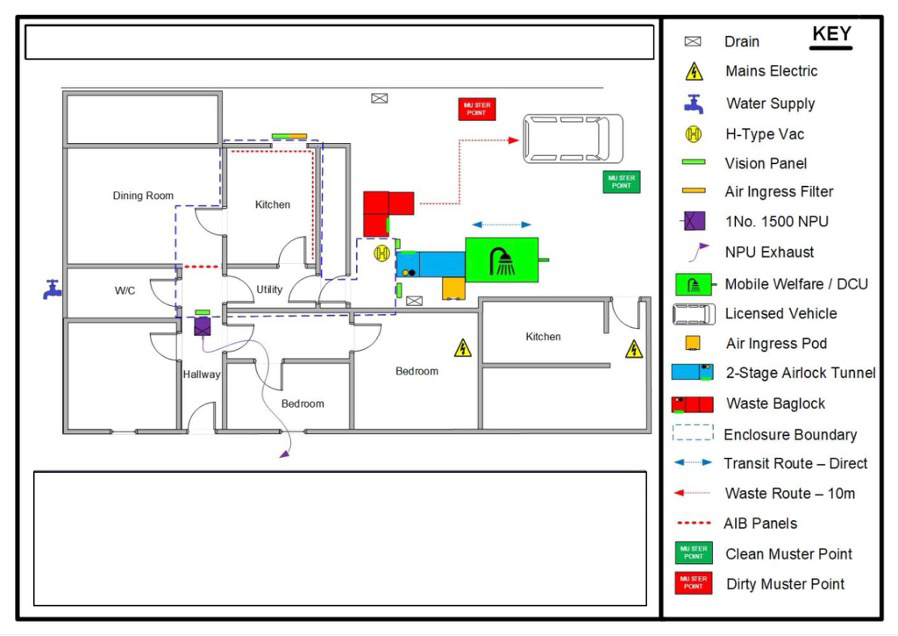
(Courtesy of Asbestech Ltd.)
Note in this example that the NPU is exhausted to atmosphere via trunking. This will reduce its efficiency markedly – HSE research indicates around 1% reduction in airflow per metre of trunking, and 2% per 90° bend. Another factor to consider when planning an enclosure is that the effectiveness of NPUs depreciates over time, so it’s prudent to allow for this when calculating airflow capacity.
Once the enclosure is built, the airflow balance may still require adjustment. To help with this, I’ve produced a spreadsheet that performs the airflow calculations. It also integrates neatly with the Assure360 Paperless App, which includes several tools designed to help prevent mistakes being made on site and double-check that supervisors are making the correct decisions.
Access the enclosure air management calculation spreadsheet here. Note that this is a read-only spreadsheet – make a copy, or download as an Excel spreadsheet via the FILE menu to use it.
The enclosure shown above is 50 m³, and the NPU is rated at 2,300 m³/h. Allowing for 20% depreciation, five metres of exhaust trunking and a couple of 90° bends, the effective airflow is reduced accordingly. In this case the ingress filter must remain open to ensure airflow passes through the kitchen area.
Ordinarily, the airlock, baglock and ingress filter would allow approximately 3,500 m³/h of incoming air. However, to balance the NPU we only require 1,674 m³/h of make-up air. This tells us the baglock will need to remain closed, and the airlock will need to be partially closed in order to restrict the amount of air entering the enclosure.
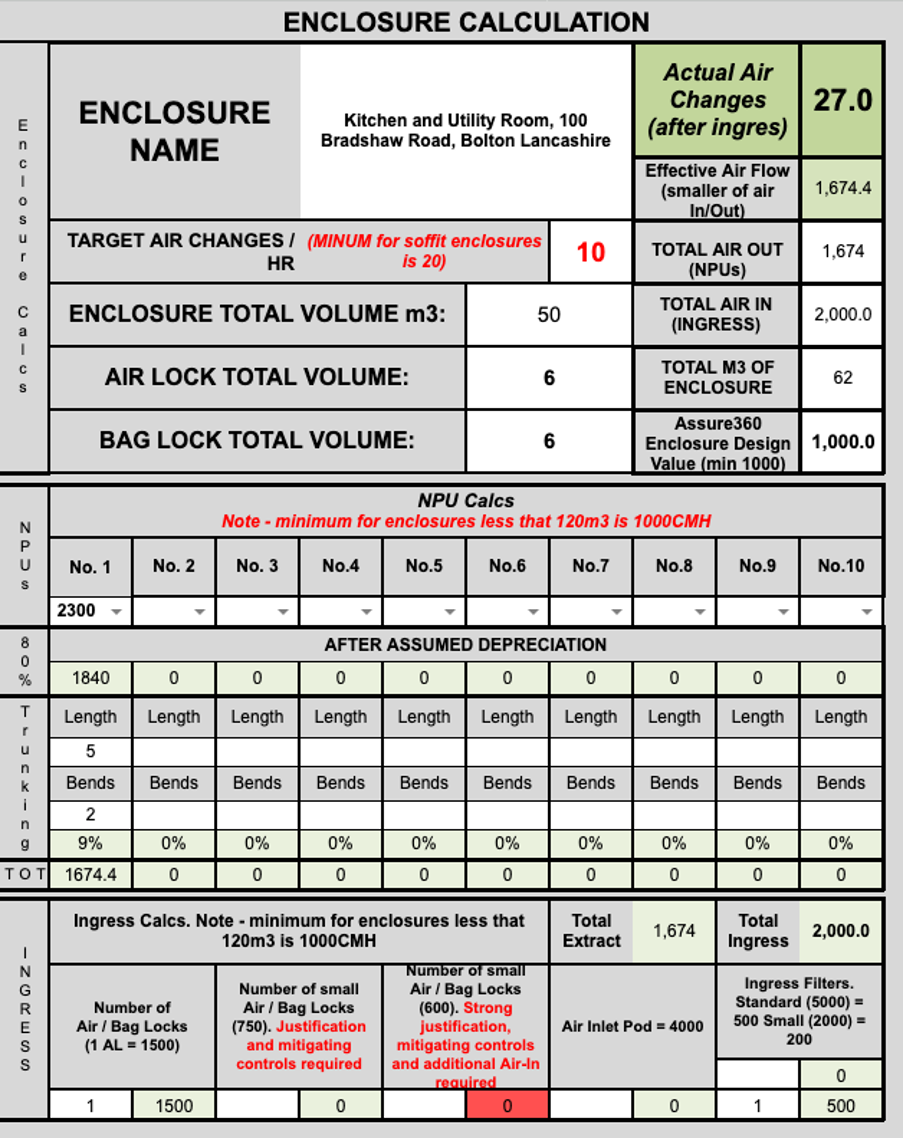
Airflow calculations are not based on everything physically present in the enclosure design. They are based on what is actually being used to achieve the required airflow balance. This is exactly what the accompanying spreadsheet tool is designed to help with.
Rather than simply documenting what appears on a drawing, the spreadsheet calculates the airflow configuration required to achieve the outcome we want: stable negative pressure and effective air cleaning inside the enclosure.
The role of the supervisor on site is to fine-tune the setup so it reflects reality – something that can rarely be achieved from the drawing board alone.
I hope you find this spreadsheet and its integration with the Paperless app useful. Feel free to get in touch if you want to know more about how to use the spreadsheet, or how it and Assure360 can work together to ensure compliance.
Tweet Share on Facebook Share on Linkedin