
Written by Nick Garland on Tuesday December 10th 2019
2019 marked the 20th anniversary of the UK’s total ban on asbestos, and – perhaps – the first tentative signs that asbestos deaths have peaked. Much to celebrate, then, but the year also saw upheaval in asbestos management, with the HSE’s long-overdue overhaul of the licensing regime becoming a talking point for the wrong reasons. Here’s our review of the year.
Back on 24 November 1999, the UK’s ban on importing and using asbestos finally came into effect. This year marked the ban’s twentieth anniversary, but sadly our use of asbestos is far from a historic problem. For a start, it’s endemic throughout our built environment, so in February we asked various industry experts: Is an asbestos-free world possible?
As we discovered, the reality is that there is neither the capability nor the budget to remove asbestos from the entire built environment, but is there a case for selectively removing it? In particular, more than 85% of the UK’s schools contain asbestos. In April we asked whether in this unique environment the current ‘manage in situ’ approach was good enough – read our asbestos in schools article here.
Within the asbestos-removal industry, the ban’s anniversary was undoubtedly overshadowed by the Health and Safety Executive (HSE)’s plans to overhaul the licensing system. This permissioning regime controls who can perform most asbestos-removal work, and there’s no question that it needed an update – back in 2016 I was one of many calling for a move to a single, three-year licence term, backed up by formal reviews.
In March the HSE made a bold move, introducing a three-year only licensing system in which the onus is placed more fully on the would-be licensed asbestos-removal contractor (LARC) to prove their competence. Instead of inspections, there’s a detailed online form comprising 14 sections – you can read my analysis of it here.
While there were positive elements to the new system, it quickly became clear that LARCs had little guidance on how to complete the form, resulting in huge time overheads as they dug around for information that could be relevant. For the HSE, the form’s open-ended nature meant that no two applications were alike, and LARCs quickly reported a processing backlog in which renewals were taking many weeks to complete.
From the start, I’m proud to say that Assure360 could help LARCs retrieve the proof they needed to demonstrate their competence. We moved quickly to develop a custom module, specifically designed to provide the exact information the HSE needed for each section of the form – at the touch of a button. We’ve now helped multiple clients through renewal under the new regime, and as it begins to mature and improve we’re working with the HSE to further develop our support.
2019 was the first full year for the Assure360 Paperless app, and it’s a pleasure to hear from clients how it continues to help them work more efficiently on site, and eliminate paperwork back at the office. Below we’ve highlighted just some of this feedback below – for each you can click the link to read the full case study.
Already, some 15% of all LARCs use Paperless, and more than one in ten licence applications to the HSE are submitted using the Assure360 system, but we’re not sitting still. Unique to Paperless, we’ve introduced a new Personal Monitoring feature that helps LARCs develop real strategies for personal monitoring that reflect operatives’ true exposure levels. Aside from ensuring that monitoring is effective, it ensures that monitoring programmes adapt to reflect what’s actually happening on site, helping minimise and manage exposure risks.
And what of 2020? There’s already a packed event schedule for the year ahead – you can see many of the key dates in our frequently updated events calendar. We’ll be rolling out further improvements to Assure360 and, I’m delighted to announce, introducing Android versions of all three Assure360 apps: Audit, Paperless and Incident. There’s much to look forward to, but for now let me wish you a merry Christmas, and a happy and safe new year.
Written by Nick Garland on Thursday June 13th 2019
For some years, there’s been a question mark hanging over the Health and Safety Executive’s licensing regime for asbestos removal. With variable licence periods creating confusion among clients and an unintended hierarchy being created within the industry, attempts to overhaul the system are to be welcomed by everyone.
For those who don’t know, the existing system is a permissioning regime. Would-be licenced asbestos-removal contractors (LARCs) and those who want to renew must demonstrate to the HSE that they have the necessary skills, competency, expertise, knowledge and experience of work with asbestos, together with excellent health and safety management systems. The outcome is either no licence, a three-year licence, or any period between. Additional conditions are sometimes attached.
It sounds simple enough, but there are multiple problems. While nobody is meant to infer anything about competency from a company’s licence term, in practice customers choosing a LARC often treat the full three-year licence as a prerequisite. In addition, LARCs can’t notify a project that extends beyond their licence period – that means that bidding for complex, two-year-plus jobs is effectively restricted to the 35% or so of LARCs with a three-year licence.
Against this, in recent years the HSE has been less inclined to give out three-year licences. Among other things, that’s resulted in an increased workload for inspectors as they conduct more regular licence inspections. There’s a burden for LARCs, too, as there’s a considerable cost and administrative overhead to each licence application.
It’s no surprise that the HSE wants to shake things up. It’s already started to pilot a new regime that shifts the onus away from licence inspections, and more onto LARCs to provide evidence of their competency. In the new system, first-time applicants still get inspected, whereas existing LARCs re-apply via an electronic form.
A couple of years ago I called for an end to the fixed-term licence, and the introduction of monitoring visits. Essentially if you’re good enough, you get a licence. If not – you don’t. it’s recently emerged that in the pilot scheme the HSE are moving towards just that. As ACAD’s Graham Warren explains in a LinkedIn blog post:
“Some eagle-eyed people have been asking ACAD why all renewals [under the electronic pilot scheme] seem to be issued the full three-year term. HSE have confirmed this is not some chance occurrence, but actually how the new system works.”
At renewal, companies either won’t get a licence, or they’ll be licenced for the now-standard three-years. This doesn’t necessarily mean that LARCs that would previously have received a one or two-year licence will be turned down. In all cases where a company is judged competent, the HSE will issue a three-year licence, but it may require a formal review to ensure any improvements are fully implemented. Crucially, this review period will remain confidential, unless the LARC fails to make the required improvements, so it won’t affect the LARC’s ability to compete for contracts.
The change is virtually what I called for, and it’s a vast improvement. By settling on a single, three-year period, the HSE will reduce the confusion among clients who see one and two year licences as less of a vote of confidence. Moving the major work of re-licencing onto a three-year cycle will reduce the burden for LARCs, allowing them to concentrate on making the improvements the HSE wants to see at the review meeting.
For the HSE, it means less licence inspection work, and a relief from the commercial pressures to grant three-year licences to the biggest contractors, who may previously have needed them to bid for the most complex works. A more centralised approach by the HSE (all applications are reviewed by a single team) will mean much more consistency, too.
As Graham points out in his post, there may be some interesting consequences. With clients no longer able to select LARCs by licence duration, they’re likely to look for other ways to determine which companies are working to deliver the highest standards. Being able to demonstrate fastidious record keeping, management and analysis – for example through membership of a trade body such as ACAD – will become more of a competitive edge.
Assure360 can really help here, too. Our data-based system makes it easier not only for LARCs to manage asbestos removal, but for them to demonstrate the high quality of their training, competency, and analysis of key safety factors such as exposure monitoring.
In fact the new regime fits seamlessly with the Assure360 ethos. Being a health and safety system, specifically designed by asbestos industry experts for the asbestos industry, Assure360 has always allowed you to showcase your expertise. Vast quantities of evidence are now required in advance of the licence assessment, and Assure360 customers can simply provide it by running a series of reports. The database presents all the proof that the HSE could ever ask for. And with the new Paperless solution, even site files can be viewed with real date and time stamps on the certification.
We’ve got a great track record of helping clients prepare for, and excel at licence renewal: under the existing scheme our customers have consistently proven far more likely to achieve three-year licences. Under the new regime Assure360 will streamline the process even further, as our reports are mapped against the questions the HSE are asking.
So if you’re applying for a first-time licence, or preparing to renew an existing one, why not get in touch and see how we can help?
Assure360 will be at the Contamination Expo on the 11th and 12th of September – stand J7, directly opposite ACAD. So if you’re looking for guidance and insight into the new process, pitfalls to avoid and strategies to help – there couldn’t be a better first port of call.
I will also be speaking on the first day – 12:30 – 13:00 at Theatre 21 The subject – you guessed it is the only one that matters right now, the New Asbestos Licencing system and how electronic solutions can help.
Written by Nick Garland on Wednesday May 29th 2019
We’re not alone in having wondered whether the HSE’s asbestos licensing system was entirely fit for purpose. With three possible licence durations and multiple conditions that can be attached, clients often use a LARC’s licence as a shortcut to judging competence. Re-inspection as frequently as every year creates lots of work, both for the LARC and the HSE, and doesn’t necessarily result in raised standards.
A couple of years ago, founder Nick Garland called on the HSE to settle on a standard three-year licence, backed up with formal reviews. It’s recently emerged that’s exactly what’s happening in the HSE’s electronic licensing pilot – in this article, Nick explains some of the benefits and consequences.
Note: The post below was originally published by Nick Garland on LinkedIn in 2016. You can click here to read the original post.
The licence terms awarded to asbestos contractors have reduced year on year. I examine the latest data and offer an opinion on a better way forward.
A phrase every LARC will be familiar with, as it seems to be in all letters written by the HSE. One of the principle purposes of such a regime is to:
“…maintaining and improving standards of health and safety”
The Health and Safety Commission permissioning regime policy statement
Maintain and improve standards of H&S, presumably by weeding out the incompetent and promoting best practice. But why then are average licence terms shorter now than they were? I have been in the asbestos industry since the early 1990s, and I’ve definitely noticed the change. Can we infer that the HSE’s opinion is that the industry is less safe and less competent than it was?
Licence assessments can be a very unpredictable time. All of the companies that I work with have heard of, or experienced extremely intense assessment interviews, but at the same time hear of laissez faire ones with very little detailed examination. Requests (demands) from the ALPIs is often insightful but can also be bizarrely arbitrary, with little practical application. One licence assessment ended up insisting that filing cabinets be used (rather than the perfectly acceptable system the LARC already had) – resulting in the conversion of the one and only meeting room into an archive room.
We all know anecdotally that it has become harder and harder to get the ‘full’ three-year licence from the HSE, but the latest figures are quite stark.
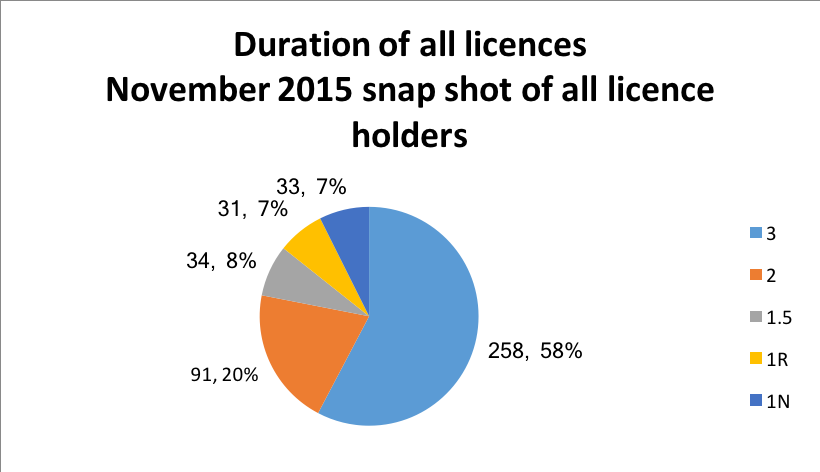
ALG figures, supplied by ACAD.
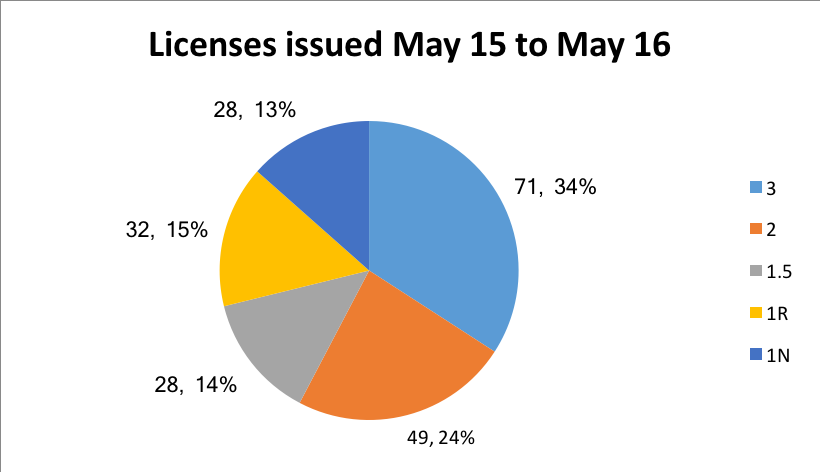
ALG figures, supplied by ACAD.
Excluding new licences (always one year) there has been an alarming drop of 23% in three-year licences issued in that period.
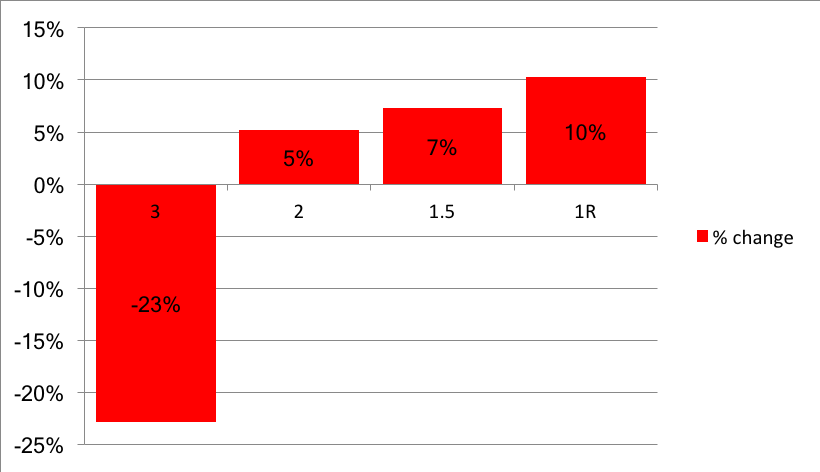
ALG figures, supplied by ACAD.
In my experience the industry, whilst there are some bad eggs, is getting much better. When I think back to the beginning of my career, where it seemed everyone had a three-year licence – the differences are remarkable. Now projects consider the wider job and recognise non-asbestos hazards. In fact, it seems a different industry with most of the stories of astonishing individual poor practice in the past.
So, if we are not getting any worse and the principle aim of a permissioning regime is to drive standards, why are the licence terms going down?
Could it simply be that there are less licensed contractors out there and the HSE want to exert more control. A tighter leash if you like? Certainly, the tone of some licence assessments and HSE visits indicate this.
The HSE tell the wider construction industry (and clients) that they shouldn’t use the licence term as a tool for selection. If the company has been given a licence (any licence) that indicates that they (the HSE) are satisfied and this should be good enough. The clients however (quite reasonably) take the view that well if you are concerned enough that you won’t give them a 3-year licence, then we are concerned too.
A licence holder can’t notify a project that extends beyond the licence expiry date.
We add then that the HSE publish the expiry date of licences – so if you track these things, you can plot a company’s standing. A client also instantly sees which companies can notify the project that they are considering. This might not seem a big concern, but very complex major works, might require 2+ years to complete – knocking out 65% of contractors.
With this in mind – are the HSE less inclined to reduce the term for a huge company? Do they back away when a downward tweak might stop a multi-million £ job in a power station? Certainly ‘the word’ is that they do.
The licence term is certainly a commercial driver.
In my opinion the HSE should remove the fixed term licence. The HSE should assess a company and give, or withhold a licence based on the interview and past performance during site visits. These licences should not expire (I hear howls of outrage).
What should replace it is a tailored review schedule for that specific contractor. Essentially, ‘Yes we are content for you to work with asbestos, but we want to see you again in 6 months, or 12 months or 3 years, just to make sure things stay on track’. A structured plan could therefore be put in place on what improvements must be implemented before the next monitoring visit.
The monitoring schedule would not be published and would not appear on the licence itself. This therefore could not be used for contractor selection. The pressure would be released from the HSE to grant 3 year licences for commercial reasons. There would be no issue of notifying jobs beyond the end of the licence expiry date – as there won’t be one. The HSE can concentrate on maintain and improving standards and do so in a much more structured way.
As I say this is an opinion piece, and I would welcome everyone’s thoughts and feedback.
I have been in the asbestos industry since the early 1990s, helping licensed asbestos removal contractors stay at the forefront of the industry.
Written by Nick Garland on Wednesday April 10th 2019
Schools are unique. In law, a school is a workplace, but the majority of people using them are children – sometimes as young as three. Despite the known vulnerability of children to pollutants, contaminants and other environmental hazards, when it comes to asbestos, schools are treated as just another workplace: they’re subject to workplace asbestos fibre limits, regulations and management approaches. And that’s a problem – both for our children, and the professionals who teach them.
Figures gathered by the National Union of Teachers’ Joint Union Asbestos Committee (JUAC) reveal that, since 1980, at least 363 of British school teaching professionals have died of mesothelioma, the cancer almost exclusively linked to asbestos exposure. An average of 19 school teaching professionals now die each year from mesothelioma – up from three per year in 1980.
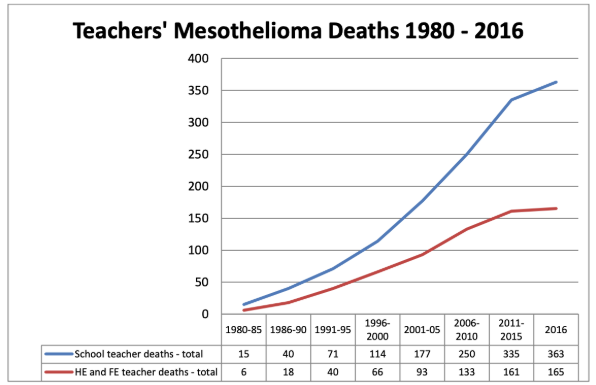
There are no equivalent figures for children, but we do know that each year around 2,500 people die in the UK from mesothelioma. Giving evidence to the Education Select Committee in March 2013, Professor Julian Peto – a leading expert in occupational carcinogens – estimated that around 200-300 of these deaths are the result of childhood exposure to asbestos in school.
The shocking figures are compounded by the fact that the onset of mesothelioma typically comes decades after the asbestos exposure which caused it. While the incidence of the disease in the general population is finally thought to be nearing a plateau – 20 years after the UK banned all asbestos imports and use – there’s no clear indication that the same applies to school-related cases.
The authorities can’t claim to be unaware of this risk. Back in 2011 the Asbestos in Schools Group – a multi-agency organisation chaired by MP Rachel Reeves – was damning, its report concluding:
Forty five years ago the Department for Education [was] warned about the increased vulnerability to children from asbestos, but for financial, commercial and political reasons the warnings were not heeded. Instead asbestos materials continued to be used in science and other lessons, and schools continued to be built using large amounts of asbestos.
Unfortunately it’s not just a historic problem. Scan the news for asbestos headlines, and on any given day you’re likely to find at least one story about asbestos being discovered, disturbed or removed at a UK school. Indeed, according to MP Meg Hillier, chair of the Parliamentary Public Accounts Committee, 85% of schools contain asbestos, and the risks become greater as those buildings age.
At present, the answer is not enough. Parliament says that the government doesn’t have enough information to address the problem, and it may have a point. The Department for Education’s first school property survey did not assess asbestos, and in 2016, when a second survey aimed to collect data on the issue, only a quarter of schools responded. When a third survey closed in 2018, 77% of schools had responded. Given the importance of the information, the survey was reopened and all remaining schools were urged to respond – the final results are due soon.
There’s no doubt the government needs more information, but there is a question over whether the survey will provide it. The safe management of asbestos-containing materials (ACMs) is a school’s legal duty, and the fact that they are hardly being forthcoming with high-level information about the presence and management of ACMs is concerning. Some multi-academy trusts (MATs) couldn’t even gather information about their private finance initiative (PFI) schools, which shows a worrying lack of accountability.
The detail of what is known isn’t especially reassuring, either. Of the 77% of schools which responded within the original deadline of the most recent survey, 68% were found to be “assured by the appropriate responsible body”. It’s a singularly woolly phrase, which means nothing to asbestos professionals.
According to the JUAC, “These latest findings show that many schools are unaware of the risk or the extent of asbestos in our schools.” With the poor response to the government’s latest survey, can we be confident that this has got any better?
But while the survey leaves us in the dark, we do know that most schools contain some form of asbestos. The UK outlawed the majority of the most hazardous asbestos types in the 1980s, but the final banning of all asbestos – including asbestos cement, floor tiles, artex and so on – only came in 1999. Any school built before 2000 could – and probably does – contain asbestos.
Sophie Ward sums up the fundamental issue: “The problem is that in many cases the asbestos is decades old and in a deteriorating condition, and when asbestos is in a poor condition, it’s more likely to release asbestos fibres.”
Children’s comparative vulnerability compounds the problem. Ward adds: “If a child is exposed at the age of five, they have five times greater risk [of developing mesothelioma] than an adult exposed at the age of 30.”
Against this background, it’s instructive to look at the Health and Safety Executive (HSE) advice to schools regarding asbestos, as follows:
The duty-holder’s responsibilities include:
Those most at risk of disturbing ACMs are tradespeople, caretakers, etc. The school’s plan needs to contain provisions to ensure that information about the location and condition of ACMs is given to anyone who might disturb these materials. The duty-holder should also ensure that staff likely to disturb asbestos are suitably trained.
As the Asbestos in Schools group pointed out back in 2011, aside from the addition of caretakers this is essentially the same advice that applies to any other employer. As with other premises, ACMs assessed as low-risk are managed in situ.
In an ordinary workplace, that can work very well. Surveyed, recorded and managed properly, ACMs should pose no risk – provided the management plan ensures that they remain undisturbed. Proper management starts with a management team that has the training and experience to properly understand the risk, and design and implement appropriate controls. Even in typical workplaces, that’s a big task.
A key component is identifying the people who might come into contact with any risk, and ensuring they know what that risk is. Anyone who might disturb the asbestos must have asbestos awareness training. In a normal workplace this would be the workforce, with tight controls for visitors and contractors. However, where the ACMs are in a classroom or a school corridor, the risk extends to children. The current rules require that this ‘workforce’ is trained – but clearly it’s hard to train away the risks of play, over-excitement, or a casually swung schoolbag.
Schools are essentially small businesses: employers, with all the duties of employment. Head teachers already have daunting responsibilities: is it reasonable to also expect them to manage asbestos for vulnerable building users? And yet, since The Control of Asbestos Regulations 2012, that’s become their duty. We have to wonder if heads are aware of this sea change in responsibility: have they been trained to take on the role, and are they properly resourced to fulfil it?
Again, the Asbestos in Schools group has been damning:
There has been a lack of asbestos awareness and a lack of resources so that schools have failed to adequately manage their asbestos. Numerous asbestos incidents have occurred and the exposure of the occupants has been widespread. The Medical Research Council concluded that it is not unreasonable to assume that the entire school population has been exposed to asbestos in school buildings. Teachers, support staff and children have subsequently died.
If our schools’ managers aren’t competent to manage asbestos, and the majority of our school population can’t be considered competent around it, and the government doesn’t know the scale of the problem anyway, managed removal would seem to be the only justifiable approach. Concerning a high proportion of the UK’s 32,000 schools it would be a big, expensive, time-consuming job, but our continued failure to act poses unacceptable risks to the most vulnerable in our society, and the professionals who teach and care for them.
Written by Nick Garland on Wednesday April 10th 2019
It is – or it should be – easy to identify when you’re working at height, but when does a work area constitute a confined space? You might think it’s equally obvious, but the seemingly subtle change in the regulations that occurred in 2014 has made some dramatic changes in what is and what isn’t a Confined Space.
For a workspace to be considered confined, there must be restricted access AND risk of one of five proscribed hazards:
A basement boiler house, for example, is largely enclosed and might have restricted access, but if the heat is turned off, it’s unlikely to be a confined space for the purposes of the Health and Safety Executive (HSE) guidance.
When the HSE updated its confined spaces ACoP (approved code of practice) in 2014, it specifically added asbestos-removal enclosures to the list of ‘largely enclosed’ areas which could be considered Confined under the guidance. Since then, all enclosures should have communication and escape procedures specific to that situation. Standard enclosures can be covered by standard procedures, but as soon as you add in a loft ladder it needs to be bespoke.
Because the first (enclosed) trigger is automatic for all enclosures, the risk of stale air, hot conditions, or fire will qualify many more asbestos projects. If the hazards can’t be avoided – for example by isolating heat sources or using different equipment – the confined space code of practice needs to be followed. That does not mean escape kits and tripods on all sites – but it does mean you need to specifically address the identified hazard, eliminate or mitigate it and factor it into your emergency procedures.
Some unusual work areas will now count as Confined, whereas others that were considered to qualify do not. An open air enclosure, in the height of summer – will be Confined because of the risk of heat exhaustion. A subterranean duct might not be!
Written by Nick Garland on Thursday November 29th 2018
The inaugural FAAM (Faculty of Asbestos Assessment and Management) conference on 8 – 9 November lived up to expectation. Not just a one day seminar, this was a rigorous academic conference with internationally recognised speakers.
The asbestos conference opened with the inspiring Mavis Nye, the first mesothelioma patient to enter remission and the founder of the Mavis Nye Foundation. Her and her husband Ray, and others just like them, are the reason we do what we do and they certainly keep me going.
The keynote speaker on Friday, Dr John Moore-Gillon, shared the other side of that same story, the diseases and their treatment. He talked about his 42 years as a doctor: the first 37 years saw incremental change in treatment but the last five have seen extraordinary progress. ‘Today, there is no point in writing a textbook on cancer treatment’, he said. ‘It will be out of date before it gets to the publisher’. This was one of the stand out moments for me at conference.
We were all plunged early into a fascinating talk on how to understand raw data and translate it to actual risk. As professionals, we may believe that we can do that already – but the reality is typically that we go from the readings to an assessment via opinion and experience. Some of us may go back to WHO figures – but there is a great deal of ‘us’ in the end result. Andrey Korchevskiy and Andrew Darnton brought us back to published research. They presented a simplified method of using this data to produce lifetime risk answers and the probable extra cancer cases that would result from that exposure.
Next came three related presentations:
All three had enormous detail and on the surface were very different, but they had a common thread running through them.
Talc.
The scandal in the US has, ridiculously when we think about it, seemed so far away, almost not real. But running through all of these talks was the fact that the mineral talc is formed by exactly the same geological conditions as asbestos is. This means that most, if not all talc mines, also contain asbestos to a greater or lesser degree. The risk is recognised to an extent by the mines and quality control put in place to eliminate the contaminant. However, the techniques used are woefully inadequate resulting in an erroneous clean bill of health.
If we look as Sean Fitzgerald does with transmission electron microscopy (TEM), or scanning electron microscopy (SEM) the story is very, very different. He illustrated that with a modified preparation technique, the very fine fibres that are invisible to the standard technique are revealed.
All three talks discussed the global nature of the talc mining industry and consequently how much of the talcum powder in the world is contaminated with asbestos.
David De Vreede talked about his campaign to highlight the dangers of asbestos in talc. He was instrumental in alerting the EU to asbestos found in some of Claire’s products. The EU subsequently sent out a recall of those products back in April.
Yvonne Waterman and Jasper Kosters continued the theme of the inadequacy of standards and testing of talc used in Europe.
I guarantee everyone there was thinking about the cosmetics in their hotel room and back home.
John Addison (the John Addison) came next with his talk on amphiboles. This left me with more questions than answers – as a 30 minute talk on such a broad subject will inevitably do. Rather than there only being five amphibole species – there are in fact over 100 – and these are just the ones catalogued by Mindat.com. All of these can cleave, causing elongated fibres in the respirable range. But does this make them asbestos?
Asbestos or ‘asbestiform’ is a term we use to describe the capacity to produce hazardous fibres. The definition is as follows:
Then comes birefringence. Summarised brutally – when we pass light through a mineral suspended in special fluids, we see different colours depending on the direction that light passes through it. When specific colours are observed this is the final evidence we need for identification. Here would be a ‘positive result’ for chrysotile (Taken from HSG248).

John argues that the key test that is not always performed in the lab is durability – can the fibres be bent without breaking them – or does it splinter like bamboo? If it can’t, then even if the birefringence indicates ‘asbestos’ then John would argue that it isn’t.
However regular analytical laboratories would not have the skills, never mind the accreditation, to positively identify these rare species.
He also added that most of the soil in the midwestern states of the US contain amphibole minerals (from the last ice age). John posed the question – if they all qualified as asbestos,- where are the bodies?’
I’m not sure where that leaves us, but I am certainly going to look further.
The morning of the second day ran through analytical techniques – Phase Contrast Light Microscopy (PLM), Scanning Electron Microscopy (SEM) and it’s big brother Transmission Electron Microscopy (TEM). In talk after talk we had been told how inferior PLM was to either of the two electron methods. But, the speed of the test and the relative cheapness means that many more instant tests can be made.
Building on this, Jean Prentice reminded us all of why PLM was selected in the first place and where it sits in the analyst’s toolbox. I started my career in the early 90s. My mentor at the time still referred to visual inspections as being relatively new, before that the analyst only had an air test to pass or fail some work. Unsurprisingly, as all enclosures were dripping wet, many filthy enclosures (in the absence of a visual) would pass first time. The HSE’s position is that the most important part of the Four Stage Clearance (4SC) is the visual. Get that 100% right and the air test will probably be OK. A key feature of the airtest is therefore the speed of response. Within an hour or two of starting a PLM test, the analyst knows whether there is a problem or not. Being secondary, it is merely a final indicator on whether something has been missed in the cleaning process.
What is the purpose of the 4SC? Jean reminded us that it is in reality a quality control check on the LARCs cleaning. It is not intended as an absolute measure of how much asbestos has been left in the area – there should be none. She asked the question – would increasing the sensitivity of the air test improve standards? Would lavishing more time and money by moving to SEM analysis help? Or would this distract us from the more important stage – the visual? Something I had lost track of and represented a moment of clarity for me.
Dr John Moore-Gillon, the keynote speaker, who closed this asbestos conference, was truly inspirational. He built up his presentation, giving us real insights into the various asbestos-related diseases and the seemingly insurmountable challenges they present. The sheer scale of a developed mesothelioma tumour is daunting.
Written by Nick Garland on Friday November 9th 2018
There’s no getting around it: construction is a high-risk industry, and specialist fields such as licensed asbestos removal especially so. In the UK, the ground-breaking 1974 Health and Safety at Work Act has gone a long way toward creating a culture of safety: fatal workplace accidents have fallen six-fold in the intervening 44 years, while employer-reported non-fatal injuries fell by 58% over the 30 years to 2016/17.
Yet the nature of the industry is that accidents, incidents and near-misses still happen, with their associated toll on workers’ health and wellbeing – not to mention the emotional, financial, regulatory and reputational fallout for employers. As a licensed asbestos removal contractor, the most important assets you have are your employees and your license. What should you do to help manage and minimise the risks inherent in your work?
It’s imperative to identify the strengths, weaknesses and skill levels across your employees, at all levels in the organisation. Not only will it allow you to ensure that projects are staffed with appropriately experienced and qualified employees, it will allow you to support any identified weaknesses with corresponding strengths.
Audit, audit and audit again: only with direct observation can you truly understand behaviour. You shouldn’t just focus your efforts on the supervisors, even though they are the easiest. It’s vital to include the full workforce in a comprehensive health and safety auditing scheme – contract managers, operatives, the admin team, stores and even the SHEQ (safety, health, environment and quality) department all have enormous impacts on the smooth running of a project.
Clearly this increased observation – not to mention the analysis of the extra data – is a task in itself, so significant thought should be put making the process as effortless as possible. If the solution is complex or time consuming, it will impose barriers and won’t be implemented effectively.
Once you know in great detail what you are facing, where the weaknesses of the team are and where you need to add extra support, you can do something about it.
You are now faced with a huge opportunity. If your team is great at A, B and C – but weaker at D and E – then you don’t need to waste time on training the first three. Having a clear idea of current skills lets you plan and deliver more focused and effective training, effectively improving skills and optimising your staff development budget.
We’re back to auditing – but now we look at the same data from a different angle. All the audits you did to get a comprehensive understanding of your team are an excellent basis from which to learn valuable lessons. Say that X, Y and Z went wrong on a site. Ask Why? What can we do to make sure it doesn’t happen again? Are there any trends building up? Are there any linked underlying causes?
Having a dashboard or high-level view that allows you to see your projects globally – or all of your team at a glance – will unmask seemingly discreet linked issues. Strategies can then be designed to get ahead of these issues before they become a major headache.
Everything I’ve been saying so far should be the standard approach for any industry, but the next is particular to asbestos removal. Measuring the exposure to asbestos is another way to test the success of a project. When removing asbestos, it is inevitable that there will be some exposure for the workers you task with the job. As employers it is our moral and legal duty to measure and minimise this.
You can’t be specific enough when it comes to monitoring exposure. And with this detail – so long as it’s recorded correctly – you will be able to directly measure the success or failure of a particular method. Treat any spikes in exposure as an accident. Investigate immediately, find the cause, and change the method. Success can be rolled out to other projects, failure can be learned from to drive change.
The key is that – just like audits – a simple but clear system needs to be designed that allows you to do all of this at the touch of a button. Any obstacles means that at best it is a task that will be delayed. At worst it could be put off entirely.
The HSE tells us that the average cost per non-fatal injury is £8,200. If you include litigation (private or regulatory), the financial and reputational cost rise exponentially.
Near misses are the accidents and incidents that didn’t quite happen. Rather than a collective sigh of relief and a ‘let’s forget about that…’ we should be gathering and analysing this health and safety gold.
There is considered to be a direct relationship between the number of near misses to the number of minor and major accidents. Heinrich, Bird and the HSE have all produced accident triangles: here’s the HSE’s one:
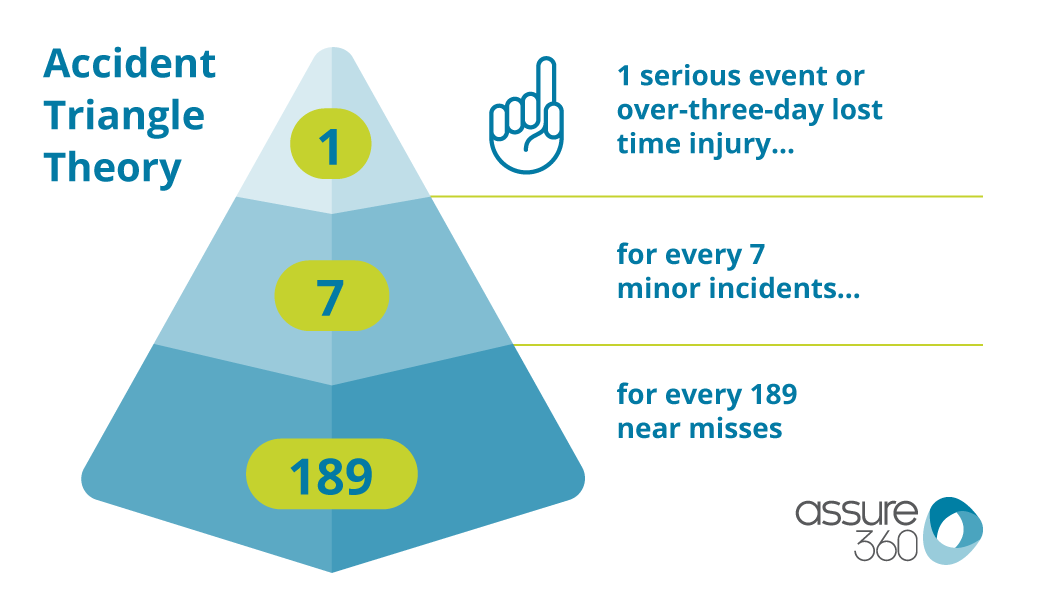
Any accident that didn’t happen is a warning of what might have happened. If we can learn and implement change before something has occurred… well, I don’t need to labour the point.
We first have to get over the natural human response of ignoring a near miss. Who would want to get someone into trouble when no one actually got hurt? However, the correct way of looking at this is: “That was close. Right, what can we do to make sure it can’t actually happen?” It’s an education process. Encourage the reporting of all near-misses through talking, explanation and rewards: regular analysis of the data you receive will allow you to preempt accidents.
One huge advantage that every licensed asbestos removal project should have is the supervisor. You have someone on site whose primary role is to ensure the job runs safely and to plan. There are obvious competence questions here that I have dealt with earlier, but the other unavoidable issue is paperwork.
Certainly with asbestos projects there are a multitude of safety-critical checks that have to be completed every day. No one would argue with that. Importantly though, the supervisor has to record that these checks have been done. Whilst this is unavoidable, it does take time away from supervising the works, reducing the supervisor’s impact in helping to prevent accidents.
Streamlining this paperwork will release the supervisor so that they can supervise – shifting their focus more towards overseeing and ensuring workplace safety.
Asbestos removal combines many common construction dangers with the specific risks of handling a highly toxic material. You can’t entirely remove the risks from such an inherently hazardous activity, but:
Get all five nailed and you have the fundamentals of how to de-risk your business.
That’s exactly what has driven the development at Assure360. With the combination of intuitive apps and a powerful database, our entire solution is directed at streamlining and simplifying H&S effort. Audits are made easy – and the legwork required for analysis largely eliminated. Exposure monitoring is instantly analysed to allow a constructive review of the success of each method. Incidents, accidents and – importantly – near-misses can be reported directly without adding to the paperwork.
All of this gives you unparalleled understanding of your people and your projects, but in a fraction of the time. Now, with the introduction of Assure 360 Paperless – the first out-of-the box solution for the supervisor – we free them to get back to what they do best: supervising.
Want to discover more? Get in touch today to book your free demo.
Written by Nick Garland on Friday October 5th 2018
Here are some dates for your diary – Nick Garland has put together his list of upcoming events for asbestos and construction safety professionals. We’ll update this page regularly.
27 February 2019
Join our February webinar and find out why more and more supervisors and managers in the asbestos removal sector are using our latest Paperless app to streamline on-site paperwork. Created by our expert team, Nick Garland will take you through everything you need to know about the system and demonstrate how it saves teams time and money. If you’d like to register for our February webinar simply sign up and we’ll send you more information.
18 February 2019
University of Reading, Agriculture Building, Whiteknights Campus
In this free evening event chaired by IOSH vice president Michelle Muxworthy, the IOSH addresses the role and significance of asbestos in workplace cancer.
1-4 April 2019
Hilton Brighton Metropole
Occupational Hygiene 2019 is the leading conference in the field of worker health protection in the UK, focusing on occupational hygiene and the prevention of occupational ill-health and disease. The conference programme combines inspiring and thought-leading plenary sessions with scientific and technical sessions, as well as a range of interactive workshops and case studies. The conference will bring together researchers, practitioners, regulators and other experts from around the world to discuss the very latest in issues that affect health at work.
9-11 April 2019
The NEC, Birmingham
The Health & Safety Event provides the perfect networking and educational opportunity to anyone responsible for running a safe and efficient workplace, anywhere in the UK. The CPD-accredited seminar programme will feature over 130 speakers from across the world of safety, fire and facilities.
6 June 2019
Location to be confirmed
Save the date for the annual ACAD golf day and awards dinner.
11-12 September 2019
The NEC, Birmingham
Registration for the Contamination Expo Series 2019 is now live. Claim your complimentary tickets to the Hazardous Materials Expo with seven events making up the Contamination Expo Series. The Assure360 team will be on stand J7, opposite ACAD.
If you’re hosting or attending an event you’d like us to list here, please get in touch.
Written by Nick Garland on Wednesday July 18th 2018
The Grenfell disaster was, among many other things, a failure of building regulations to protect residents. It’s clear to me that the Hackitt Review had to re-learn the lessons of work health and safety, and with Dame Judith a previous head of the HSE, I awaited her review with some optimism. Here’s why I believe she has grasped the opportunity. (more…)
Written by Nick Garland on Wednesday March 28th 2018
Finding asbestos contamination on a site or building project can feel paralysing. But there’s no need to panic. Here’s a simple guide to help.
The words ‘asbestos’ and ‘contamination’ are probably two of the things you least want to hear. Whether you’re involved in commissioning or designing a construction project or just occupying a building, asbestos can lead to worry, cost and delays.
Outside of the nuclear industry, the management and safe removal of asbestos is the most regulated process you can be involved in. And regulation invariably means expense – particularly if there’s regulatory infringement.
What is asbestos? As far as day to day practicality is concerned – ‘asbestos’ refers to the actual product that has been installed into a building. Because the ‘benefits’ of asbestos were so far reaching and its production relatively cheap – the type of products it was used in were virtually unlimited.
Asbestos can be found in:
And many other materials and structural elements.
Tony Rich, a respected asbestos consultant in the US, has taken and collated a vast collection of photographs of examples of materials and locations where asbestos has be found from roofing to cigarette filters
With the number of different products so extensive it’s no wonder that properties constructed before the early 1980s almost certainly contain asbestos. As the ban only came into force in 2000, even those built as late as 1999 could have some.
As we increasingly look for asbestos in soils we are finding more and more. Even if we ignore fly tipping and re-burying on site, there are several reasons why the ground we stand on can become contaminated.
Alas for many years we were not very good at finding asbestos in buildings. In defence of the surveyor, the proliferation of asbestos is huge (especially in the UK) and progressive refurbishments can cover over and conceal it. But the approach to intrusive pre-demolition surveys used to be quite weak.
The guidance on what you needed to do with asbestos once found in buildings about to be demolished was not always in concert with the hazardous waste rules. For example, it was widely accepted that Textured Coating had low asbestos content, was bonded to the surface it was painted on, and when demolished, did not constitute hazardous waste.
Buildings could be demolished without even looking for asbestos, either intentionally (we don’t want to know) or as an incompetent oversight.
Whatever the reason, if a building is demolished with asbestos still in it, that asbestos will find its way into the ground. The site itself could become contaminated and / or the subsequent rubble could be converted into secondary aggregate for other sites.
Whether you find asbestos in a building, or find it contaminating land you’re going to be building on, I’ve created a simple acronym to help remember the useful steps to take:
R – Respond calmly
2 – Two important questions to assess risk
D – Decide what you’re going to do next
2 – Two trade organisations who can help you find a licensed asbestos professional to help
If you discover asbestos, in the first instance – do not panic. As the HSE’s Martin Gibson has said – in the UK we have a long history and genuine expertise in managing the risk from asbestos. This does not always mean remove it.
With the proviso that you shouldn’t touch or disturb asbestos – the best rule of thumb when assessing the risk of asbestos in a building is to ask these simple questions:
For example, if the asbestos material is a corrugated garage roof: this is out of reach (or at least not easy to knock into) and clearly quite hard. So the risk is low.
If it is low level pipe insulation, it’s easy to touch and relatively soft. The risk is high. Simple.
You need to have as much knowledge as possible to answer these questions. And when it comes to asbestos that means a survey. This will tell you where any asbestos is and what the risks are.
The very nature of ground contamination makes the ‘problem’ an entirely different beast.
By being in the ground the material is buried and therefore hard to find. It degrades – breaking down and dispersing the asbestos fibres. Surveys have to follow a different pattern and are detailed in the HSE’s asbestos analyst guide (read my recent summary for more information). On the positive side, (especially in the UK) the ground is damp – important as wet asbestos does not get into the air too easily.
The risk assessment for ground contamination though remains essentially the same. Ask yourself two questions:
Loose insulation at the surface is high risk. Buried cement is low risk.
The next step is decide what you are going to do about it.
For asbestos in a building, providing that the material is in good condition there are plenty of options that do not include costly removal. In fact this is the HSE’s primary recommendation. If you can avoid touching, damaging or in any way disturbing the asbestos – then it is safer to manage it in situ. Even this is relatively straightforward – it involves a periodic check to make sure that its condition has not deteriorated.
If you do leave asbestos in the building – anyone who could come into contact with it should know it is there. If they could damage it through their work, they should have Asbestos Awareness training. These courses are so widely available that it is almost certain that there is a company near you that provides them. Check out the IATP or UKATA website to find a provider.
If however the asbestos is in poor condition, or it is in such a position that it could get damaged in the future, action may need to be taken. This still doesn’t necessarily mean removal but it does mean that you will need professional assistance. Options other than removal could be to protect the asbestos – help ensure it doesn’t get damaged. This can range from covering it up, painting it or to simply close and lock the door.
Again with ground contamination, we are faced with different challenges. We often only know of the existence or the contamination because digging is planned. But it could be something as simple as buried broken cement coming to the surface on a walkway. In either case some form of action is usually required. Just like asbestos in buildings though, that action could be ‘close the door’. In this case it would be to install a capping layer above the problem to seal it off. If however digging is unavoidable then some form of controlled removal will be required.
The rules on where this material goes is simple, but has huge implications:
If either of these are the case, then the material is ‘hazardous waste’ and therefore expensive to dispose of. If not at these levels, but still present, it is not ‘hazardous’, but must be disposed of at a landfill site that has an ‘asbestos cell’. Significantly less expensive, but still onerous.
Therefore a single fragment of visible asbestos can render a whole load contaminated. Careful early planning, screening and segregation becomes critical.
I have always recommended that a licensed contractor is used for any work on asbestos. This is (strictly speaking) not always legally required, as some low risk asbestos (the cement sheeting I mentioned earlier) does not need a licence. It does however need special equipment, training, medical supervision and insurance. In my experience you are much more likely to get it done right first time with a licensed contractor.
There are two main trade organisations: my one: ACAD, and ARCA. Both can offer lists of members that have passed their audit scheme. However, I would counsel that you would need more than this. Any company that operates an internal competence scheme like Assure360 gets a gold star in my opinion. Beyond that – personal recommendation (if your procurement will allow) is always the surest way to a happy outcome.
Land remediation is a specialist, complex skill that most (even licensed) contractors don’t have. The approach does not normally include enclosures, but could in the most serious of cases. Careful selection is therefore vitally important.
The final piece of advice I always offer is to become an educated client. Asbestos removal is expensive, complex and scary. Going ignorant into a contractual relationship in those circumstances is brave indeed. What’s more, CDM15 no longer allows clients to say ‘I didn’t realise’, or ‘that’s not my area’.
So, either get someone in your organisation that understands the subject (e.g. the BOHS course P405), or appoint a consultant independent of any of the asbestos project team who can be your expert advocate.
There is even help in selecting the right person: FAAM is the new faculty for asbestos professionals and commits its members to a level of expertise and an ethical code of conduct. Ask are they full members of FAAM (MFAAM)?
Expertise in asbestos land remediation is unfortunately less widespread. Whilst asbestos in the ground is a problem that has been with us for nearly as long as asbestos has, it’s been somewhat under the radar for most professionals.The introduction of the comprehensive document CAR-Soil has allowed training course to be developed often by CL:AIRE. CL:AIRE also publish a list of their members, but I don’t believe there is a formal auditing or vetting process.
Either your in-house expert or the external advocate would then be able to directly check that the project is being run safely according to the plan. In other words audit. Assure360has been specifically designed to help clients like the Royal Mail to monitor asbestos projects whether in the built environment or in the ground (no apologies for the shameless plug).
Whilst asbestos is a scary word – the Brits are world leaders in managing the risk. Get the right people around you and don’t panic.
Written by Nick Garland on Friday February 2nd 2018
Britain was the first country in the world to have an industrial revolution, and we were the first to start importing asbestos. We have imported the most asbestos of any country in the world. In fact in the ‘50s, ‘60s and ‘70s we imported 40% of the world’s capacity to produce amosite / grunerite.
We have so much asbestos that we can’t remove it all – we have to manage it.
These startling facts were shared by Martin Gibson (HSE) speaking at the European Asbestos Forum in September. They perfectly crystallise the unique situation that the UK finds itself in. The reality that we can’t remove our asbestos – only manage it – is also the foundation of all of our legislation. In essence: assess the risk and design solutions to keep people safe.
This takes a special kind of professional – one who is expert in the regulations, but who can see beyond the guidance to the purpose. They need to be able to design practical solutions rather than gold-plate and over specify.
How do you know you’re working with someone with these professional skills? Who can you trust? Asbestos is the biggest occupational health problem the UK has ever seen, yet anyone can claim to be a consultant or expert.
“We are a highly qualified asbestos consultancy firm”
“We are specialist consultants to survey and test any asbestos”
“Leading accredited asbestos management consultancy”
These are all genuine marketing lines promoting the skills and qualities of asbestos consultancies. Do they mean anything? How do we know, what confidence do we have?
The two existing professional asbestos management bodies have never been quite right. IOSH is focused on Health and Safety and BOHS has the whole breadth of Occupational Hygiene to consider. Being chartered in either does not speak to your asbestoscompetence, but there hasn’t been any real alternative
Until now.
Finally, there is a home for the asbestos professional. BOHS, with it’s shiny new royal charter has created a new faculty – Faculty of Asbestos Assessment and Management (FAAM). The launch event was back in October last year and the first few full members – myself included – were accepted into the faculty over Christmas.
https://www.youtube.com/watch?v=dLIgwq5sEL8
Now for the first time we have a home. One that insists on the maintenance of professional standards and where failure to maintain those standards will have consequences.
FAAM’s stated principles are:
FAAM will support members with
To be clear – FAAM will not be claiming that non members are incompetent, only that those who are members, have demonstrated competency, maintain that level and operate to an ethical code.
The levels of membership and the qualifications you need are:
Technician
• Level 4 – (one of P401 to P404), S301, W504, RSPH L4, or • Level 3 – RSPH Level 3 (plus written bridging exam) – OR…
Associate
• P405 or P407, or
Three from P401, P402, P403, P404, S301 or W504
Licentiate
Certificate of Competence (Asbestos)
Member
• CV, professional experience portfolio (or PEP) and personal interview
Fellow
… to follow … significant contribution to the profession
Whilst BOHS as a whole has a royal charter the new faculty does not – but there is the tantalising possibility that it might in the future.
The whole concept has excited me since it was first mooted – but I must say getting my acceptance documents through was a thrill and for the very first time there are letters I will be proudly using after my name – MFAAM. I urge all like minded professionals to apply.
Written by Nick Garland on Friday February 2nd 2018
In 2014 / 2015, the HSE carried out their Analyst Project – or to give it its full name ‘TheAsbestos Analyst Inspection Programme’. Its aim was to examine the performance of analysts in the removal process. At the BOHS roadshow last month, the HSE’s Martin Gibson revealed the initial findings and the first conclusions – perhaps the most surprising is how it might impact on the licensed contractor.
The HSE contacted all UKAS accredited labs and asked them to complete a questionnaire – the results were extremely enlightening.
Of the 145 UKAS accredited labs not everyone responded (obviously) – more than a third of them in fact. But if they thought they would stay under the radar, they were mistaken and the team targeted them for visits just the same.
Twenty 4SC visits were planned and in all cases the analysts were told to expect the HSE. Whilst this solved the issue of turning up when nothing is happening, it did mean that the analysts would be on their best behaviour.
I have broadly split the findings into the four stages of the process. I have also tried to highlight areas in the draft analysts’ guide that is intended to correct this. A copy of my white paper summarising the guide can be obtained on the Assure360 website.
One general point to be made is that wherever I mention photos – each has to be digital and date and time stamped to prevent forgery. And as usual there is a health warning with this post – this time from Martin Gibson – he stressed that the findings did not apply to all the analysts!
Whilst the analysts were checking that the asbestos had been removed, a detailed review of the surrounding area was a different matter. Whether the general site conditions were fit to start the inspection was often ignored. The worst example was this transit route – strewn with rubble and other non-asbestos material. It should have prevented failed at Stage 1.

The new draft guide has detailed the key inspection areas for the first stage of the process (including the transit routes and the areas surrounding the enclosure). Photographs are now required to demonstrate the adequacy of the situation.
The HSE’s view is that this is the critical part of the whole process, and raised the most number of issues in the investigation.
Analysts were observed moving randomly around the enclosure. Guidance (and logic) has always had it that a methodical pattern will help avoid missing something.
20% of the analysts wore domestic clothes underneath their overalls. This would have prevented them from decontaminating properly in case of a failure. Any of my regular readers will know that I believe that full decontamination via the DCU should be followed with every enclosure entry.
Formal failure certs were not always issued when an enclosure was rejected by the analyst. Whilst I can understand the instinct not to create paperwork, these failed certs are critical for addressing the root cause – that the LARC didn’t clean it sufficiently and the Supervisor failed to identify the issue. Clearer guidance on when to formally fail an enclosure is included in the new guide.
Two analysts arrived without overalls and two were unshaven. I don’t know whether these were the same individuals, but when you remember that the analysts were expecting HSE attendance – this kind of sloppiness is shocking.
What PPE and what to wear underneath is also detailed extensively in the new guide – the handy table is reproduced in my white paper on page 44.
There were also some startling implications over the amount of cleaning that analysts do – but I will leave that till later in the piece.
There were incidents that raised questions over basic competence namely calculating fibre concentrations incorrectly (decimal point wrong). This may just be the nerves of being overlooked.
More significant, in my eyes, is that one of the analysts forgot the brush for the disturbance test. Again, when you recall that the analyst knew the HSE would be in attendance, wouldn’t the instinct be to double and triple check your equipment? A photograph of the brush is now needed in the new look Certificate for Reoccupation.
Generally, the HSE found insufficient time was spent on reading the slides – one took just nine minutes to read three slides. This compares with the 10-15 minutes per slide in the current draft analysts guide and the 10-25 minutes in the old version! Just as I was forgiving to the analyst that got the decimal place wrong, to race through this phase of the process when observed by the authorities makes you wonder ‘what normally happens?’. The new look certificate with time and date stamped photos and time declaration at the signature stage should help this.
This is where the final checks are conducted post dismantling the enclosure, but I also include decontamination and PPE.
Frequently the analysts did not wear overalls when conducting the final checks. This is obviously unwise as dismantling the enclosure can reveal hidden problems. Mostly the analysts were entirely unprepared for these unpleasant surprises including not carrying RPE. Whilst the guidance is a little clearer in the new guide – Stage 4 is missed off the handy summary table, and the reader must go hunting in the Appendix. Hopefully the final draft will be amended.
The HQ visits established that practical training for decontamination was lacking. On site this was evidenced by analysts being unsure when to decontaminate and following the incorrect DCU entry/exit procedures when they did. Much more detailed guidance on decontamination procedures is included in the new guide – including training as a core skill.
No apologies for this section, though my regular readers might think that I am a broken record. The project established what we have been seeing with the Assure360 data. Most personals air tests were very short term and usually only 10 minutes. Further, they included no contextual information – just ‘removal works’. To compound this, the analysts often reported the calculated results which were below their own Limit of Quantification (LoQ). This is next to useless to the LARC who is attempting to improve their methods. They need long duration tests, with decent (low) LoQs and detailed information over what was happening during the test. Assure360 has analysed over 5000 personal air tests and even here we are finding that approximately 10% are for only 10 minutes.
This is what I hinted at earlier – something that all analysts will already know – analysts do quite a bit of cleaning as part of the visual. What makes it startling is the implications.
I am very aware that the LARCs have views on analysts and the ‘helpful’ ones are those that pitch in to get the enclosure through the clearance. I counted myself as one of those. In the Project, many analysts stated that they conducted minor cleaning. But what constitutes ‘minor’? Well in one case it was cleaning for over an hour!
The HSE’s view of this is that >15 mins cleaning constitutes licensable work and must not be done by the analyst. What’s more – any such breach is considered, at least in part, the LARC’s fault:
HASAWA
36. (1) Where the commission by any person of an offence under any of the relevant statutory provisions is due to the act or default of some other person, that other person shall be guilty of the offence, and a person may be charged with and convicted of the offence by virtue of this subsection whether or not proceedings are taken against the first-mentioned person.
Whilst the new analysts’ guide (still draft) has been written in such a way as to take some of these findings into account (get a copy of my white paper here), some last-minute changes have found their way in.
The new Licenced Contractor Guide which I understand was complete – just awaiting a slot in the HSE schedule to publish it – will now need a re-draft. Further guidance will be included on
“It is very rare that site supervisors carry out an inspection before the analyst arrives.” Analyst – Anon
My experience however is that the good supervisors take their role seriously and complete these visual inspections. However, the required declaration by the supervisor ‘time taken on visual’ may come as a bit of a shock.
The HSE’s view is that the visual inspection is by far the most important part of the whole clearance process. If the responsibility is primarily the LARC’s – a light touch / brief visual by the supervisor won’t be acceptable. The draft analyst guide gives us very detailed suggested times for these visuals.

This table indicates that a small boiler room should be inspected by the supervisor for 2-4 hours before the analyst can start stage 1 of the process. It also begs the question if the Supervisor is conducting a visual and therefore not supervising the rest of the team – does all activity stop?
There will have to be a sea change in expectations.
Written by Nick Garland on Monday October 23rd 2017
Essential reading to help you unpick the significance of the changes coming our way by Nick Garland, CEO of Assure360.
Here’s my summary of the draft of the new Asbestos Analysts’ Guide from the HSE. I’ve been publishing blog posts on this over the last six months, and this white paper is the complete set of articles on this with some updated additional analysis.
Download the Asbestos Analysts’ Guide White Paper [PDF]
The HSE’s new Asbestos Analysts’ Guide is coming soon or so we have been confidently told for the past year. When we do get it, it is designed to help both Analysts and their clients comply with the Control of Asbestos Regulations 2012 and its ACoP.
It’s the client I am particularly aiming this summary at, but those with technical backgrounds should also find it useful. It is also for this reason that I largely don’t cover the appendices – in of themselves a whopping 178 pages long!
This is obviously a summary and clearly not intended to replace the guide. In particular, the appendices contain a lot of important detail and should still be studied to gain the fullest picture. A further note of caution, this is a review of the ‘draft for consultation’ – there may well be changes before final publication. Publication of the consultation paper was a surprise when it was issued over Christmas, so stand by your beds.
I regularly write about this and other topics relating to safety and asbestos management. I’ve been working in the industry for over 20 years, so I have a fair bit of experience to share – the good, the bad and the ugly.
Why not connect with me at LinkedIn if you’d like to talk more about this. I’d be delighted to hear from you.
Written by Nick Garland on Monday October 23rd 2017
In the fourth part of my summary of the new draft Asbestos Analyst’s Guide from the HSE – I’m concentrating on soils.
For those of you who have read either of my other summaries – this stand-alone article is a continuation.
If you want to read the first three instalments:
Part 1 – Appointing the right asbestos analyst
Part 3 – Reoccupation certificates and clearances
You can download a PDF of the complete white paper on the new analyst guidance here.
This time I am concentrating on the age old, but simultaneously new issue of asbestos in soils.
It should be remembered the HSE’s interest starts and ends with protection of the worker and others directly affected by the project. There is a very real difference between HSE and Environment Agency take on asbestos in soils. Another much more ambitious and targeted document on this other angle is:
‘Asbestos in soil and made ground: a guide to understanding and managing risk’.
CIRIA 733 must be read to gain any proper understanding of the subject.
My usual health warning – this is obviously a summary and clearly not intended to replace the Guide. The appendices contain a lot of important detail and should still be studied to gain the fullest picture. Finally, this is a review of the ‘draft for consultation’ – there may well be changes before final publication.
Asbestos surveys are required under the duty to manage and the current Construction Design and Management (CDM) Regulations. Where there is ‘a reasonable expectation that asbestos would be, present and could present a risk to workers’– surveys must be completed. This is no different for the ground.
This is an area of asbestos analytical work that has been too long ignored, but growing dramatically. Historically – poor surveys and removal projects have failed to identify or remove asbestos containing materials (ACMs). Subsequent demolition would therefore create contaminated rubble to enter the aggregate supply chain. QED. Other than poor practices, there are other reasons:
The guide specifically states that speculative sampling should not be undertaken. We’re told only complete soil investigation if other (desktop) analysis indicates that there is a risk:
However, as I said in the introduction, the potential source of contamination is very broad and could be totally unrelated to the list given us in the guide. I agree – don’t do speculative sampling, but if there is planned ground works – asbestos surveys should be mandatory.
ACMs present in contaminated land can vary from whole sheets of asbestos or sections of pipe insulation to smaller fragments. Clearly, condition will deteriorate over time, leading to the presence of fibre bundles. When lying close to the surface and especially when the ground conditions are dry, fibres can be readily disturbed and released to the air. It is this interface with the air that brings the risk to the worker.
The desktop study and subsequent survey (if deemed necessary) should determine the risk to workers doing the digging. The risk assessment should establish the locations(s) of asbestos in the ground and identify the type, product, condition and amount (e.g. areas/depths). Soil type and moisture content are also key. Adequate controls can then be designed and implemented. Clearly discoveries during the project may require us to revisit the assessment.
The guide suggests a targeted approach.
Careful examination and picking of the area *. This would allow the surveyor to present the lab with larger pieces of ACMs (about 3-5cm2) and smaller pieces of debris and fibre bundles as distinct samples.
*Sieving may also help to separate the coarse fraction (stones etc.). Detailed procedures on decontaminating the sieve to prevent cross contamination of samples is needed.
The team’s task is to hunt out asbestos and only present suspect materials to the lab. To get any type of risk assessment, there would have to be an adjustment factor (suggested at ‘x 0.1’) – this would allow for the fact that the ACMs were collected over a much larger area.
This method has the advantage that a large area of the site can be covered more quickly. Its principal use is to establish if a main survey is needed. It will also allow a main survey to be better planned.
A note of caution – the naked eye, in site conditions, is especially vulnerable to fatigue. When you add the likely requirement for wearing safety glasses – the potential for missing ACMs must be acknowledged.
The guide indicates in the appendix that the targeted method is suited to the Preliminary Survey, but the Main Survey (if needed) would employ the traditional approach.
Select the sample points and carefully map the area (including depth).
The normal approach is to reduce (using coning and quartering) a 1m2 area of soil down to a 1-2 litre or 1-2kg sample. This is a method to reduce the sample size without creating a systematic bias. The technique involves mixing the sample, pouring it into a conical shape, flattening it out into a cake and dividing the sample.
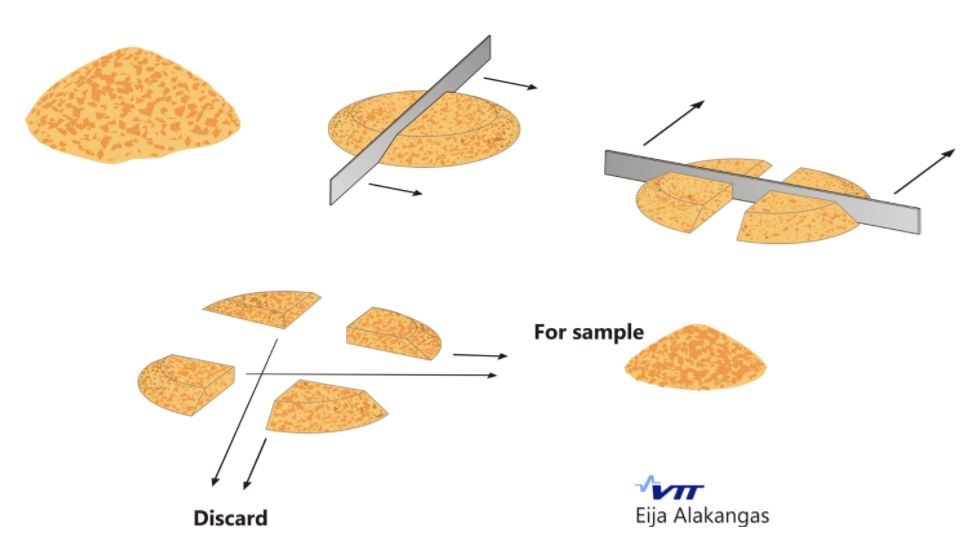
Image courtesy of Eija Alakangas, Technical Research Centre of Finland VTT Ltd.
The exercise should be repeated to get to the end sample size of approximately 1kg.
The soil type at the depth should be detailed to allow greater understanding (i.e. made ground, sandy, clay etc. will all have an influence on the final risk assessment). All should be logged on a site plan. This will allow not only a register of what has been identified – but can also be compared with previous site plans to better target further investigations. E.g. an old site plan indicates that a boiler room used to stand where a few positive samples were taken.
Whichever method is used, the guide highlights an important safety issue in that the activity should be done at the surface and the surveyor should not enter trenches or holes, unless properly shored up.
Laboratory identification of asbestos is obtained using the standard analytical methods. However, there is significantly more preparation required. Concentrations of dispersed fibres down to approximately 0.001% can be identified using the standard method – but I have found that this is very dependent on how long the analyst is prepared to look (20 minutes is suggested).
Quantification is critical to develop an assessment of risk; an appropriately accredited lab must therefore be selected. In such cases, results would be reported as a weight for weight (w/w) percentage of the matrix. Note the current rules for hazardous waste is 0.1% w/w, or (crucially) if any visible fragments of ACM are in of themselves >0.1%. This would mean (taken to extreme) a single 10p sized piece of AIB or cement in an otherwise clean load would render it hazardous waste.
I am not detailing too much that appears in the appendices in this summary – however, there is a table in appendix 2 which seems to contradict this:
The presence of ‘XXX’ indicates it is unfinished, but the guide seems to be adrift of what I understand is the hazardous waste rules.
These surveys, coupled with ‘near source’ and ‘far source’ air testing (see my second summary here), should be used to assess the risk and design the control measures.
As with all asbestos controls, the starting point is don’t disturb it, but as the land is due for remediation this is unlikely to be a solution. The guide states that where there is mostly bound asbestos in soils below 0.1% w/w, airborne levels are unlikely to exceed 0.001f/ml. However, where this is free fibre and especially in dry soils – the fibre release can be greater. Just like with standard asbestos removal suppression is a key element of any designed control.
The guide produces a flow chart to clarify the decision-making process, but I think it will get reworked before final publication. I will not reproduce it here, but the chart indicates that if samples identify asbestos that is buried and unlikely to be disturbed – it should be reported as ‘no asbestos found’ – certainly a typo. The principle will likely be that if the asbestos is buried and unlikely to be disturbed it will present no risk to the workers and therefore as the guide is only interested in these workers – we’re back to where I started – leave it alone.
Because of our historic failures, this whole area of remediation is where the future of the industry lies – as we strive for an asbestos free world.
Written by Nick Garland on Monday October 23rd 2017
With the shock of the Grenfell Tower fire still raw in our minds, Nick Garland look to echoes of the past for lessons to relearn.
“Grenfell Tower met all required building regulations – as well as fire regulations.” This is the statement from the contractor responsible for installing the cladding. The thing is, it might very well be true – but does that make it right?
In 1974, the year that the Health and Safety at Work Act (HASAWA) became law, the number of fatal injuries in British industry was 651, over six times higher than today. Pre-1974, the H&S framework had not been slack – in fact it had been highly proscriptive. The regulators set a list of targets, which industry would strive to achieve.
Simple.
The inevitable problem with this kind of approach to safety regulation comes where regulation is not drafted perfectly, so compliance to the letter of the law falls well short of what is needed. Problems that the regulator did not foresee will be missing from the guidance and therefore never complied with.
The Aberfan disaster in 1966 was a clear and horrific example of this. A previously unknown underground spring found the surface under the dramatically increasing slag heaps. The spring turned the foundations of the heap to an unstable slurry, and the whole lot slid down the hillsides killing 144 people, 116 of whom were children. The Coal Board had complied with the 1966 regulations because there had been no mention of what was required if underground springs appeared under your workplace.
Now take a look at the building regulations of today.
“External walls are elements of structure and the relevant period of fire resistance (specified in Appendix A) depends on the use, height and size of the building concerned. If the wall is 1000mm or more from the relevant boundary, a reduced standard of fire resistance is accepted in most cases and the wall only needs fire resistance from the inside.”
and
“… it is possible for some or all of the walls to have no fire resistance, except for any parts which are loadbearing.”
The Building Regulations 2010
It may be the case that the infamous cladding at Grenfell Tower was not approved as a fire proof panel. But it seems that the regulations are drafted in such a way as to suggest it doesn’t need to be. I am sure that it is more complicated than that and the height of the tower has a big influence – but the fact that cladding on dozens of tower blocks is now failing fire safety tests suggests that the regulations are at the very least easy to misinterpret.
Lord Robens, the much-criticised chairman of the Coal Board at the time of the Aberfan disaster, used this experience to revolutionise how we think about H&S. His report in 1972 directly led to the Health and Safety at Work Act 1974 and the creation of the Health and Safety Commission and the Health and Safety Executive.
This didn’t stop him from continuing to be unpopular. His most controversial idea was that those that own the hazards are best placed to assess them. This therefore is the core of the Health & Safety at Work Act (HASAWA): the simple goal to ‘create a safe place of work’. I believe this idea is ingenious because this twist harnesses the imagination and expertise of the hazard creator (the employer), allowing the regulator to stay ahead of the game.
Now comes the next touch of genius. ‘So far as reasonably practicable’ (SFARP). But what is ‘reasonable’? There is guidance to help the decision, but to a large extent it is down to the employer. But woe betide them if they fall short of SFARP, because the regulator checks, carry warrant cards and severely punish those not doing enough.
I loathe this phrase, it is lazy and misinformed. Billy Brag posted on Facebook recently – remember Grenfell Tower the next time you hear someone complaining about health and safety. Well done Billy.
‘So far as reasonably practicable’ is by contrast inspired. This clever phrase completes the circle:
1. Create a safe place of work;
2. Do all you can to achieve this and critically …
3. We will check that you do.
This harnesses the employers’ imagination, and in this age of private litigation – their fear too. ‘Is this far enough? … let’s just do that bit more…’.
The reality is – all the examples of seeming ‘H&S gone mad’ (including the famous conker ban), was the employer choosing to go the extra mile or two (rightly or wrongly). The legislation was written specifically to get this extra mile because ‘not far enough’ is just that.
If legislation can be beautiful – this is.
Dial forward to the 2014/2015 stats and the impact of the remarkable legislation can be seen. Fatal injuries in British industry have dropped by 85% and reported non-fatal injuries are down by 77% since the HSAWA became law.
This is the rub; the revolutionary legislation is the Health and Safety at WORK Act and has no bearing on domestic situations or appropriateness of design – unless it is to be a place of work. The main supporting regulation for construction that sits under HASAWA is the Construction (Design and Management) Regulations 2015. The main duty for designers in this document is:
…so far as reasonably practicable, eliminate foreseeable risks to:
Again, a gaping hole for us to slip through.
There are two saving graces: firstly common parts (areas of a building used in common – so the fire escape, foyer, lifts etc…) all count as workplaces. Secondly there are very detailed building regulations which everyone must comply with.
But now we are back to the shadow of Aberfan – if the regulators do not spot a problem and allow for it, then it is effectively invisible.
Today’s building regulations are just as, if not more, proscriptive than the legislation predating HASAWA. For those that are calling for the regulations to be reviewed – I could not agree more. The regulations should be entirely re-written, with Lord Robens’ vision at the heart – so that it is the employer, the developer – those that make the money out of our toil that have a duty to ensure that what they do is without risk – so far as reasonably practicable.
Written by Nick Garland on Tuesday August 29th 2017
We’re exhibiting at Contamination Expo 2017 again this year. Find out why you should be going – and why you should come and talk to us on stand C3150 about your asbestos and safety management headaches.
The Hazardous Materials Expo 2017 is happening on 27 and 28 September at the ExCel Centre in London. Doors open at 10am. There’s more visitor info on the Expo website here. You can find a floorplan for the Expo here.
We’ll be hosting a stand ready and waiting to talk to your about your asbestos and safety management headaches. We’ve got more than 20 years’ experience in the industry so no matter what your challenge, you can pretty much guarantee that we’ve been there.
We’ll be holding consultation appointments on both days and offering demos of the Assure360 – our simple app that brings health and safety innovation into the 21st century. Everyone who books a demo while they’re at Expo will be entered into a prize draw to win an iPad worth £500.
We’ll also be launching our new whitepaper – ‘An Asbestos Analyst’s Guide’. This free resource offers our take on the HSE’s draft new analyst guidance. It’s essential reading to help you unpick the significance of the changes coming our way. Get your free copy when you come and see us at stand C3150.
Get in touch if you’d like to book a demo of Assure360 at the Expo
Written by Nick Garland on Friday June 2nd 2017
We’ve just released an updated version of the Assure360 app – here’s how it helps to turn auditing into meaningful improvements in safety.
Our app was born to help companies manage asbestos removal projects (the most regulated UK industry after nuclear), so compliance is critical. But the structure also encourages the auditor to examine ways to improve. The app identifies good innovation on site as well as allowing the user to record aspirational best practice identified elsewhere. The combination of the app and the cloud database, instantly links audit findings with actions. Whether the observation is something that has gone wrong, innovative best practice, or a lesson learned from external sources –the sophisticated workflow process makes sure no one forgets.
The audits completed on the free app are the most comprehensive available, developed by myself over the past decade. They are uploaded directly to a database in the cloud, where the system interprets them for you. Non-conformances are presented to the designated managers for them to close out. It even reminds them if the due date expires. The high-level dashboard not only shows the immediate information required to spot trends, track close-out and develop strategies for improvement, it also allows a structured walkthrough so that you can showcase how you go about managing H&S to clients and regulators. A warts-and-all approach, where ‘challenged’ sites are discussed, becomes real evidence of proactive management.
Multiple organisations can participate in the process. The company themselves will obviously take the lead – but customers and trade organisations can also complete audits on the free app. The cloud structure can be designed so these 2nd and 3rd parties can view their audits and relevant internal inspections too. As all the audits are on the same system, close-out of non-conformance and learning from best practice is streamlined.
With the help of the army of auditors who use it, Assure360 has been evolving since its creation. As findings are anonymously shared on the central cloud database – this means that users constantly and automatically learn from others in their own sector and beyond.
Assure360 now covers safety auditing in every workplace and is so flexible it can be tailored to any industry, language or country. This flexibility was a key demand from our users who have been an integral part of the research and development. Continuous feedback, active participation, innovation and plain bright spark ideas have allowed us to design the experience to match not just what users need, but what they want.
We are still very close to our roots, but now the asbestos industry can start to learn from other sectors.
Read my feature on LinkedIn to find out more about what needs to change in safety auditing.

Written by Nick Garland on Tuesday May 30th 2017
For decades, the HSE’s requirements have not been well communicated, or have been described in terms frequently misunderstood by the industry. The license holder (or the prospective one) has too often been left to work it out for themselves.
It takes a courageous removal company to stand their ground when presented with the opinion of the inspector on the spot. To be fair, there is no manual that the HSE can pull off the shelf describing the perfect asbestos removal company. But this ad hoc, local, opinion-led approach has produced a host of different solutions:
Whilst some of these questions are new to the last few years, exposure monitoring has been causing licence holders problems for my entire career.
But why is this so difficult? The LARCs – licensed asbestos removal consultants – do manage health and safety, producing method statements and documentation far more detailed and considered than their construction counterparts. They spend vast sums on training staff, and ensure levels of supervision beyond what other industries would even consider. Exposure monitoring has been a challenge, but the tests are done in line with guidance and by skilled analysts, perhaps just not frequently enough – but done.
So why do these questions become so difficult to answer in a licence renewal meeting?
First, there is no 100% right answer and nowhere to look for advice, beyond asbestos specialised health and safety consultants (like myself). The trade organisations can also pitch in with this, but the independents are too few and far between to help everyone. However, as all industries can tell you, parachuting in a consultancy to ‘identify and solve underpinning problems’ sometimes leads to superficial solutions. The way I have always approached it is to become embedded in that company – almost as a part time H&S manager or officer. This degree of understanding is vital for crafting solutions.
Second, the nature of licence renewal is often adversarial, with the future of the company on the line. This does not lead naturally to a relaxed environment where ‘business as usual’ can be showcased.
So, how can Assure360 help?
Firstly, all reputable asbestos removal companies conduct audits. These are sometimes conducted on Excel, or iAuditor (an interface with Excel) but often on paper. The problem with these solutions is that they tell you little beyond high level non-conformances and it can be challenging to extract meaningful trends. The paper version (or a PDF) is often a cul-de-sac, with non-conformances trapped on the paper, hidden in a file.
When asked – ‘How do you manage H&S?’, too often the answer is a jumble of files, hard to decipher Excel spreadsheets, and in worst case scenarios un-actioned paper audits.
Not so with Assure360. The audits completed on the free App are the most comprehensive available, developed by me over the past decade.
A warts-and-all approach, where ‘challenged’ sites are discussed, becomes real evidence of proactive management.
One client, Rob Wasson from Delta Services, recently contacted me after a licence renewal. He told me: “When I demonstrated the Assure360 system to the HSE, it made me proud of all that we had achieved.”
That degree of confidence and enthusiasm can only be massively influential at renewal time.
The new question that the HSE can nail us with is how do you ensure the competenceof your workforce?
Competence is a tricky customer and can be a complex thing to measure – after all, just showing them the training certificates is not enough. I’ve written previously on our blog about what to look for in a good competence scheme. Assure360 however does it all for you. The same comprehensive audits are just interpreted in a different way.
The beauty of this is that you have already done the work. So instead of one more job that your overstretched team are asked to do – it is a matter of moments.
In my experience when helping a licence holder prepare for the HSE, the one thing that they are least confident with is exposure monitoring. Often there has been plenty of ‘personals’ done (though sometimes not). Sometimes these are compiled into an Excel spreadsheet, though often not. When asked ‘how are these used?’ it is frequently met with a pregnant pause.
In some ways, the LARCs have been led up an exposure monitoring blind alley. People in asbestos removal often only have a vague understanding of what exposure monitoring is for (you can read more on this in my earlier article here). They get provided with dozens of 10-minute ‘personals’ that tell us next to nothing. The feeling of ‘what is the point of this beyond keeping the HSE happy?’ has some justification.
The approach that Assure360 has transforms every personal monitoring test into an assessment of how successful the method was.
With 360, ‘the point’ is clear – it has a direct impact on the improvement of methods.
Assure360 is specifically designed to address all the challenges I have identified in my nearly 25 years in the industry. For the past two years, it has been helping LARCs improve themselves and with that, the industry.
Ken Johnson from Delta Service recently told me: “The moment I saw the system demonstrated I knew it was an absolute must for us. It ticked so many boxes – all the areas that the entire industry seems to struggle with.”
The central theme is simplicity, Assure360 is a system, one that you follow, implement and operate yourself. Just by doing so you gain greater understanding of the management of your company. You operate it yourself (no expensive consultants) and everyone contributes – this simultaneously saves money and strengthens your health and safety culture.
To find out more how we can help, contact us today on 0845 226 4318
Written by Nick Garland on Wednesday May 24th 2017
The Assure360 app collects a huge amount of data and this gives us unique insight into the issues our peers in the safety industry tackle during site audits and tech reviews.
Our app is the only community audit and compliance tool available for the asbestos removal and construction industry. With more than one hundred safety professionals using the system – so far they’ve completed more than 2000 audits – we are developing real insight into the challenges and issues our clients and peers face and overcome. As a result, Assure360 has the power to genuinely improve the construction industry.
The Assure360 system incorporates site audits and also records tech reviews during the planning stage. This allows managers to learn from common issues picked up by their peers – before the project goes live.
We regularly share the community’s findings with our army of independent auditors through our customer newsletter (you can sign up to this at the bottom of this page). Here is a taster of the most recent findings we shared covering audits and site reviews from January 2017.
If we look at the overall top 10 we see predominantly paperwork issues, that either are, or can be identified during peer reviews:
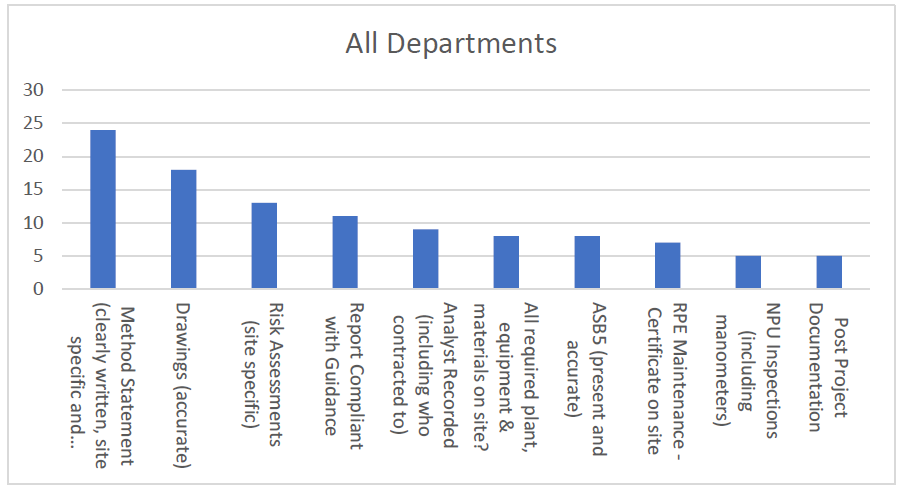
The top 10 list looks like this:
Whilst there are some favourites here, Risk assessments (site specific) indicates that the auditors are trying to come to grips with that age-old problem of generic risk assessments. Assure360 will automatically record this with an action to identify and resolve the underlying issues.
Whilst on the surface – ASB5 (present and accurate) seems alarming, I am aware that this is being used to track when teams are not on site when they should be.
Assure360 allows us to drill down and identify issues faced by supervisors. This allows the teams to address targeted issues within supervisor meetings, rather than allowing company wide concerns to cloud the issue:
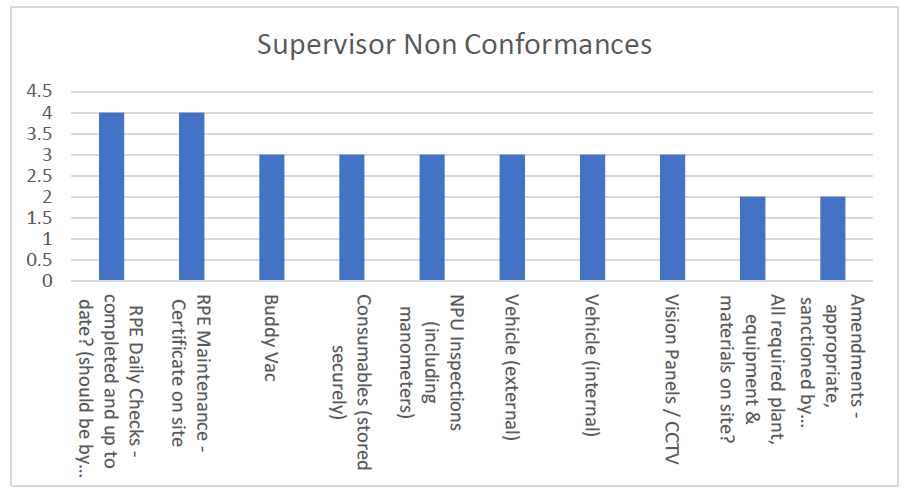
The top 10 for supervisors looks like this:
Again, for supervisors there are some familiar hurdles to overcome. But some surprising issues are being targeted as well. Vehicle inspections – when taken together – is the most common issue.
Similarly, contracts managers can focus on their challenges:
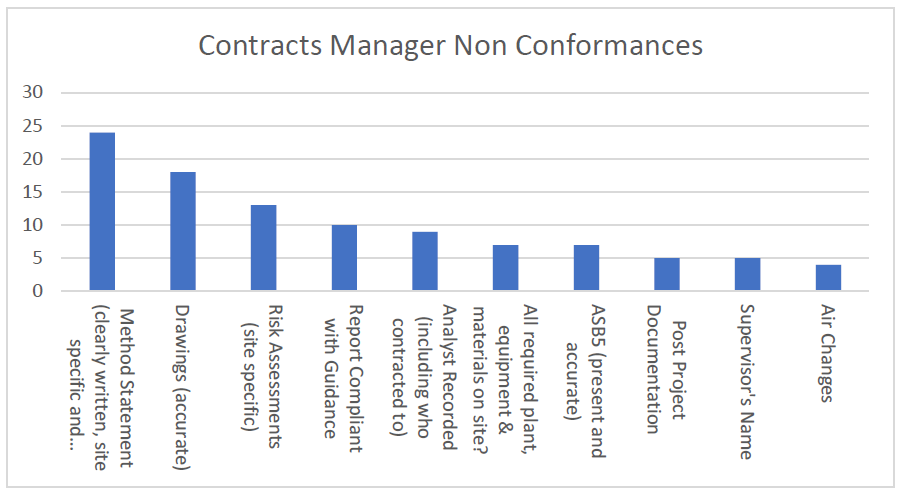
The top 10 issues for contracts managers are:
How does this data compare with your own audits? Do you have a tool that can help you monitor and tackle these issues, saving you time and money and keeping everyone on the project up to speed?
Let us know what kind of data you’d be interested in seeing and book a demo.
Written by Nick Garland on Thursday April 27th 2017
The data shows that the licence terms awarded to asbestos contractors have reduced year on year. But in my view, standards in our industry are improving. So what’s going on? And is there a a better way forward for asbestos licensing?
A phrase every LARC will be familiar with, as it seems to be in all letters written by the HSE. One of the principle purposes of such a regime is:
“…maintaining and improving standards of health and safety”
The Health and Safety Commission permissioning regime policy statement
Maintain and improve standards of H&S, presumably by weeding out the incompetent and promoting best practice. But why then are average licence terms shorter now than they were? I have been in the asbestos industry since the early 1990s, and I’ve definitely noticed the change. Can we infer that the HSE’s opinion is that the industry is less safe and less competent than it was?
Licence assessments can be a very unpredictable time. All of the companies that I work with have heard of, or experienced extremely intense assessment interviews, but at the same time hear of laissez faire ones with very little detailed examination. Requests (demands) from the ALPIs is often insightful but can also be bizarrely arbitrary, with little practical application. One licence assessment ended up insisting that filing cabinets be used (rather than the perfectly acceptable system the LARC already had) – resulting in the conversion of the one and only meeting room into an archive room.
We all know anecdotally that it has become harder and harder to get the ‘full’ three-year licence from the HSE, but the latest figures are quite stark.

ALG figures, supplied by ACAD.
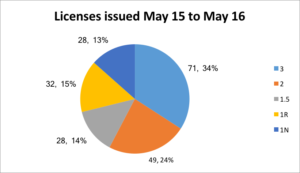
ALG figures, supplied by ACAD.
Excluding new licences (always one year) there has been an alarming drop of 23% in three-year licences issued in that period.

ALG figures, supplied by ACAD.
In my experience the industry, whilst there are some bad eggs, is getting much better. When I think back to the beginning of my career, where it seemed everyone had a three-year licence – the differences are remarkable. Now projects consider the wider job and recognise non-asbestos hazards. In fact, it seems a different industry with most of the stories of astonishing individual poor practice in the past.
So, if we are not getting any worse and the principle aim of a permissioning regime is to drive standards, why are the licence terms going down?
Could it simply be that there are less licensed contractors out there and the HSE want to exert more control. A tighter leash if you like? Certainly, the tone of some licence assessments and HSE visits indicate this.
The HSE tell the wider construction industry (and clients) that they shouldn’t use the licence term as a tool for selection. If the company has been given a licence (any licence) that indicates that they (the HSE) are satisfied and this should be good enough. The clients however (quite reasonably) take the view that well if you are concerned enough that you won’t give them a 3-year licence, then we are concerned too.
A licence holder can’t notify a project that extends beyond the licence expiry date.
We add then that the HSE publish the expiry date of licences – so if you track these things, you can plot a company’s standing. A client also instantly sees which companies can notify the project that they are considering. This might not seem a big concern, but very complex major works, might require 2+ years to complete – knocking out 65% of contractors.
With this in mind – are the HSE less inclined to reduce the term for a huge company? Do they back away when a downward tweak might stop a multi-million £ job in a power station? Certainly ‘the word’ is that they do.
The licence term is certainly a commercial driver.
In my opinion the HSE should remove the fixed term licence. The HSE should assess a company and give, or withhold a licence based on the interview and past performance during site visits. These licences should not expire (I hear howls of outrage).
What should replace it is a tailored review schedule for that specific contractor. Essentially, ‘Yes we are content for you to work with asbestos, but we want to see you again in 6 months, or 12 months or 3 years, just to make sure things stay on track’. A structured plan could therefore be put in place on what improvements must be implemented before the next monitoring visit.
The monitoring schedule would not be published and would not appear on the licence itself. This therefore could not be used for contractor selection. The pressure would be released from the HSE to grant 3 year licences for commercial reasons. There would be no issue of notifying jobs beyond the end of the licence expiry date – as there won’t be one. The HSE can concentrate on maintain and improving standards and do so in a much more structured way.
As I say this is an opinion piece, and I would welcome everyone’s thoughts and feedback.
I have been in the asbestos industry since the early 1990s, helping licensed asbestos removal contractors stay at the forefront of the industry.
Let me know what you think. Drop me a line using the email at the bottom of this page.
Written by Nick Garland on Monday June 27th 2016
The draft guidance that was doing the rounds last year on blasting techniques (whether that is Quill, Torbo or ice) has now been released as ALG meeting minutes, rather than a full ALG Memo. I am not too sure on where that places it in the regulatory framework, but it is clearly guidance that shouldn’t be ignored. There a few changes to the February 2015 draft that prompted my original summary.
The following piece is an update on the main points to be aware of.
The memo starts with the recognition that blasting may be required in a few rare occasions, but also declares that the process should only be considered as a last resort and not a go-to silver bullet. It also insists that the use of the process (above other more traditional approaches) must be fully justified by the licensed contractor, with evidence in support. What this translates to is that the method must not merely address and mitigate the significant additional hazards, but that the reasons for introducing them in the first place are declared and justified:
Clients are normally the main driver as to why blasting is being considered (“I want an asbestos free building”). It would therefore be wise to involve them in the decision process, explore whether the reasons for that desire outweigh the added hazards and ultimately justify why it is required. The guidance states that robust processes should be in place to ‘prevent misuse’. Or put another way – review of the justification and sign off by senior management. The technique must also be declared on the ASB5.
The guidance suggests the following controls:
** Wet Vacs may be problematic guidance as they do not typically have HEPA filters but the moisture in the ‘garnet’ will damage a standard vac.
These controls will considerably increase time, plant and materials and with them costs. It is difficult to imagine a client stomaching the substantial increase.
I can almost hear the echo of ‘It’s only guidance’, which it is, but the imperative is to implement something equivalent or better and the suggested controls are quite specific and difficult to argue against. As it must be declared on the ASB5, the likely increased chance of an enforcement visit will mean that Ignoring the document will be a high risk card game with your license as the stake.
Find out how we can help you with asbestos waste management – call us on 0845 226 4318
Written by Nick Garland on Monday September 28th 2015
Transiting is the simple process that operatives follow to exit an enclosure. It is the moment where they remove PPE and if they get it wrong, expose themselves to increased asbestos. It is therefore critical. However, when I audit removal projects in the UK, I often come across an almost wilful disregard of this guidance. The poor procedure is reinforced by large training providers (I am thinking of one in particular) that actively train incorrect procedure to delegates.
The guidance is clear:
So why do over 10% of audits completed by myself and others (using my Assure360 system), record instances of PPE removed in the dirty stage or even in the enclosure itself?
The reasons we hear from the individual operatives, supervisors and their management, typically include ‘well you wouldn’t want to take all that contamination to the outside’ or ‘well the middle stage is a buffer’ or most common of all ‘well I went on a training course last week and they told me…’. All of these demonstrate a fundamental lack of understanding as to why the guidance was written as it was.
Correct risk assessment at the moment of transiting should tell us quite clearly who is most at risk – the operative. Therefore what is transiting for? The primary purpose is to ensure that an operative exits a hazardous environment safely. It has a secondary purpose – to ensure that in exiting, – that hazardous environment stays confined. The dirty stage (it’s nick name is such for a reasons) is the most hazardous part of the airlock system, so why should we be asking operatives to remove any PPE here? Removing PPE in the enclosure is clearly slightly insane.
If we lose sight of who is most at risk, it would allow us to think that the secondary purpose is the main one. On the shaky foundations of this ignorance and with the confidence that ‘well it’s only guidance’ brings, we get the poor procedures we so often see.
If the primary purpose was indeed keeping the hazardous environment confined, whilst allowing workers to exit – then a buffer zone or sacrificing PPE early to keep ‘us civilians’ safe, seems sensible.
My frustration, as a professional, comes when major training companies, who frankly should know better, actively teach removal of overalls in the dirty stage of the airlock, sometimes they even council throwing them back into the enclosure. This is directly apposed to guidance and demonstrates a lack of understanding and competence in the trainer. I know of several examples where the employer has designed the correct (guidance led) transit procedures – only to find that their employees have been de-trained at great expense. This misleading training undermines the company’s efforts to protect its workers and potentially induces enforcement action.
I therefore challenge the industry as a whole and training providers in particular to reconsider transiting in light of what it is actually for – protecting the employee.
Find out how we can help you with asbestos waste management – call us on 0845 226 4318
Written by Nick Garland on Monday July 13th 2015
This article is the second in a series of three, following on from my earlier piece “Why the Brits are best at H&S?”. I demonstrate in more detail the case for a Risk Assessment approach; but go further to explore where we can look for improvements. The final article will be a case study of two infamous and catastrophic incidents. I have taken a more academic approach this time – with a few references thrown in to show my sources.
The UK approach to H&S pre H&S at Work Act was highly prescriptive and targeted at specific industries, embodied in the Factories Act (Vermico, 2009). If government failed to predict and legislate, significant accidents could occur without any breach of regulation. The number of fatal accidents in the first half of the 20th century had steadily declined. However, during the 70’s, the rate had plateaued and then increased (Dalton, 1998, p. 2) – Lord Robens was tasked with creating better legislation. Realising that the workplace was getting more complex and faster paced, he didn’t believe that the established system of regulation was up to the task.
An horrific incident in the UK that deeply affected everyone was Aberfan. In 1966 a previously unknown underground spring found the surface under the dramatically increasing slag heaps. The spring turned the foundations of the heap to an unstable slurry and the resulting landslide killed 144 people, 116 of whom were children in the local school. Robens in his role at the National Coal Board, would have been aware that no regulations had actually been breached, because the regulators hadn’t predicted the risk. The impotence of the status quo would have been painful.
Robens believed that the traditional approach of ever-increasing, detailed statutory regulation was out-dated, over-complex and inadequate (Safety and Health at Work, 1972, p. 151).
The Robens report was trying to achieve a broader coverage, to all employees, not just specific industries or work place types. The reports main thrust, was those that own the hazards are best placed to assess them. This therefore is the core of the proposal, a simple goal based system (create a safe place of work), supported by guidance would allow the hazard creators to be flexible enough to control them.
However, in the decades after the publication of his report many aspects of how he saw the world of work were going to change. The effects of the information age, globalisation and the raw geographic distance between management and site require greater flexibility and a higher degree of autonomy for the front line workers.
Supervisors in particular have been transformed by the new management approach. Local responsibilities, especially in sites remote from head office, ensure that supervisors deal with strategic decisions. Effectively supervisors are no longer seen as workers and are now a key level of management (James Lowe, 1993).
Small and medium sized businesses are on the rise, providing the majority of all private sector employment.
The 70’s and 80’s were the peak of the union membership and these began to fall dramatically in the years to come.
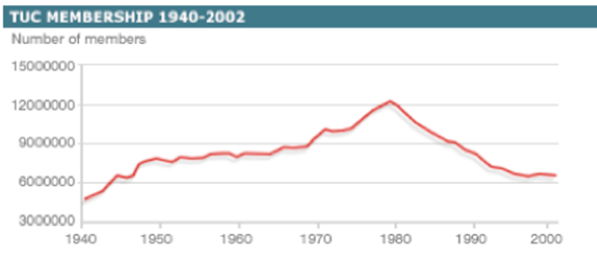
With the reducing numbers of union members their authority has also declined, limiting influence over safety management.
In other words, the modern world of work is effectively built up of cells, either multiple independent organisations working together, or semi-autonomous teams. The role the unions once played in tying these organisations together and enforcing a good H&S culture is weakening.
Robens realised in the mid 20th century that roles and responsibilities had drifted apart (between policy makers and policy doers). In the 70s this was to say that the government could not keep pace with industry, was not aware of the risks and therefore could not legislate in advance. So it has continued in the late 20th and into the 21st century, where the policy maker is largely the company management team and the policy doers are the operatives and Supervisors on site. Management design H&S Policy, but the workers are asked to interpret and implement it.
Whilst this new flexible management style is better able to cope with the demands of the modern world, Robens did not envisage it. He saw that rigidity and hierarchy could tightly control a safe system. Decision making imposed on front line supervisors undermine Robens’ central belief of who a worker is.
Over the past 30 years, the simplification process that was the other element of Robens’ plan has started to reverse. The flat structure of a single Act with supporting approved codes of practice (ACoP) and guidance is now more a labyrinth of regulation (Pomeroy, 2010, p. 3). It is widely believed that whilst law has got simpler how to comply with that law (due to the supporting regulations) has got increasingly complex (Cullen, 1996, p 9 and Vermico, 2009).
Part of this reversal is due to the influence of European legislation. Once enacted, a member state has no choice but to introduce an EU directive into domestic legislation. The Control of Asbestos Regulations (CAR) 2012 was introduced as a direct response to the Considered Opinion. The HSE were effectively informed that the risk based approach that they had taken when introducing CAR 2006 was not in keeping with the letter of the European Asbestos Worker Protection Directive (AWPD). Consequently they were instructed to change it.
In addition EU law is by tradition more prescriptive. In Lord Cullen’s speech to the Royal Academy of Engineering (1996), he says:
When one looks at the six pack of regulations it is clear that they are more prescriptive than the earlier regulations under the 1974 Act and certainly more prescriptive than Robens would have envisaged.
And
… their language seems to go too far down the road of telling the duty holder exactly what to do.
He gives an example taken from the Workplace (Health, Safety and Welfare) Regulations 1992 where approximately 80 words are used to specify the seating arrangements that are required on a site.
For many, many years the UK asbestos industry has used wetting techniques to damped down the material before removal – this prevents the fibres from being released into the air and therefore breathed in. This is so embedded now that we can not envisage a job done in any other way. However in Holland, fully compliant with the AWPD, they still remove asbestos dry and damp removal is a revelation. I believe this is a direct result of complying with prescriptive regulation rather than aiming for a goal – ZERO worker exposure.
The following figures were taken from the HSE’s European Comparison report (2011). Whilst accident rates have fallen, we can see the fatal accident rates remained largely flat in the 8 years following the introduction of the Six Pack.
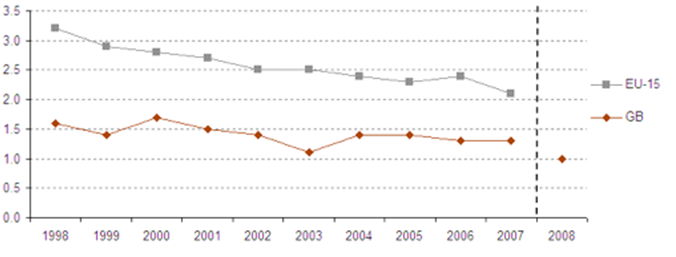
Standardised incidence rates (per 100 000 workers) of fatal injuries at work in GB and the EU, 1998-2007, and GB 2008 estimated incidence rate (Eurostat).
The Six Pack was introduced in 1999, which was immediately followed in the UK by a sharp rise in in the fatal accident rate. The Revitalising Health and Safety initiative was introduced by the HSE in 2000 to tackle the stagnation in the UK accident figures (HSE, 2000).
These statistics suggests that the increase in the prescriptive nature of the legislation was incompatible with the goal based regulation of the UK. Cullen suggest that the increase prescriptive nature of the European Union legislation is contrary to the systems generated by HSWA 1974 (Cullen, 1996, p. 6). The Revitalising Health and Safety strategy could be seen as extra support for the British companies, effectively as a patch to rectify the effects of the Six Pack.
The US has a similar proscriptive approach to H&S. In fact going further to pull the teeth of the regulator. The Voluntary Protection Programs (VPP) introduced in the mid 80’s. VPP is a process whereby companies can introduce certain controls and systems including a cooperative agreement between management and workers, an active occupational health and safety management plan and to pass an OSHA audit every three years. In return they are free from unannounced visits, effectively un-policed self-regulation.
James Pomeroy wrote in his SHP article International Safety Systems – Workin’ USA, (2010) that Mr. Michaels returned this damning assessment on the OSHA:
OSHA is constrained by both budget and legal authority. The ratio of workplaces to inspectors is more than twice what it was when the organisation was set up. Most OSHA standards are ancient and inadequate, and the organisation lacks the resources, or political clout to issue an adequate set of new ones. Many injuries and fatalities occur in the absence of violations of existing standards. Consequently, changes in the number and type of inspections are unlikely to have more than a minor impact on OSHA’s mission.
The US model, so far as they can be compared to the United Kingdom has produced starkly inferior accident figures. James Pomeroy (2010) compares the fatal and non fatal accident rates in the USA with the UK. In 2007 the US reported figures of 3.8 fatalities per 100,000 employees. This compares with 0.8 in the UK. In addition the non-fatal accidents were reported as six times greater. Indeed the fatality rate of 3.8 is worse than the figures reported by Poland and Bulgaria in 2008 (European Comparisons Report, 2011).
With so many similarities to the discredited Factories Act, taking lessons and elements from the US system is in effect drawing from the UK’s own past.
But – we can’t escape the fact that many of Robens’ assumptions have been weakened. The rigid hierarchical management structure and the strong influence of the unions has gone. The UK governments control over its own domestic H&S legislation is no longer absolute. Even the concept of who is a worker and who is management has changed. But the central core of the proposal, those that create the hazard are best placed to understand and control it, remains a powerful argument.
How therefore do we improve? Other than the US and EU model of prescriptive legislation, there is another alternative approach to the UK’s – the Canadian Resposibilization.
The Canadian Criminal Code states that individuals who undertake, or have authority, to direct how another person does work have a legal duty to prevent bodily harm to others (Gray, 2009, p. 327). This key shift in emphasis makes individual employees responsible for their own H&S.
Ontario has introduced a H&S ticketing regime (similar to parking tickets), these are directed in the main at workers and supervisors found not to be taking personal responsibility for their own H&S (Gray, 2009, p. 330).
The system has flaws and has been criticised as unfairly targeting the worker. The tickets available to the inspector are predominately aimed at the operative and the Supervisor (Gray, 2009, p. 331). However it quite clearly re-enforces the tenet that the employee has a responsibility to act safely and it is not just the management’s problem.
This, if used alongside the existing UK system of management, would adjust Robens proposal that safety was a function of management and only required the cooperation of employees. Employees wouldn’t just need to cooperate with employers, but help enforce good safety.
The main problem that Robens identified was that hazards were changing too rapidly for government to regulate. His solution was essentially simple; give the goal, create a safe place of work, to the individuals who understood the hazard the most, give them help to do this and police the system to ensure that it was done. He effectively predicted the shift in management theory, allowing decisions to be made closer to where they would have effect.
However he did not appreciate that the change that he was witnessing was only the beginning. Nor did he realise that his assumption that a supervisor was a worker and not management would be questioned.
In addition, Robens could not have predicted the influence European legislation would have on the future UK legislative framework. Whilst the law, is simpler at its core, compliance is increasingly complex. With the umbrella responsibilities of HASWA 1974 looming over companies, we get a system that is trying to be both goal based and complex.
To tackle the dramatically changed landscape, Robens needs to be strengthened at the same time as evolving.
Where regulation cannot be further simplified due to the influence of Europe, the regulators need to return to the collaborative and supportive vision Robens had originally. This will assist companies to comply with legislation.
The largest influence on H&S is management. However, the belief that an employee only has to cooperate is unhelpful. H&S management should recognise flatter company structures and supervisors as the first rung in management. This would involve taking lessons learned in Canada with the Responsibilization strategy and blending it with Robens. The ticketing system could be used to bring about a shift in the view that H&S is mainly the responsibility of senior management. Employees and especially frontline supervisors would recognise that if senior management create an unsafe environment, cooperating with this, is in effect condoning the procedure.
The flaws of the Canadian system, that it unfairly targets the worker, would be removed if the fines attached to the employee tickets were comparatively low and the fines attached to the employer ticket high. The existing system of enforcement notices available to the HSE would ensure that the focus remains on management.
The duties enshrined in the Health and Safety at Work Act 1974 should remain. These ensure that Robens’ core statement that H&S is principally a function of management continue to be our focus. The addition of the ticketing regime would expand the duty holders all the way through the organisation, ensuring the policy makers remain connected with the policy doers.
Find out how we can help you with asbestos waste management – call us on 0845 226 4318
Lord Cullen. (1996). The Development of Safety Legislation. Paper presented at the 1996 Royal Academy of Engineering and Royal Society of Edinburgh Lecture
Dalton, AJP. (1998). Safety, Health and Environmental Hazards at the Workplace. London: Cassell.
European Comparisons. (2011). Retrieved from the HSE website: www.hse.gov.uk/statistics/european/european-comparisons.pdf.
Gray, G.C. (2009). The responsibilization strategy of Health and Safety – Neo-liberalism and the reconfiguration of individual responsibility for risk. British Journal of Criminology, 49, 326–342.
HSE (2000). Revitalising Health and Safety Strategy Statement. London: Department of the Environment, Transport and the Regions.
Lowe, J. (1993). Manufacturing reform and the Changing Role of the Production Supervisor: The Case of the Automobile Industry. Journal of Management Studies, 30 (5), 739-758.
Pomeroy, J. (2010, March). International Safety Systems – Workin’ USA. Retrieved 13 March 2012.
Safety and Health at Work (1972a). Volume 1. Report of the Committee 1970–72. Chairman, Lord Robens. Cmnd. 5034. London: HMSO.
Vermico, P. (2009, July). Time to Act?. Retrieved 13 March 2012.
Written by Nick Garland on Tuesday June 16th 2015
First of all apologies for the title, it is intended to be a humorous one and I believe we can learn a lot from Europe. However, British H&S regulation has a not so secret weapon that gives it absolutely the right foundation and a huge advantage when it comes to the ‘league tables’.
So we must be doing something right.
At the recent European Asbestos Forum, Dr. Herm Zweerts of Arcadis presented a fascinating piece on the approaches to asbestos and the supporting legislation across Europe. His analysis showed that:
The control limits set for asbestos exposure across the continent varied dramatically.
The underlying regulatory controls also seemed to show differences in approach.
We in Britain should definitely learn from our European colleagues and in particular the areas of openness and transparency. France’s requirement for an asbestos survey to be conducted prior to any domestic property sale would in theory eliminate accidental asbestos exposure in the home. The fledgling NL mapping process that details known asbestos containing public buildings onto a cloud-based database with geographic map is also fascinating. In my experience it is often ignorance that leads to poor management of asbestos and ultimately exposure. Not knowing there is asbestos in the house, results in the artwork being positioned unwisely, or the ambitious removal of a wall leading to massive exposure. However, couple the French absolute requirement to survey domestic properties before they’re sold with the NL cloud database would give real transparency and the prospect for a roadmap to an asbestos free world.
Whilst we are still in this imperfect contaminated one though, ignorance remains our enemy. Asbestos is a scary subject, like the Plague or Anthrax just the word is often enough to strike terror. At best the world seems to know enough to be worried but not nearly enough to be considered knowledgeable. In this fertile ground of fear and ignorance, disreputable organisations can exploit us. I have heard of many projects large and small that are much much larger than the actual asbestos problem warranted. The German approach of independent experts may help this, but I believe we need to go further. Everyone that has any involvement in asbestos whether they are an asbestos operative, construction worker or property manager needs to understand asbestos better. Let me be clear – I am not attempting to minimise the problem, but calling for us, all of us to become educated clients.
Rigorous qualifications for the UK asbestos worker – like ACAD’s NVQ coupled with genuine competence and TNA assessments such as the ones that Assure360 can provide will transform the workforce into a professional one. Asbestos awareness courses for all (construction worker, tradesmen, teachers and even the general public) will give a level of knowledge that will dispel the fear. Those that commission asbestos removal projects or manage buildings should have advance courses in asbestos such as the UK’s P405 – shining a light on shady practice.
A central exposure database (like the Spanish one), could help fuel innovation. My Assure360 system centrally collates all exposure monitoring data in the cloud in an attempt to transform a duty of care task into this driver for innovation.
I started the piece asking ‘why are the Brits best at H&S?’, this was meant to be humorous, but there is a single reason for our practical regulation and my lack of concern over our high asbestos control limit. This is the foundation to all UK H&S regulation – The Health and Safety at Work Act (HASAWA). HASAWA came into force in 1974, is over 50 years old, and will in all likelihood be with us for at least another 50 – a near perfect piece of legislation. The authors understood that regulators do not have any hope of keeping pace with innovation. They will never be able to understand evolving industries sufficiently to implement adequate safety rules. So with a stroke of genius, they turned the whole framework on its head. The basic principles are:
The last phase is crucial – do what you can to eliminate or mitigate the risk. If we believe you could have done more, you WILL be prosecuted. Later guidance and regulation helps the employer in this task, but it remains their responsibility to assess the risk and eliminate it. The regulator no longer has to keep pace – all they have to do is make a qualitative judgement – “has the employer done enough?”.
The employer must constantly innovate to minimise the affect of his activities. This is the driver to the practical rules that Herm identified. The (embarrassingly high) figure set by the UK government for exposure is in reality a nominal one. As (due to HASAWA), the employer must reduce exposure as far as they can. The reality of UK asbestos worker exposure is somewhere between the French and German levels.
If legislation can be beautiful then HASAWA in its simplicity is just that.
The US legislative framework is very prescriptive, as is much of Europe. In essence if you can tick the requirements laid out for you, you’re in the clear. A graphic (and hopefully extreme) example of why this is a very poor approach is this:
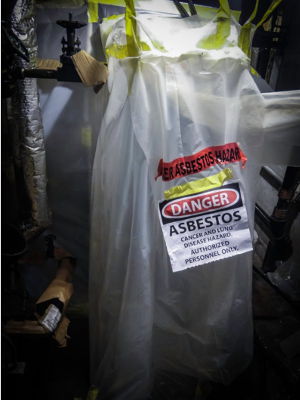
Photograph kindly provided by Tony Rich of Asbestology LLC (in the USA)
It may take you a little while to work it out, but this is apparently a ‘technically compliant’ airlock in the US. It has three stages, separated by flaps. Ticks the boxes laid down in regs, but I’m sure you would agree – wholly inadequate. If the US had a Risk Assessment based approach like HASAWA, rather than a prescriptive one, an enforcer would be able to take one look and start building his / her prosecution.
It is because of HASAWA that we are very unlikely to see a Gulf of Mexico oil disaster in the North Sea. BP and it’s US subcontractors followed all of the rules, squeezing protocols and procedures until the relevant boxes could be ticked – with tragic and catastrophic results. In the North Sea, with a different approach, it would have been obvious that they could go a lot further than they did.
The one big weakness in the UK is that HASAWA is the Health and Safety at WORK Act, and therefore has no bearing on domestic situations. This is where I believe we can lean from France and NL, eliminating ignorance and fear.
Therefore my call is this one – the UK legislators should learn from the best in Europe. A good start to this would be by engaging in the European Asbestos Forum and in particular contribute to the 2016 conference. Secondly the world should recognise the fundamental flaw in trying to keep up with industry and lay the responsibility where it should be – with those that create the risk.
Find out how Assure360 can help you with asbestos health and safety compliance – call us today on 0845 226 4318
Written by Nick Garland on Thursday July 17th 2014
Here at Assure Risk Management, we pride ourselves on being able to provide you with a number of differing services, all of which encompass health and safety, or the dangers of asbestos. We offer professional Health and Safety advice to the asbestos and construction industry.
We specialise in audit and competence schemes, outsourced health and safety management, legal expert witness services and asbestos consultancy and training.
Our risk analysis based approach to providing audits combined with the wealth of experience we have gathered over the years allows us to bring a unique holistic edge to our health and safety management schemes.
Having been in this industry for over 20 years, we are also extremely proud of the reputation we have gained from continually satisfying our customers and clients, whilst always hitting high standards with the quality of our work. This ensures you can be assured of not only expertise but a sound practical approach.
We do offer some services that may come in useful for you in your workplace setting, which we will inform you of here.
With changes to the licensed asbestos training environment, the asbestos industry will have to understand its workforce in much more detail. Our Health and Safety Management system gives you the correct understanding of the Asbestos Removal Competence Scheme.
A powerful online database, married with our Audit Scheme, allows the most comprehensive analysis of the asbestos removal process available. Uniquely, the system allows you direct access to the data and all of the reports.
We also have an iPad application that allows you to compete internal audits independently, which means you don’t need to rely on any external consultants. However, it does allow you to use third party auditors to expand your coverage. This synchronisation of both internal and external audits allows for a larger data set, and therefore more accurate data analysis.
Our ability to provide both generalist health and safety expertise and detailed forensic understanding of the asbestos hazard gives all of our clients the assurance they need.
We provide specialised expert advice in support of licensed contractors either applying for their first HSE licence or at the time of renewal.
We can also provide the following services – amongst others – to many licensed asbestos removal clients, aiding them to build a streamlined, well managed company:
And these three are just examples of what we can do, there are other areas we get involved in.
Here at Assure Risk Management we understand that training is not just presenting facts to a group of delegates; asbestos awareness training is about saving not only the lives of the staff you are responsible for but also safeguarding their families. It also ensures work stoppages are kept to a bare minimum allowing you to meet your deadlines
Our training is tailored to each client, offering operative and management focused courses to ensure you have asbestos competence. We also provide duty to manage bolt-ons for managers with a responsibility for buildings.
Our final bespoke training service is the provision of high quality e-learning packages for larger clients. These interactive presenter led courses incorporate broadcast quality filming and innovative techniques to deliver the most effective e-learning experience.
If you have any questions or would like to find out more about how we can help you, call us on 0845 226 4318 or email us [email protected]