
Written by Nick Garland on Tuesday February 23rd 2021
DMD Environmental is an asbestos specialist with offices in the East Midlands and East of England. Offering asbestos surveys, management, and removal, the company works with customers ranging from major government bodies and housing organisations, to individual homeowners.
Like many licensed asbestos removal contractors, DMD Environmental has found that the successful expansion of its business has come with a large administrative burden. Mandatory record keeping, and the need to analyse and act on the data it collects, represents a major undertaking for a business running multiple projects and sites at any one time.
DMD Environmental had previously tried to address this, implementing a digital form-based system to capture site data. Unfortunately the system was only a partial success, with staff finding it complex and hard to use. Moreover, the company was still heavily reliant on paperwork, and committing many hours of manpower to labour-intensive processing and analysis.
As the company continued to prosper, it faced a growing need to streamline its existing processes. Additionally, it recognised that modernising its data collection and analysis had the potential to improve the way it could manage projects and staff. In January 2021 it hired group coordinator Kriston Fox, and tasked him with finding solutions.
Fox quickly understood that the existing system didn’t meet DMD Environmental’s needs and, after fruitlessly contacting the vendor, began looking at alternatives. With an entrepreneurial background in IT and customer-facing roles, Fox sought out a data capture and analysis solution that would support a modernised, paper-free approach to site management. Within a month, the business had implemented an Android tablet-based solution powered by Assure360.
Fox understood the full potential of moving DMD Environmental to cloud-based technology. By adopting Assure360 Paperless and Assure360 Audit, the business was able to free its supervisors from the burden of paperwork. Just as importantly, with data flowing back from sites in near real time, managers gained a more detailed view of their projects, letting them offer more proactive and timely support.
The rollout of Assure360 presented an opportunity to reinvent the way that DMD Environmental managed its sites. Fox equipped the tablets with Zoom and Microsoft Teams, creating a tool that connected managers with their project teams. With easy communication, instant data capture and paper-free site management, the business cut down the need for site visits, and removed common friction points from its asbestos removal workflows.
Importantly, the solution has been embraced by the same staff who had a poor experience with the earlier system. During training, supervisors were astonished that they could fill in job details in Assure360 Paperless, and seconds later see the data arrive in the cloud-based Assure360 dashboard. Instead of having to carry large ring binders of paperwork around, site teams and their information are now linked to the wider business via a single, wipe-clean tablet.
DMD Environmental’s experience shows that it’s possible to rapidly improve and modernise paper-bound asbestos removal processes – even when they are longstanding.
Assure360’s experience and support also played a key part in getting DMD Environmental up and running quickly. From video-based demonstrations during pre-sales, to extensive support and training materials during rollout, the Assure360 team was on hand to ensure a friction-free experience. It also worked with Fox to ensure that the business could realise the full benefits of the platform, and get the maximum return on its investment.
“Our business had a lot of paper – the industry itself is very traditional, and can be quite tech-averse. At the same time, the people who work on site have an exceptional level of knowledge and understanding. Our goal was to try and get the two to merge together – supporting our workers’ expertise with technology that would help them apply it.
I took a look at the previous system and understood the feedback the staff had given me on it: ‘I tried it but it doesn’t work. It’s too complex. It’s not user friendly’. I realised I wouldn’t want to use it. I knew we needed something better, and having spoken to Rick and Chris [Garland], we landed on Assure360.
People in the office can’t go and strip asbestos out of a building – they wouldn’t have a clue. But you need to provide the information from the site in the way that people in the office – and the Health and Safety Executive – want it. That’s what Assure360 does. The more you use it, the more info it collates, the more detailed your reports become – it’s pretty mega.
Having Assure360, the hard work’s already done. As soon as we’re inputting the info on site, our contract manager or auditor can go out and audit again using Assure360. This constantly gives us a live picture of where we stand.
Being able to have instant, live connectivity is a game-changer for this industry. And anyone that’s in this industry that doesn’t realise that will fast become outdated, and they will struggle – look at what’s happened in retail. Now I can instantly see how things are going on our sites. Our MD or contracts manager can come in and ask me ‘What’s going on on that job?’ and I hit a button and there it is – with pictures and everything.
And if we get a problem, we can crack on Teams and sort it out. Rather than the supervisor having to call in, and the contract manager having to go out to site – which could be 100 miles away. That saves them two or more hours of driving, and the manager thinking ‘What are the problems going to be?’, and having to work out ‘If we need a new bit of equipment, where are we going to get it from? If we need a new member of staff, where are we going to get them from?’
If we know straight away, we can deal with that issue straight away.
I think it helps that when I send Assure360 an email I get a response, whereas with our previous vendor I didn’t get a response until I terminated our contract. What I found in Assure360 was a provider who was open to new ideas, wasn’t holier than thou, and was credible. They know what they’re talking about.”
Written by Nick Garland on Wednesday February 10th 2021
The Covid pandemic is virtually unprecedented in living memory. And aside from the awful human cost, its impact on the economy will be felt for many years to come. As a health and safety consultant, I’m also fascinated by the challenges it has created around workplace safety, and the effect on employers, employees and the regulator as we all try to stay safe.
And what of the regulator? The Health and Safety Executive (HSE) has been under enormous budgetary pressure for many years. And over the long months of the pandemic, I’ve become increasingly concerned that its lack of resources is hampering its ability to enforce Covid-safe working conditions.
Let’s begin by looking at how the HSE’s budgetary challenges were already impacting its operations before Covid. Looking at the data from the 2017-18 and 2019-20 annual reports, we can see the following:
| HSE Annual Report
2017 / 2018 |
HSE Annual Report
2019/2020 |
|
| Proactive inspection visits | 20,000 | 13,300 |
| Prosecutions | Not reported | 355 |
| INs | Not reported | 5,000 |
| PNs | Not reported | 1,900 |
| Asbestos visits | 1,000 | 900 |
| Inspectors | 1,058 | 1,059 |
| Prosecutions | 509 | 355 |
| Construction fatalities | 30 | 40 |
While the number of inspectors didn’t drop between reports, site visits did very markedly. Even the HSE’s attendance on asbestos sites fell by 10%. In the same period, prosecutions were down by 30%, and construction fatalities climbed by a third.
The tail end of this reporting period also saw the emergence and spread of Covid-19. The HSE recently told the Guardian that it had made 32,000 site visits during the pandemic. Meanwhile, the HSE’s Coronavirus management information dashboard provides this monthly breakdown of covid case notifications throughout 2020-21:
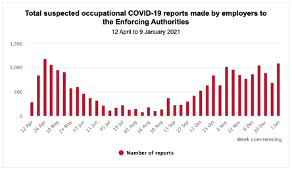
If these figures are accurate, they represent a massive surge in activity for an already overstretched body. Despite the recent trend of falling attendance on site and a reduction in prosecutions, there has now been a huge increase in numbers of unannounced visits. But is it having the desired effect?
Nationally we have seen very worrying increases in the infection rate during the most recent wave of the pandemic, and data from PHE suggests that some of this is coming from workplaces.
The latest Public Health England surveillance data suggests workplace infections surged as people returned to work in January. The number of coronavirus outbreaks in workplaces rose by almost 70% in the first week of the national lockdown, with 175 Covid case clusters reported in English workplaces
The Guardian 16th January 2021
Before continuing, I wanted to provide a short reminder of the levers that the HSE has available when it comes to enforcement. As a starting point, it can issue verbal and written instruction or guidance, which can be as simple as a chat or email from the inspector.
Certainly within the licensed asbestos removal industry, these basic measures have some real weight. If you don’t act effectively on instruction or guidance there can be dire consequences during licence renewal. However, in other less heavily regulated industries I’m not sure whether they provide quite the same imperative to act.
The HSE’s next level of action is quite a big step up. Improvement Notices (IN) give detailed instructions on what improvements you need to make, and by when. They can be appealed, but unless that’s successful you will need to act.
Next come Prohibition Notices (PN), which are very severe – and often also lead to prosecution. A PN essentially stops a certain activity immediately. Again, you can appeal, but the stoppage still kicks in with immediate effect. PNs can be wide-ranging and major: they can shut down an entire construction site or factory.
So, has the surge in HSE visits to companies translated into more of these enforcement actions? Recent news articles would suggest not. According to a January 2021 analysis by the Observer, the HSE had been contacted nearly 97,000 times on Covid-related workplace safety issues – including 2,945 times between 6 and 14 January alone. The newspaper found that overall, just 0.1% of these Covid safety cases received an IN or PN. A simple calculation suggests that’s roughly 97 Covid-related enforcements throughout the pandemic.
A January BBC News article quoted slightly higher figures for complaints during the same 6-14 January period, and suggested significantly higher levels of enforcement. In that week, it says the HSE received 3,934 coronavirus-related complaints, and took action in 81 cases. However, it notes that only one company faced more than a verbal or written warning.
A brief look at the enforcement action register suggests that the number of enforcement notices might even be lower than these headline figures. I found eight PNs where the only reason COVID was mentioned was as a justification as to why another misdemeanor was hard to close out. A similar investigation into the INs might show up similar cases.
Further analysis shows another interesting trend – Covid-related enforcements seem to centre on companies in the construction sector. Of the nine remaining PNs I found, five went to just two companies. Of the six companies found at fault, all but one were in the construction sector – and the inspectors’ comments seem to focus on washing facilities.
This seems out of step with reality when, as the BBC notes, the 500 confirmed or suspected office outbreaks in the second half of 2020 were more than those centered on supermarkets, construction sites, warehouses, restaurants and cafes combined. So why were no PNs issued here?
As others have noted, while workplace safety enforcement in the UK as a whole relies on the Health and Safety at Work Act (HASAWA), Scotland has legally obligated employers to ensure their employees can work from home wherever possible. But is this the most sensible health and safety advice?
HASAWA should give ample powers to the regulators. Since 1974, employers must assess the risks at work and reduce them so far as reasonably practicable. And if they don’t there is the big stick of enforcement action and prosecution. Many of the examples given in the articles above appear to be pretty flagrant breaches.
However, home working or furloughing staff might add financial burdens that are the final straw for a company’s survival. And therein lies the balancing act for an employer. I can imagine situations where, in the face of practical and financial challenges from sending people home, a diligent employer is instead able to make the workplace covid secure. The flexibility of HASAWA allows this to happen. If home working was an employee’s right, imaginative and effective solutions might not exist, and some companies may not survive.
Obviously, where it’s reasonably practicable, the goal should be to eliminate the risk. In the case of Covid-19:
Elimination may be impossible, or very burdensome, whereas mitigation may bring the risk down to a low enough level for people to remain in the workplace.
Despite this, in many cases cited by journalists it looks like little or no effort has been made. Interviewees speak of working side by side in warehouses, or conducting telephone sales and administration in a very small or poorly ventilated office.
The law is simple: if a company has not done enough to mitigate or eliminate a risk, then they are liable for serious punishment. But only if they get caught. With 33,000 visits, it’s clear that the HSE is making serious efforts to enforce safety during Covid. But with only approximately 80 INs and nine PNs, the evidence suggests that its approach to enforcement might be very light-touch.
An example contained in a second BBC article hints at where we might be going wrong on workplace Covid safety. A member of the public alleges that he works among 30 people on one floor of his employer’s office, that the windows are always closed, and – unbelievably – that they still hot-desk. With five or six covid cases apparently linked to the firm, it seems a clear example of a company not doing enough, or at least taking actions that are demonstrably not working.
The firm states in its defence: “We have worked closely with Public Health England since the start of the pandemic to implement extensive safety measures in line with government advice.”
And for me, that’s the heart of the issue.
During the pandemic, companies are looking to the guidance and – in far too many cases – scratching their heads on how they follow it and still make a profit. What they’re not doing is following the principle on which the HASAWA is built: looking at their underlying duties, and ensuring they take effective and specific actions to deliver a safe workplace.
An employer is compelled by law to ensure that its place of work is as safe as possible. The government also provides helpful advice (guidance) on how employers can fulfill this legal duty. How you go about making your workplace safe is, to some extent, up to you. You can follow the guidance, or craft something else – but the immutable fact remains that your legal duty is to make it safe.
My fear is that the HSE’s approach may be permitting a culture in which companies can point to generic guidance, in place of implementing specific measures that keep their employees most safe in their specific workplace. The HASAWA is beautifully crafted to get the extra mile out of employers – but if there is no enforcement, then an important pillar is missing, and the whole church is at risk of falling down.
Written by Nick Garland on Wednesday January 13th 2021
For Assure360, our Audit app has a special significance. Originally launched back in 2014, Assure360 Audit is at the heart of our streamlined and paperless health and safety auditing system. In 2017 we gave it a major refresh, adding more functions and a fresher look. As we pass 10,000 audits, I’m excited to announce that we’re hard at work on version 3.0.
The latest version is going to be brilliant, but before I tease you with the improvements, I thought I’d recap a little on the history of the app, and how it’s tied into our own. The Assure360 system is the result of my nearly 30 years spent working as a health and safety professional, specialising in the asbestos industry. One of our most important product features is that we offer our customers the benefits of everything I’ve learned in my ‘day job’.
The genesis of Assure360 came when I was working as an embedded health and safety manager for several licensed asbestos removal contractors (LARCs). I was designing audit schemes, completing training needs analysis and competence systems, and undertaking the analysis of exposure results… again and again.
I’d created a series of interconnected Excel spreadsheets to help me complete the work, but there was still plenty of manual work involved. It was repetitive, time-consuming – and prone to error.
In the space of a couple of months I met an app developer and a database company, and had a bit of a lightbulb moment. I realised that I needed an app to record the data quickly, and a database to do the tedious legwork in the background. Most pertinently, I realised that if I needed it, so would other professionals in our industry, and that’s how Assure360 and the Audit app came about.
From the start, the app accomplished most of what I set out to achieve, but our ethos has always been to work with our community to continually make things better. After three years of using the app myself and gathering feedback from our early customers, we updated it to version 2.0 – essentially the version you’re using today.
Version 2.0 had some big improvements over the original. It was better to look at, and added some powerful new functionality. Most importantly we added the ability to craft bespoke audit question sets, giving the app immense appeal to non-asbestos construction firms and specialists like demolition teams. It’s a testament to Audit’s appeal, usability and usefulness that it’s rated 4.5 out of 5 on the App Store.
“I just find it so, so easy to use, so simple. It doesn’t take up half the time of my own audit system – where I’m uploading photos, copying and pasting information. It’s none of that, it’s quick. It’s a great app really.”
Chris Pedley, CP Safety
Roll forward another three years or so, and we’re delighted to be working on another major upgrade. Just like with version 2.0, changes for version 3.0 will be the result of our continued experience using the app. And I mean ‘our’. I still use Audit daily in my ongoing work in health and safety, but the whole Assure360 team is tuned in to the feedback and suggestions we get from the ever-expanding Assure360 community.
So what’s new in version 3.0? As with our recent updates to the Assure360 Paperless and Incident apps, one of the biggest new features will be Android compatibility. With the release of Audit version 3.0, the entire Assure360 suite will be available for Android devices for the first time. This lowers the barriers to entry for our system, as Android devices tend to be a fair bit cheaper than those from Apple. Just as importantly it gives our customers more choice and flexibility, for example letting them run Assure apps on rugged tablets in the harshest environments.
Other improvements will include the ability to log multiple photos with an item, and the instant upload of audit findings – helping ensure teams are working with the very latest data.
We’re also excited to be adding new self-help tools that will let users craft their own bespoke audits. Much like when we introduced bespoke question sets, this allows auditors and other users to tailor the app and our system to the exact work they’re doing. The goal is to streamline the process further, and remove any obstacles and manual workarounds that could introduce errors.
“My clients aren’t just getting a box-ticking exercise, they’re benefitting from my expertise and feedback, and the software’s ability to help produce actionable information.”
Chris Pedley, CP Safety
We’re working on lots of other improvements alongside those main revisions, but like everything we do, the upgrades are a community approach. If you’ve got a feature to suggest, an issue to flag up, or any other idea for making version 3.0 as good as possible, please do drop us a line.
Want to discover more about the refreshed and improved Assure360 apps? Read more about our health and safety and asbestos management apps
Written by Nick Garland on Thursday December 10th 2020
Who would have thought that a virtual conference could keep you glued to your seat? If I’m honest, not me. Times are busy for us at Assure360, and so when I looked at the programme for the BOHS/FAAM conference there were a few slots where I thought “I might be able to miss that.” More fool me – the two days were absolutely riveting.
So here’s my attempt to sum up a few of the highlights from the conference. I haven’t included all the sessions, but if you’re a FAAM member I think the plan is for you to be able to log in and browse them all.
The control limit
The conference got underway with a history lesson, but one that really set up so much else for the two days. The Health and Safety Executive (HSE)’s Sam Lord took us on an interesting journey through how we arrived at the current asbestos control limit. She even explained the logic behind the name, and the important shift in thinking that it represented: that is, that there is no ‘safe’ limit.
Sam went on to give us an update on the HSE’s new Analysts’ Guide, which does finally seem to be nearing release next year. The guidance will contain two changes to the air testing criteria which I think are brilliant.
The first is that the UK will come in line with the World Health Organisation (WHO) method for sampling against the control limit. The four-hour time weighted average (4hr TWA) test has always been very challenging – not least because many tasks (when you take off breaks and decontamination) are not four hours long. But whilst they are difficult, these are legally mandatory duty-of-care tests.
The new guidance introduces important flexibility in the pump flow rate:
| Application | Sampling rate (l/min) | Min air volume 25mm ⌀ filter (litres) | Minimum number of graticule areas to be examined | Calculated airborne concentration at the LOQ |
| 4-hour control limit | 1-2* | 240 | 100 | 0.04 |
| 10-minute short-term exposure limit | 4 | 40 | 100 | 0.24 |
| Specific short-duration activities | 4 | 120 | 100 | 0.08 |
| Assessment of suitability of RPE | >0.2-4 | 40 | 100 | 0.24 |
* Note the change from 1 to ‘1-2’. This allows for higher volume tests in a shorter period.
** Brand new test – see below
Sam’s talk linked nicely with a presentation by Dan Barrowcliffe on the second day, about personal monitoring. I was able to catch up with Dan after the conference for some more thrilling personal monitoring chat (I appreciate perhaps not everyone shares my enthusiasm).
He and I discussed how the minimum volume column is important. For a 4hr TWA test this volume is 240 litres, which means you need to run the pump for between two and four hours. If you’re running it for two hours, where do the other two hours of a 4hr TWA come from?
If you have good enough data, based on accurate personal monitoring, you can interpolate them from your anticipated values. This opens up exciting potential for Assure360 users, as with 18,000+ personals already in the system we can potentially convert an awful lot more tests into the difficult-to-achieve standard. Watch this space – we will have a new report to do just this in the new year.
Short-duration activities
The other crucial change to the guidance – and something I’ve been calling for for years – is the new ‘Specific short-duration activities’ test. This is essentially what a well run, competent LARC does all of the time: test the peak high fibre release activities to measure the effectiveness of their methods.
Now that it is in the guide, analysts will know what parameters to test against, finally allowing LARCs to do their job properly. I personally would like a little more flexibility (a flow rate of 2-4, rather than 4), but now I’m being picky.
At the end of day one, Dan did an updated review of his four-stage clearance (4SC) project (see my summary of the preliminary findings here), and how it has influenced the new analyst guide. The project showed some encouraging improvements in analyst behaviour and performance on site. One of the main points however, is the application of a hard limit of 10 minutes on how much cleaning can be done within the 4SC. Equally importantly, this shouldn’t be done by the analyst at all. This change should bring an end to nightmare jobs where a hoard of operatives are trying to clean in the enclosure during the inspection itself.
The day of the trial
Day two started with an innovative mock trial, which moved from fascinating to excruciating as we watched the full horror unfold. The ‘case’ examined what could happen when an organisation that thinks it’s on top of asbestos policy discovers the hard way that it hasn’t been. The actors were all asbestos professionals – and somehow were able to tone down their knowledge levels to stay in character. I still don’t know how they did it, but it was absolutely enthralling.
The afternoon focused on asbestos technology. I found it all very interesting, particularly when learning about Hysurv’s use of drones to conduct visual surveys of buildings. I was lining up plenty of ‘well, it won’t work because…’ and ‘all very well, but what about…’ comments, only to find them comprehensively eliminated by their capabilities. One highlight was watching a drone fly through a tangled ceiling void!
The ability to survey a roof in vivid detail, showing the precise location and accurate measurements of presumed asbestos materials, was incredible. The equipment also seemed well capable of surveying confined and restricted-access spaces – potentially improving safety and raising surveying standards in the most challenging jobs.
So, far from skipping sessions I found myself largely glued to my screen for the full two-day programme. If virtual conferences are the shape of things to come – and it looks like they might be for a few months yet – then consider me an enthusiastic convert.
Written by Nick Garland on Thursday December 10th 2020
Let’s be honest, nobody’s going to look back fondly on 2020. The arrival of Covid 19 and the ongoing pandemic has ruined plans, destroyed businesses – and sadly cost far too many lives. But while it’s been a challenging and sobering year, new vaccines promise better times ahead. And many of the changes forced on businesses will be the basis for better trading as we turn the corner.
The year everything changed
You can’t look back on 2020 without discussing Covid 19. Mushrooming from a small outbreak centered in Wuhan, China, to a global pandemic in just three months, the virus has left few aspects of our lives untouched. From the outset, the lockdowns necessary to control the disease’s spread created social, financial and emotional scars that may take years to heal.
For many businesses, it was quickly clear that the pandemic represented an existential challenge. We in the construction and asbestos-removal sectors have been luckier than some, with much of our work allowed for most of the year, but still these have been difficult times.
So far, so obvious, but for the rest of this post I want to focus as much as possible on the positives from this year – the new tools and solutions that have helped us carry on at the pandemic’s peak, and which will continue to make business better as we emerge.
A lucky break with tradition
In April we marked a year since the Health and Safety Executive (HSE)’s introduction of the new digital service for asbestos-removal licensing. Fraught with challenges – and, for a short time, horror stories – the long overdue overhaul had a difficult few months, but in retrospect it got here just in time.
By the time the pandemic hit, the HSE had ironed most of the creases out of its new system. The industry, too, had a better understanding of what the HSE expected – helped in part by innovations such as Assure360’s custom licensing module.
As inspectors were grounded under lockdown conditions, the move to digital assessments began to seem uncannily well-timed. Asbestos-removal contractors could renew their licenses and continue working, where otherwise they might have been dependent on inspector visits that couldn’t happen.
A new way to work
If 2020 is remembered for anything other than Covid, it will be as the year that accelerated digital transformation. Global businesses were already on the path, digitising existing processes and inventing new ways to work, but few smaller firms had been caught up in the wave. Covid changed that at a stroke – forcing even the smallest firms to embrace Zoom, cloud-working, and countless other digital tools.
For the asbestos removal industry, it’s a big change. We’ve been around for a while, and our highly regulated industry previously depended on meticulous paperwork. Assure360 has been selling the technology to change that for some years, but 2020 has seen a dramatic growth in interest, as more firms sought out ways to support socially-distanced working.
This is particularly true for Assure360 Paperless. Our digital supervisor support tool removes the site paperwork from asbestos projects. In itself, this cuts the amount of materials being passed around between workers, but during the pandemic another benefit grew in significance.
By automatically synchronising site data with our cloud-based system, Assure360 presents managers with reports and analysis based on the freshest data from the project. Many users have relied on this to reduce their visits to site, confident that Assure360 is providing the insight they need to manage jobs remotely.
Zoom spreads
As the year drew on, people began to use these new digital tools more extensively. In the asbestos industry, briefings and supervisor meetings started to happen over Zoom. In the wider world, recruitment and induction was increasingly carried out remotely – some people are still working from home in new jobs where they’re yet to meet their colleagues!
And as it became obvious that the usual round of conferences and seminars wouldn’t happen, organisations began to think about how they could deliver essential events virtually. ACAD switched its regional meetings to a virtual platform, for example, while we provided a webinar on Covid-safe working.
While the biggest events like the Hazardous Materials Expo have had to be cancelled altogether, academic conferences like BOHS and FAAM were able to go ahead online – to great effect.
As businesses, event and training providers all get greater experience with digital tools, it’s likely we’ll all continue to do things in new ways as the pandemic begins to recede. For example, several of our Paperless customers are planning to continue remote management, with fewer site visits. As Phil Neville of Asbestech pointed out, aside from helping greatly through the pandemic, our paperless technology has helped him reduce vehicle mileage in line with the firm’s ISO 14001 undertakings.
For events, digital access could help more delegates ‘attend’ even far-flung conferences. Next year’s iMig2021 – originally due to be held in Brisbane this year, then postponed to next March – will now take place virtually in May. While it’s a shame for people who would have made it to Australia, the pivot to a virtual setting means that far more people can now take part.
For many, 2020 has been a miserable year, and it may be a few months yet before things get better. 2021 begins with the end of the Brexit transition period and whatever fallout that brings, and it may be some months before the vaccination programme really bears fruit.
In the meantime, paperless and remote technology continues to help us navigate the pandemic, and promises to improve efficiency and create new possibilities in the future. After a difficult year, that’s a welcome source of hope as we go into 2021.
Written by Nick Garland on Wednesday November 11th 2020
If it wasn’t clear already, the arrival of second lockdowns in England, Wales, and several European countries confirm that this crisis will be here a while longer yet. Despite promising news from various vaccine trials – most notably the Pfizer/BioNTech candidate – mass vaccination programmes seem unlikely before Q2 next year. In the meantime the world needs to do its best to control the virus without disastrous damage to the economy.
What the UK government is trying to achieve with the second English lockdown is almost insanely difficult. The public needs to be fearful enough of the disease that it takes control measures seriously, optimistic enough that it can see light at the end of the tunnel, and yet still go out to work so that the economy does not grind to another halt. This despite a cycle of lockdown and release that’s likely to continue until late spring next year.
Processing what we need to do to come out the other side is going to be crucial. Construction and manufacturing have been targeted as protected parts of the economy, and the messaging is clear: keep safe, but keep going.
I’ve already written a couple of articles focusing on how to tackle the challenging working environment that Covid presents. Here I’m going to briefly revisit this and look at the latest advice. But it’s also important we acknowledge that changes such as increased remote working are going to be here to stay. I want to look at why embracing them, and making them part of a future strategy, is important to business success post-Covid.
For all contractors, the first place to start is with the most recent version of the Construction Leadership Council (CLC)’s safe operating procedures (SOPs). At the time of writing these were up to version six, dated 20 October.
The SOPs have an excellent section structured according to the hierarchy of control, which succeeds in being both detailed and clear. However, the key points from this version are:
The challenges that these guidelines present will of course vary depending on the site. Space is crucial. In smaller, enclosed sites with limited access, maintaining a safe separation is likely to prove challenging. On large sites with big workforces, there may need to be staggered start/finish times – and careful management of queues entering the site or core facilities like the canteen.
Other issues will tax everyone – for example, the difficulty of simply getting staff to the site in shared vehicles. The government’s guidance remains much the same: increased washing and cleaning, barriers, bubbled teams and short journey times. However there’s a key difference in lockdown two: public transport isn’t yet being reserved for key workers. If you must use it, cover your face.
When it comes to face coverings, we’ve certainly moved on from when I last wrote. At that time, Royal Society president Venki Ramakrishnan was calling for face coverings to be part of standard procedures. Now the CLC agrees – up to a point. While the SOP clearly states that we should not be recommending additional PPE due to Covid, it does specify face coverings in certain confined situations.
My view – and it is certainly something I have practiced since April – is that we should be wearing face coverings when we can’t guarantee social distancing. On busier sites, and particularly indoor projects, that has been most of the time.
What hasn’t been discussed much is the problem of wearing face coverings with glasses, whether that is readers, safety, or – as in my case – both. Anyone who has the problem of fogging is balancing the risks of impaired vision against the protection of their fellow workers. For what it’s worth, the only face masks I have found that fit close enough to reduce fogging are the ones with the metal strip on the bridge of the nose.
Whatever face covering you wear, you should absolutely avoid dust masks with a valve. Remember that we’re wearing face coverings not to protect ourselves, but to disrupt our breath out – and therefore protect others. Valved masks keep glasses clear because they let our breath escape unimpeded. For similar reasons, face shields offer little other than immediate protection if someone coughs on us.
The most difficult, draconian measures will be gone with the pandemic. But I wanted to stress the importance of stepping back and looking at positive changes that will continue to reap benefits beyond it. Companies who have been forced to find ways to reduce site traffic and enable remote working are finding new efficiencies that will support a stronger recovery when the pandemic is over.
Let’s not kid ourselves – there’s no substitute for boots on the ground when it comes to construction work – but the technologies businesses put in place now will have a longer-term benefit than ‘just’ minimising the risks from Covid.
We know that remote workplace technologies reduce the risk to managers and supervisors, and lower the chances that they spread the virus to or from their colleagues. Yet at the same time they introduce new and lasting efficiencies. Video calls reduce the need to travel, saving on expenses and letting managers use their time more effectively. Video briefings and inductions help reduce face-to-face contact, but they can also be more flexible and convenient. We all recognise the difficulties caused by having to shut projects down for an afternoon just to get the whole team together, now this can just be an hour at the end of the shift where everyone logs in to a call.
We see the same benefits from removing the paperwork involved in asbestos management and health and safety auditing. During Covid, the Assure360 Paperless app has helped customers reduce the amount of paperwork and other material going on and off site, and improved visibility for managers as they seek to maintain quality while minimising site visits. In the words of GreenAir Environmental director Graham Patterson: “If it wasn’t for Assure360 I think we’d have a major issue with having paper method statements, everybody touching it, and the virus sitting on that surface which you can’t wipe down.”
However, the benefits to streamlining critical safety checks predate the pandemic, and will continue after it’s gone. Customers who have adopted Paperless and other Assure360 solutions as a way to improve their ability to manage jobs in a socially-distanced environment have already discovered the big efficiency improvements we can deliver in normal times. “The Assure360 system has streamlined the company massively,” adds Graham Patterson. “And if we were to go back to the old paper systems I think we would struggle.”
The second wave of lockdowns remind us that we’re not done with Covid yet. We’re continuing to improve our products to provide essential support now, and more worthwhile benefits in the long term. After redesigning Paperless to make it even easier to use and even more of a time-saver, we’re working on an update to Assure360 Incident – our accident and near-miss reporting app.
The same principles apply as with all Assure360 products: an effortless user interface, letting even non-technical users improve and streamline essential health and safety record keeping. And with this update, Incident will also become the second Assure360 app to gain Android support, reducing the cost of entry to the Assure360 system.
Now more than ever it’s imperative to cut paperwork and supervision overheads, while simultaneously ensuring greater compliance. And when things are better, the efficiencies your business discovers today will continue to deliver benefits and competitive advantages as the economy recovers. I think we should all see this as evidence that the light at the end of the tunnel is actually a brighter future.
Written by Nick Garland on Wednesday November 11th 2020
With Covid still here and big events like the Hazardous Materials Expo already postponed – again – this year’s conference season promises to be very different. Happily, some events are still going ahead, albeit virtually.
On 18-19 November the British Occupational Hygiene Society (BOHS) and the Faculty of Asbestos Assessment and Management (FAAM) are presenting what will be my first ever virtual conference. While I’m not sure what to expect, I am indeed looking forward to it.
The conference programme kickstarts with a review of the asbestos control limit: the limit for asbestos concentration beyond which legally imposed controls become necessary. Sam Lord of the Health and Safety Executive (HSE), and Rick Pomeroy of ABP Associates, will be talking about the history and challenges of air testing during works. I’m curious to know whether they’ll expand the conversation to take a broader look at licensed contracting and testing against the contractor’s own internal procedures – often much more stringent than the old control limit.
After the break on day one it’s the turn of Garry Burdett, principal scientist at the Health and Safety Laboratory. He’ll be giving us the lowdown on the implications of work done by the European Chemical Agency and the USA’s Environmental Protection Agency. Are we set for a change in the control limit? Sam Lord takes the final slot before lunch to give us a progress report on the Analysts’ Guide. Astonishingly my white paper on the draft is still relevant, several years on.
After lunch I’m keenly looking forward to what most people might see as a minor part of the sessions. When we became aware last year about asbestos identified in some marble, my concern was not so much ‘is that kitchen worktop hazardous’, as whether the worker cutting the slab to size was adequately protected. We haven’t heard much on that yet – hopefully we will on 18 November.
In the morning of the second day the programme will cover some interesting developments in duty holder training, along with the HSE’s view on where we are failing in this area. The final afternoon is taken up by technology and myth busting sessions – always a great way to end a conference!
If you have not signed up, I urge you to do so. In a year where so much of the usual industry networking and discussion has been blocked by the need to maintain social distancing, the FAAM conference takes on even greater significance than usual. And as with so many long overdue catch ups – while we can’t be there in person, doing so virtually is the next best thing.
Written by Nick Garland on Thursday October 15th 2020
Back at the start of July the Health and Safety Executive (HSE) released its annual accident statistics, covering 2019 / 2020. Among these, as always, are figures detailing the worst case situation – people who die while at work.
The headline figure is encouraging. Over the period, 111 workers were killed – a significant decrease on previous years. Over the previous period 149 workers had lost their lives, and the average over the past five years was 137.
While this is clearly good news, the figures have – like so much else – been affected by the Covid-19 pandemic. Economic activity dipped in February and March – alarmingly in many sectors – so some reduction in injuries was to be expected. Those of you who work on construction sites will know they were eerily quiet at the end of Q1, only recovering near to full speed toward the end of the lockdown.
Our own Assure360 figures back up that impression, with a drop on year-on-year audits. In the past 12 months, 1,790 audits have been completed, whereas in the previous 12 months it was 2,048. That’s a 13% drop, against a background of rising subscriber numbers through the year, with most of the reduced activity seen between March and June. Thankfully we are now back to more normal rates, indicating that at least with Assure360 users, we are seeing some recovery.
How dangerous is construction?
If we go back to the HSE figures, we can drill down a bit to get more detail on how this year compares to last:
| Sector | Fatalities 19/20 | Fatalities 18/19 | 5yr average (19/20) |
|---|---|---|---|
| Construction | 40 | 30 | 37 |
| Agriculture | 20 | 32 | 27 |
| Manufacturing | 15 | 26 | 20 |
| Transport | 11 | 16 | 14 |
| Wholesale and retail | 6 | 18 | 9 |
| Waste and recycling | 5 | 7 | 9 |
| Administration and support | 6 | 10 | 4 |
| Other | 8 | 10 | |
| Total | 111 | 149 |
As you can see, all sectors saw the drop that you might expect against a backdrop of reduced activity – with the exception of construction, which instead experienced a 33% rise in fatalities. The obvious question is, “Why?”
The HSE’s report points out that “in statistical terms, [the] numbers are small and subject to fluctuation”, but construction still looks like an outlier.
Superficially, things look more encouraging for the sector if you examine the fatality rates expressed per 100,000 workers. When viewed this way, we can see that agriculture and waste are significantly more hazardous industries. But again, construction is the only sector showing an increase.
| Sector | Fatalities per 100,000 (19/20) | Fatalities per 100,000 (18/19) |
|---|---|---|
| Agriculture | 5.96 | 9.21 |
| Waste and recycling | 4.57 | 6.05 |
| Construction | 1.74 | 1.31 |
| Transport | 0.69 | 1.00 |
| Manufacturing | 0.52 | 0.92 |
| Administration and support | 0.38 | 0.62 |
| Wholesale and retail | 0.10 | 0.31 |
The per-sector view makes it clear that the agriculture and waste industries face serious safety challenges. Construction is inherently hazardous, too, but effective legislation such as the Construction (Design and Management) Regulations 2015 (CDM 2015) ensures we have tightly controlled working procedures. Even so, that’s cold comfort when the normalised rates above confirm that the increase in fatalities isn’t down to an increase in workers. The hard truth is that we just failed to keep our people as safe as in previous years.
Look at the detail of the HSE figures and we see that working at height and related issues (for example, dropped objects) are by far the biggest killer – they make up 42% of all fatalities. While we can’t identify from the report how many of these deaths are in the construction and asbestos industries, height is clearly a hazard we encounter frequently.
Interestingly, there’s been a small increase over the 18/19 figures, where height-related incidents were a factor in 38% of fatalities. Perhaps this is an indicator of where we may be going wrong. Is the sector as a whole taking its eye off its most significant risk?
Again, we can shed further light on the HSE figures by examining our own. Assure360’s community-based approach to health and safety means that our users benefit from aggregated figures recorded across all auditing and near-miss reporting on our system.
Auditing and near-miss reporting have always been the traditional methods we use to identify and mitigate safety issues. So what does our data tell us about height-related non-conformance?
| Question Text | 18-19 | 19-20 | % Difference |
|---|---|---|---|
| RA (Height) | 27 | 8 | -70% |
| Tied (scaffold) | 23 | 13 | -43% |
| Double hand rails (scaffold) | 22 | 8 | -64% |
| Scaffold (Fans) | 18 | 6 | -67% |
| Safe access between lifts | 16 | 11 | -31% |
| Inspection (Scaffold) | 13 | 8 | -38% |
| Scaffold (Design) | 13 | 14 | 8% |
| Scaffold (Gates/hatches) | 12 | 4 | -67% |
| Ladders / Hop Ups (Suitable) | 9 | 3 | -67% |
| Scaffold (Boards) | 8 | 12 | 50% |
| Scaffold (Matches Design) | 7 | 6 | -14% |
| Scaffold changed by site team | 5 | 4 | -20% |
| Inspected (ladder & podium) | 4 | 2 | -50% |
| Scaffold (Condition) | 4 | 5 | 25% |
| Double hand rails (tower) | 3 | 2 | -33% |
| Ladders in use (where podiums could be) | 3 | 2 | -33% |
| Ledger Bracing | 2 | 0 | -100% |
| Inspection (Tower) | 2 | 2 | 0% |
| Ladder & Podium (condition) | 1 | 0 | -100% |
| Lifting Plan (method) | 1 | 0 | -100% |
| Training (Height) | 1 | 0 | -100% |
| Trip Hazards (scaffold) | 1 | 0 | -100% |
| Work at Height (rescue plan) | 1 | 0 | -100% |
| Tower (condition) | 0 | 1 | 100% |
| Unprotected openings (scaffold) | 0 | 1 | 100% |
| Total | 196 | 112 | -43% |
| AUDITS | 2048 | 1790 | -13% |
In fact, it reveals that observed height related nonconformances among our users have gone down dramatically, from 196 to 112 in year-on-year comparison. That’s a 43% drop in observed issues, whereas (as we covered earlier) the number of audits fell by only 13% during the same period.
That means one of two things. Either Assure360’s users are bucking the apparent trend in the industry, and fewer height-related issues are there to be seen. Of course, that would be great, but the figures could instead show that – perhaps like the wider industry – we’re not looking hard enough at this area.
This is the age-old problem of auditing: no matter how good you are, there’s always the chance of blind spots. As the circumstances behind some of the annual fatalities would doubtless reveal, being ignorant of this can be catastrophic. All the more reason to ensure you include external, independent audits in the mix, to help you challenge systemic bias or shortcomings in your processes.
Historically the UK has been the best in the world at bringing people home safely from work. This is absolutely an achievement to be proud of, but these figures remind us that safety is something we must all work at. Especially in high-risk industries, we can never be complacent. As health and safety professionals we should be redoubling our efforts to give workers the protection they deserve.
And if you can, it’s best to learn from other people’s lessons as well as your own. One advantage that Assure360 can offer its users is that they don’t have to wait for annual HSE reports to see what is happening in the industry – our shared benchmarked data is available 24/7.
Written by Nick Garland on Thursday October 15th 2020
The last six months or so have been, to put it mildly, challenging. Since Covid-19 first gained a foothold in the UK, the restrictions on businesses and individuals have had a huge impact on the economy. At the same time, the toll on public health has been staggering. As the UK braces itself for ‘Covid winter’, many face an uncertain outlook.
Against this backdrop, there are of course positive stories – there have been boom times for home improvement, furnishings and supermarkets. The construction industry hasn’t been quite so lucky, but it’s not the worst hit. Work continues – and for many asbestos workers, existing stocks and experience with PPE meant that it never stopped.
The pandemic is by no means over of course, and at Assure360 we’re determined to help our customers ride it out as safely and successfully as possible. I wanted to take a moment to talk about the things we’ve been doing to try and help. And, as we prepare for more disruption across the winter, flag up a couple of other things we’ve got in the pipeline.
Improved apps
The first and most important thing we’ve done is to offer a free upgrade to our Platinum subscription level to those who aren’t already on it. Platinum includes the Assure360 Paperless app, designed from the outset to replace a supervisor’s site paperwork with the electronic recording of safety checks and information.
In normal times one of Paperless’ main benefits is a big uplift in supervisor and back office efficiency, but during the pandemic the app’s role in cutting site traffic has become even more important.
Electronic record-keeping reduces the paperwork that has to go back and forth, and provides management with an up-to-date, remote view of any developing issues, helping them manage more effectively with less time on site. As Graham Patterson, director of GreenAir Environmental put it: “Assure360 [Paperless] itself has streamlined the company massively, but it’s helped greatly under the lockdown.”
At the same time we released a new, improved version of Paperless, which now supports Android devices as well as iPads. The most significant change is a completely reimagined Site Diary feature, designed to minimise the amount of text entry by supervisors. Now almost every imaginable entry is covered by drop down menus, and evidenced by photos when needed.
We’ve also updated our system to reflect the changed circumstances we’re all working in. For example, we’ve added Covid-specific audit questions.
More help and advice
We’ve always prided ourselves on the help we offer our customers, both when initially setting them up on the system, and with the day-to-day questions and issues that arise. During the pandemic we’ve been very aware of the difficulty of travel, and the need to cut down on face-to-face meetings, so we’ve been working especially hard to improve our support for those new to the system.
We’ve improved and added to the Assure360 Help Centre, creating more “How to…” videos to support the quick and easy rollout of Assure360 to your team. For customers adopting Paperless as part of their response to the pandemic, these have become a central part of inducting staff.
“One of the things that was a Godsend were the videos on how to use Paperless,” explains Phil Neville of Asbestech. “There’s one for supervisors – like a 10-minute long video – on how to use the tablet on site. It’s very instructional. It runs through from logging on to the system to closing a project down, very succinctly.
“We used that video as the core of our induction because we weren’t able to bring supervisors in and do face-to-face training – because we were avoiding unnecessary personal meetings.”
Phil Neville also explains how the Android tablets bought for Paperless became essential to Asbestech’s ability to support remote working. “We had Zoom put on all the tablets so that we can have training sessions and screen sharing with the supervisors remotely. Alongside Paperless, we added virtual meetings to our toolbox.”
This ability of Android and iPad tablets to support more than just Paperless helps customers increase the return on investment from adopting the Assure360 solution. In addition to the multiple benefits of Paperless itself, the tablets support other ways to work safely and remotely during challenging times. If we assume the average licensed asbestos removal contractor (LARC) has a site team of 10, then the average saving per year is in the region of £10,000 – even when you factor in the costs of Assure360. Even a micro LARC with just one supervisor would save money overall.
Doing more
Despite this, we’re aware that some firms are still struggling to get back on track after a summer of disruption to essential paperwork and administrative tasks. Particularly, there are concerns for some businesses as they approach licence renewal, with paper site records yet to be processed, and vital evidence not available for easy entry on the HSE’s online form.
We’re doing everything we can to help new customers – and those upgrading to Paperless – get their existing data onto our system so it’s available to support licence applications and the proper management of their work. And we’re continuing the free three-month upgrade to the Platinum subscription level for those who aren’t yet on it.
We’re also working on new and improved versions of both the Assure 360 Audit health and safety auditing app, and the Assure360 Incident near-miss reporting app. Like Paperless, the updated versions will be available on Android for the first time, meaning we’ll support a far wider range of devices. And as Android tablets are generally cheaper than iPads, the cost of entry to Assure360 will fall further.
These are difficult times, and we’re not out of the woods yet. We’re working hard to support our industry and communities, but if there’s any way we can help you more, do please get in touch and let us know.
Written by Nick Garland on Thursday September 10th 2020
In its 2018 report on the asbestos analysts inspection programme, the Health and Safety Executive (HSE) found that the practice of personal sampling was very poor. Tests were predominantly run for only 10-30 minutes and included very limited information on what the operative was doing at the time. Together this leads to such small sample sizes that the reported results are alarmingly high, yet it provides no information to understand what led to ‘hugh’ reading. In short, it’s near useless.
In contrast, the HSE judged background monitoring to be good. It found accurate counting of fibres, plus floor plans and contextual information that illustrated clearly what was going on.
But here’s the issue: the skill set for both of these areas is fundamentally identical, and yet one was found to be very poor and the other excellent It seems to me that the problem is one of ignorance about what the tests are for. Background tests are broadly understood, but personal monitoring much less so.
To get more useful results, we need licensed asbestos removal contractors (LARCs) to focus on why they need to do the test. Despite what many will tell you, they’re not doing it to check that the exposure is below the control limit. In fact they’re attempting to measure how successful their own control measures have been, and use this to drive improvements.
For this to be effective we need as low a limit of quantification (LoQ) as possible. And to achieve this we must have high flow rates, longer durations, and the full 200 graticules read.
Assure360 and its member companies are taking this principle to heart, but we’re also using data to add to a collective, community-based approach. By analysing data shared among the group, we help each other drive improvements. Assure360 members have been recording, analysing and sharing personal monitoring data since 2014. And at the time of writing, 17,818 tests have been processed through the system.
The HSE Science Division (previously HSL) has been conducting further research into improving the quality of sampling results in its Asbestos Exposure Project. The study is examining the life-cycle of asbestos removal projects. It includes working methods, types of masks and air monitoring during the work – and clearance testing at the end.
The research not only shadows the air test results of on-site analysts with electron microscopy, but uses biological monitoring of the removal operatives. The latter involves sputum and breath condensate. In-mask samplers have also been used to determine levels inside the RPE – i.e. asbestos that has bypassed the filter completely. The aim of the study was to establish how effective protective methods are, and whether any changes are required to the guidance.
In the course of the work, the HSE became aware of our vast library of personal monitoring data. Following a request by lead researcher Daniel Barrowcliffe, our member companies asked for it to be shared not just with the research project, but with the wider community. Accordingly I’m delighted to attach two appendices providing the anonymised data from our community.
Appendix 2 – All Personal Monitoring Data
I’m proud that we’re in a position to help with such an important, and potentially lifesaving bit of research, and I’m particularly grateful to our customers for their willingness to share this data. In particular I’d like to thank Asbestech, Asbestos Essentials, Gwella, Hendersons, Horizon and Sperion for their help with the project.
By sharing our data, I hope we can help drive a greater understanding of the risks faced by asbestos-removal contractors. And, returning to my initial point, I hope we can help push more LARCs to focus on more thorough personal tests. Ideally, we’ll contribute to a change of focus that sees personals not as a box-ticking exercise, but as an opportunity to reduce exposure and risk for those on the front line of dealing with asbestos.
Written by Nick Garland on Thursday September 10th 2020
Nick Garland is the CEO of Assure360. He has 25+ years of experience in the industry. He tells the story of where the vision for Assure360 came from, the hurdles along the way, and what’s coming next.
It was effectively a happy accident.
I was an embedded H&S Manager for several licensed removal companies. I was designing and participating in audit schemes, completing training needs analysis and competence systems, undertaking the analysis of exposure results… again and again. The Assure360 system already existed, but as a series of interconnected Excel spreadsheets. I was repeating the same tasks over and over again which was incredibly time-consuming and prone to error.
In the space of a month or two I met an app designer (Matt Glover, who still works on the project) and a database company that I was reviewing for the Royal Mail. The penny dropped – what I needed was an app to record the data quickly, and a database to do the clever legwork.
I have been working in the asbestos industry since 1992, at first as an analyst. In 1999 I retrained into health and safety (H&S). This was initially just an extra string to my bow, but I quickly realised the obvious – asbestos removal was just a construction project with a complex and highly regulated hazard attached. In 2004 I made the switch that most consultants never do, and started advising licensed asbestos contractors on H&S. It was this that really completed my education. Without direct experience of both sides of the industry we professionals can be very blinkered.
Working in the licensed sector – and for several different companies simultaneously – has given me a deep understanding of how the HSE thinks and what it requires. In recent years I’ve been able to strengthen this through close contacts with senior HSE figures: their insight was instrumental as we helped customers through the licence renewal overhaul in 2019.
Smaller removal contractors – especially ones that go to the expense of hiring a H&S manager – also taught me something else that makes all the difference. They recognise that looking after their people and, that precious licence, is of critical importance. They don’t want to pay for advice couched in clever terms or so caveated that it is opaque. They want clear advice that represents your opinion – even if that is a hard truth.
The solution has evolved to add additional functionality. Our system now helps tick off all of the tasks that the HSE demands, but which are very difficult to achieve and remain commercially competitive.
We started with competence and training needs which ordinarily would be a massive additional task to add to an already busy team. By making the audit smarter we created a tool that could do this task for you at no extra effort.
Recording exposure testing was next. This always seemed a fruitless task that only kept the HSE happy to no practical use. The Assure360 database changed that, so that every test and daily exposure became an audit of the removal method – driving improvements.
Recording and analysing near misses and incidents is critical to avoiding serious accidents in the workplace. Next we developed Assure360 Incident, our reporting app, to provide insight into safety performance and trends. Crucially, it helps identify the process, equipment or training gaps that could be putting people at risk.
We’ve recently redesigned Assure360 Paperless, the latest addition to our suite of apps. Since its original launch, the app has been streamlining the record-keeping process, allowing supervisors to focus on actually supervising. Meanwhile, the office can process and review checks as they’re made – instead of having to wait for the site paperwork to come back.
In the new version we’ve made the process even easier, reimagining the Site Diary feature to use drop down entries and photos – a far quicker way of recording the day’s significant events. We also added Android support, lowering the cost of entry to the Assure360 solution and opening it up to more users.
Paperless has been the biggest challenge, without a doubt. We had to solve seemingly insurmountable twin requirements. We needed offline data capture, meaning that it was not susceptible to the vagaries of poor signal. We also had to work out what happens if the iPad was lost or damaged – we had to make sure customers wouldn’t lose all their paperwork.
We cracked both challenges by using data – rather than forms – so we only ever deal with tiny snippets, rather than whole files. The information stays on the iPad, but the app chirps updates back to the cloud whenever it has a little signal.
Of course, more recently everybody has faced a huge challenge in the shape of the Covid-19 pandemic, and the construction and asbestos-removal industries certainly haven’t been immune. We knew that Paperless was the ideal product to help reduce site visits and the need to handle paperwork, so from early on in the crisis we offered our customers free access. We’ve now formalised this into a free three-month trial.
As well as offering ‘wipe-clean paperwork’, we’ve introduced Covid-19 specific audit questions into the system. And throughout we’ve been publishing regular updates on safe working on our website and in the newsletter.
The birth of Assure360 was, in a way, a lucky happenstance. The need was always there, but meeting both the app developer and the cloud database designer in short order led to a lightbulb moment.
We continue to add to our series of How To videos, which have been warmly received by clients. Many are using them as the core of their training on the system (although we can offer tailored support). We haven’t stopped at updating the Paperless app – we’ll be refreshing Audit and Incident, and will add Android support for both. The People and Plant sections of the system will also develop into full modules designed to help Admin and Stores.
It’s important. As the HSE’s Dr Martin Gibson has put it: “Britain was the first to have an industrial revolution. We were the first to start importing asbestos, and we have imported the most asbestos. In fact – we imported 40% of the world’s capacity to produce amosite* in the 50s, 60s and 70s. We have so much asbestos that we have to manage the problem.”
* amosite is the most common of the highly dangerous amphibole (needle-like) forms of asbestos
Written by Nick Garland on Thursday September 10th 2020
The Health and Safety Executive (HSE) guidance on blasting techniques was released a few years ago by the Asbestos Liaison Group (now the Asbestos Leadership Council) as appendices to meeting minutes. This approach was a handy way of releasing the guidance without all of the pesky red tape that normally plagues official documents. Alas, even this route has now closed – evidenced by the fact that the last one was well over a year ago.
I wrote about the guidance at the time. Technology has changed over the last few years, but the original document started with the recognition that blasting may be required in a few rare circumstances. It also emphasised that the process should only be considered as a last resort, and that it shouldn’t be regarded as a go-to solution.
The guidance also insisted that the use of processes like Quill, Torbo or ice (above other more traditional approaches) must be fully justified by the licensed contractor, with evidence in support. What this translates to is that the method must not merely address and mitigate the significant additional hazards, but that the reasons for introducing them in the first place must be declared and justified.
It’s important to consider those additional hazards, which typically include:
At the time there was also a concern about potential high vibration at the lance end. This concern however seems to have been unfounded, or at least it has been mitigated by newer devices. A recent HSE case study has found no significant vibration exposure from the technique.
Regardless, other concerns remain: in particular the potential for very high exposure, and the inability to effectively conduct personal monitoring or supervise the works. So why would anyone still consider blasting?
Clients and analytical consultants are normally the main driver when it comes to blasting, often due to an eagerness for ‘an asbestos-free building’. It would therefore be wise to involve them more fully in the decision making process, and explore whether their reasons for wanting to be asbestos-free outweigh the added hazards from blasting.
Ultimately, the guidance says that blasting should be justified, and that robust processes should be in place to ‘prevent misuse’. Or to put it another way, there should be a review of the justification, and it should be signed off by senior management. The technique must also be declared on the ASB5.
On a more practical level, the amount of waste the technique generates is quite astounding. The contaminated grit is heavy and requires frequent clean up. In addition, the grit itself can impact into the surface you have cleaned – requiring extensive fine cleaning. If you are not very careful, the grit can be blasted beyond the boundaries of the enclosure – spreading the problem by contaminating hard-to-access voids.
Blasting clearly presents contractors with additional challenges that make it anything but a silver bullet, and the tightening guidance has generally made it less suitable, more of the time. However, since I last wrote on the subject, new equipment that has become available that could offer a potential lifeline.
For example, Beacon’s smart recirculating NPU is an astonishing piece of kit that allows for prodigious number of air changes – vastly more than the traditional approach. Graham Warren of ACAD wrote a very good summary of how the system works, and how it can improve working conditions in the enclosure.
From the perspective of blasting in particular, the really clever bit is that the Beacon’s NPU combines recirculation and an inline heater. This means that the air inside the enclosure can be kept above the dew point – preventing condensation and drastically reducing the visibility issues and the barrier to personal monitoring.
But while the vibration issues of blasting are less of a concern, and visibility and air testing are much improved, there still remain many issues. If you’re still considering the technique for a project, you should refer to the list of additional controls suggested in the original guidance – I discussed these in my earlier article.
Still, as any H&S professional will tell you, the first thing you should consider is elimination. And in this case, technology improvements among needle guns may make it easier to eliminate blasting as an option.
While blasting requires a huge trailer, needle guns – such as the Trelawny VL303 Needle Scaler, with an electric compressor and dust cowl – are much more portable and convenient. Trelawney’s solution is low vibration, allowing for more than eight hours’ trigger time, and the H-type vacuum attachment ensures that the dust and waste generation is minimal.
So could improved needle guns finally end the need for blasting? Both techniques are slow going, but I’ve spent time talking to supervisors proficient in both, and needle gunning seems to win. I’m sure there may still be times when blasting is the only workable approach, but as the alternatives improve, the justifications for blasting will have to be stronger and stronger to pass muster.
Written by Nick Garland on Tuesday August 11th 2020
Confined spaces and asbestos removal often go hand in hand, yet the lack of understanding about risks and controls could be putting people in danger.
As I discussed in an article last year, the Health and Safety Executive (HSE)’s confined space rules changed back in 2014. The changes were subtle, though. The minimal fanfare around them has meant that – even six years on – those that commission projects and their appointed consultants still miss much of the point. But the fact that licensed asbestos-removal contactors (LARCs) are unwilling or unable to correct the misguided instructions they’re getting has the potential to make dangerous situations worse.
To recap briefly, there are two triggers that together will make a work area a ‘confined space’. The first is whether access to the area is substantially confined, with ladders, ducts, and ‘enclosures for the purpose of asbestos removal’ specifically listed. The second is whether one or more of five proscribed hazards – fire, heat, gas, or free-flowing solids or liquids – are present. In essence, if the access arrangements restrict people’s ability to get in or out of the workspace, and there is a risk of sudden death, then the confined space regulations apply.
What’s The Hazard?
It seems simple, but the nature of the hazard is absolutely critical to determining what the correct controls should be. The proscribed hazards are for the most part quite different in the risks they pose:
It only takes a moment’s thought to realise that the controls to mitigate risk from explosion, say, are entirely different to those required for drowning, poisonous gas or elevated temperatures. In fact, the controls required for any single hazard could actually make other risks more serious. Despite this, what LARCs often see is an insistence from their clients on implementing the stock controls for poisonous gasses – regardless of the situation.
This problem is particularly serious if we consider ‘increased body temperature’. Elevated body temperature can cause loss of coordination and serious health risks, and untreated can quickly become a major risk to life.
In warm weather, many typical asbestos enclosures – in roofs, for example – are going to become confined spaces by risk of heat. But when contractors realise that an area is a confined space, the common response is to require equipment such as an escape kit. Not only will an escape kit do nothing to help, but the extra bulk might make matters worse. And the outcome could be catastrophic.
Read more on safe working at high temperatures.
So how do you avoid catastrophe? Firstly, whether you’re the client, principal designer, principal contractor or a subcontractor, you must be aware that all asbestos enclosures satisfy the first trigger for the confined spaces regulations.
Secondly, and most important, as soon as you confirm that a second trigger is present, you must understand in detail what the hazard is. If you can’t eliminate it, you need to implement controls specifically to deal with that hazard.
The threats that trigger a confined space are different in their nature, and there is no one-enclosure-fits-all approach to properly managing them. The consequences of applying inappropriate controls could be as bad as – or worse than – not managing the risk at all. And if you’re imposing the wrong controls on a subcontractor out of ignorance you could be liable for the consequences.
Written by Nick Garland on Tuesday August 11th 2020
Established in 1983, Asbestech has grown to become one of the leading asbestos and hazard-removal businesses in the UK. With a nationwide presence, supported by five regional offices, Asbestech delivers the highest quality solutions for major clients in the public and private sectors. Originally focused only on asbestos removal, today Asbestech has extensive hazard-abatement expertise spanning specialisations including lead paint and ventilation cleaning. In addition, the company has expertise in reinstatement work to replace hazardous materials with modern alternatives.
Already an Assure360 customer, Asbestech was using the system to reinforce and extend its culture of safety, quality and performance. In particular, Assure360 had helped the company dramatically improve the way it audits and analyses its performance on site. However, despite enjoying increased efficiency, and having gained a more dynamic view of where to focus investments in process, training and support, operations director Phil Neville was keen to target further improvements.
In particular, Neville was aware that the Assure360 Paperless app might offer significant productivity gains, by reducing the on site paperwork burden for Asbestech’s supervisors. However, for various operational reasons – the company had yet to move forward with the upgrade.
Things changed at the peak of the Covid-19 lockdown. As Neville successfully renewed the company’s asbestos-removal licence, he realised how much adopting Paperless would have helped with the questions asked by the Health and Safety Executive (HSE). At the same time, Assure360 was working on a revised Paperless app which would support Asbestech’s existing Android mobile device infrastructure, and the company became part of the beta testing programme.
Asbestech used the momentum of the lockdown to implement improvements to the way it manages jobs on site. In addition to investing in updated Android tablets and the Assure360 Paperless upgrade, the company installed remote working tools including Zoom. Doing so immediately helped increase face-to-face contact with teams using the new virtual tools, and reduced the need for staff and paperwork to travel between office and site locations.
In addition, the switch to Paperless allowed Asbestech to improve and streamline its processes on site. With supervisors no longer needing to make and manage paper records, more time was available to supervise asbestos-removal work. With data regularly synchronised to the cloud, rather than languishing in folders in the site office, contract managers gained a real-time view of supervisors’ checks, helping identify and correct any issues as they developed.
“We used a paper-based system before. We’d do our checks then we’d have to go and finish our paperwork – it was very time consuming that way. Even so, I was a bit sceptical about using a paperless system at first. I’m not the most computer-literate person in the world.
“The new system is better. Obviously it takes a few days to get used to the app – but once you do it’s quicker. It’s exactly the same checks you’d be doing with a paper system, but you haven’t got the folder. You haven’t got the paper there – it’s just done on a small screen. It’s made my job easier.”
“Paperless is a more efficient way of doing the paperwork on site. It means nothing gets mislaid or has a cup of coffee spilt over it, and you can always read it because there’s no poor handwriting to contend with. It’s very efficient.
“It wasn’t easy making changes during lockdown, but what prompted me to roll out Paperless in the middle of the pandemic was that I could see how much it would help our site teams, and also with the questions that the HSE were asking as part of our licence renewal.
“Removing the paperwork has really helped us. Now supervisors don’t need to bring reams of paperwork back to the office, which is good because that’s one vector through which the coronavirus might otherwise spread. It’s also good in terms of eliminating unnecessary travel, helping us meet the environmental commitments of our ISO 14001 certification.
“The other way in which it is a real godsend for us is that my contract managers get the information everyday, whereas before they were talking to the sites, but they wouldn’t see paperwork until they did a site visit or it came to the end of a project. Now we can see every day what paperwork’s been done – and quality check it. If one of the supervisors needs a bit of coaching on filling out his site diary effectively, we can jump on it straight away rather than wait until the end of the job.
“It has helped in other aspects of the business too. For example, we recently had a scheduled audit from the British Standards Institute as part of our ISO 45001 accreditation, and being able to run through the site info via the PC while screen sharing with the auditor made the process simple. The auditor commented that he thought the Paperless system was excellent, and that he wishes more of his clients he audits had it.”
Website: www.asbestech.com
twitter: @asbestech
Written by Nick Garland on Thursday July 23rd 2020
GreenAir Environmental is a Glasgow-based asbestos surveying and removal company. Founded in early 2016, the company has built its reputation on exemplary standards and competitive pricing, delivered through a partnership between experienced staff and cutting edge technology.
Today, GreenAir has grown into a leader in the asbestos industry, completing contracts of all sizes across the UK. Using technology from CCTV to drones, it prides itself on offering full transparency and accountability to clients and the Health and Safety Executive.
GreenAir’s director, Graham Patterson, has pursued a clear strategy to distinguish the company in the marketplace. By using the latest equipment and systems, GreenAir aims to offer not only higher standards of safety and cleanliness, but to operate with streamlined workflows and agile working methods.
Graham has focused on the application of technology to achieve greater transparency and better results, for example by equipping all enclosures with wifi enabled CCTV which allows for remote viewing. At the same time, he has designed record-keeping and collaborative working systems that reduce paperwork, and support scalable, flexible teams. By minimising his administrative overheads, and reducing the need for him to be on site, Graham’s business can work more efficiently and offer more competitive pricing.
GreenAir chose Assure360 as a central component in its technology-led approach. By exploiting its combination of app-based, granular data collection and a secure, cloud-based dashboard, Graham has been able to cut paper out of his business processes, and improve his vision of what happens on site.
Graham’s approach has proved a great success in normal times, but during the Covid-19 pandemic it became vital. Like many asbestos removal contractors, GreenAir’s protective equipment meant it could keep operating at the height of lockdown. Even so, restrictions on staff contact meant that the company had to devise new working methods that met or exceeded social distancing requirements outside the enclosure.
Assure360 proved fundamental to these efforts, supporting a completely paperless approach. “We wipe the iPad down and we can pass it to each other,” said Graham. “Having the iPad on site is transformative. We use date-stamped photographs to record attendance, and whether someone’s clean-shaven – our guys can take the photos from two metres away. We can pass the method statement round on the iPad, so everyone knows what they’re doing.”
This ability proved critical under lockdown, as partners and principle contractors queried multiple details in an effort to ensure safe working. “We got to the fourth revision of the method statement before we were allowed on one site,” Graham explained. “To be honest, not much had changed from the first revision, because they were trying to get us to implement things – such as face-fitting our masks – that we already do.”
“We wouldn’t normally mention face fitting in a method statement because it’s mandated by our licence,” he adds. “So we were having to add stuff that we wouldn’t normally put in, for their benefit rather than ours.”
“Assure360 itself has streamlined the company massively, but it’s helped greatly under the lockdown. If it wasn’t for Assure360 I think we’d have a major issue. The supervisor’s doing all his checks and enclosure inspections on Assure360, so again it’s all done at the click of a button. If work needs updated we can do it remotely and it’s updated on the system – we don’t need to print anything off.
“We’re lucky that, while we’ve never experienced anything like the Covid-19 pandemic before, the precautions that they’re asking us to take are something we do on a daily basis without actually thinking of it too much. But if we were to go back to the old paper systems for actually managing jobs I think we would struggle.”
Graham Patterson
Director
Written by Nick Garland on Thursday July 23rd 2020
With the UK past the peak of the Covid-19 pandemic, the focus has shifted towards kickstarting the economy. While we acknowledge that many in the asbestos and construction industries continued to work throughout lockdown, as sites ramp up fully again we all face new health and safety challenges to comply with social distancing requirements.
Assure360’s cloud-based solution provides companies with the platform through which to help manage a safe return to work. Offering a paper-free and secure way to audit and monitor site performance, it ensures that critical data can be communicated to site teams, and gathered for compliance and analysis, with less reliance on face-to-face meetings.
In particular, Assure360 Paperless ends the reliance on inefficient site paperwork when logging critical safety checks. It reduces the amount of potentially contaminated material travelling to and from site, and offers efficiencies which help offset the time lost to stricter controls in the workplace.
We want to help, which is why we’re offering a free-of-charge 3-month trial. We believe Paperless can provide important support in these difficult times, and we’re also inviting you to a free webinar to explain how.
A repeat of our popular Benefits of Paperless in a Social Distancing Climate webinar will be running via Zoom at 3pm on Monday September 14th. Places are free, but please book by following the link above.
During the webinar, Assure360 founder Nick Garland will share a detailed description of how our Paperless solution – part of the Platinum subscription – could help you increase your use of remote management, lower costs, and reduce the need for teams to come back to the office during these unprecedented times.
We believe that our solution can really help LARCs get through this, and we want to help. Please join us at the Benefits of Paperless in a Social Distancing Climate to find out more.
Written by Nick Garland on Thursday July 9th 2020
As the UK begins to lift its lockdown restrictions, the focus is shifting towards how we safely restart the economy. Work is resuming on construction and demolition sites across the country – and more trades are coming onto those where it never had to stop. But with the threat of the coronavirus very much remaining, it’s more important than ever to implement and enforce safe working practices.
As sites fill up, distancing, protection and welfare will be critical in ensuring the construction industry doesn’t become an incubator for a second wave of the pandemic. For this post, we spoke with two major contractors who have continued to work in the crisis, to try to understand what safe working looks like in the new normal.
For all contractors, the first place to start is with the Construction Leadership Council’s safe operating procedures (SOPs). The key points of the most recent version are:
The challenges that these guidelines present are, of course, going to vary depending on the site. Space is crucial – in smaller, enclosed sites with limited access, maintaining a safe separation is likely to prove far more challenging. Other issues will tax everyone – for example, the difficulty of simply getting staff to site in shared vehicles. Both of these are reflected in the calls by the Royal Society president Venki Ramakrishnan who said:
“Not wearing a mask should be considered as ‘anti-social’ as drink-driving.
“Face coverings are widely accepted as a means of reducing spread – protecting others in case you’re spreading the virus without symptoms, so I do believe that we are moving in that direction. This may sound strong now, but the move to more general use of face coverings is gaining momentum, so it may be prudent to start thinking how it could be incorporated into our standard procedures.”
There have been many calls for the government to be more prescriptive about what companies should do to get back to work, but health and safety law doesn’t – and can’t – really work like this. At its foundation is the recognition that legislation can’t address every risk or keep pace with the change. Instead a goal is set, and the employer (being the expert) implements controls specifically appropriate to the workplace to achieve this. Where they can’t, they must implement something else to mitigate the failings.
It’s the right approach, but the problem is that with Covid-19, the employer is no longer necessarily the expert in the hazard. This is where it’s necessarily for us all to constructively engage with unions and other outside bodies to find the solution.
Can you work safely?
We’ve already discussed specifics of whether and how you can keep working safely under Covid-19, but it’s worth revisiting some key parts. First, we need to remind ourselves of the risk hierarchy:
As the restrictions are relaxed, the range of construction projects that can go ahead is becoming very broad. However, within every project the individual tasks need to be assessed. Where it’s not possible to follow the SOP guidelines in full, consider whether that activity needs to continue. If it must, take all the mitigating actions possible to reduce the risk of transmission.
The next critical area is to understand who should and shouldn’t be at work, and give workers very clear guidance. Again, we’ve covered this in more detail in our previous post, but anyone displaying the key symptoms of infection (fever, coughing) should follow the guidance on self-isolation. Those considered vulnerable, or who live with vulnerable people, should stay away from the site.
Getting to and from work
We’ve discussed the difficulties of sharing vehicles amid coronavirus restrictions, and for some contractors this is likely to be the key challenge. “We have non-drivers coming to site, so it’s not possible for them to take a vehicle each,” explains Graham Patterson, director of Glasgow-based GreenAir Environmental. “One of our sites is 45 miles down the motorway from our guys’ homes, and you can’t really drive that far with the windows fully down. They drive with a mask on, and they clean the van when they get out of it.”
But as society opens up, public transport may again become accessible. It seems highly likely that it will be mandatory to wear ‘face coverings’ when using public transport or even going outside of your own home. It’s unlikely that this will mean a P3 respirator, especially as they’re in short supply. More likely there’ll be a requirement for cotton face masks.
It should be remembered that face masks are intended to protect others – not the wearer. They act as a barrier for your inadvertent coughs and may reduce the amount of virus particles distributed by infected people. To protect ourselves we wash hands, stay at least two metres apart, and try to stop touching our face.
As soon as face coverings become mandatory they’re likely to be in short supply, but it is possible to make your own. If you’ll need a mask for long periods it needs to be light, comfortable and not too hot. The latter will only become more important as we move into summer, as sweating encourages you to touch your face. If you are, or you know someone, handy with a needle and thread, you can find patterns such as this on the internet.
Deliveries
Coordinating deliveries and collections may also pose a challenge – particularly on smaller sites. Graham Patterson explains: “The roads are quiet, but still drivers can only give you approximate arrival times. When they get on site, they have to stay in their cabs until everyone is at least two metres back..One of our sites is small, so it’s just trying to organise that.”
Patterson also has misgivings about how some of the protections may work as more trades return to site. “There’s a groundworks contractor who’s due to start on Monday and he’s on the seventh revision of his method statement to even get allowed on site. We went through four.”
“The principal contractor is being incredibly careful, and has designed a site which looks really good. It ticks every box and then some. But it might not be practical when the new contractor turns up, so we’re expecting a day of ‘this is working, this isn’t working’.
“Below it all we face simple issues such as as if anyone is not well, whoever they came to work with has to stay off as well. You could quickly have a situation where you aren’t carrying out any new inductions and you run out of staff.”
Setting up the job
There are likely to be changes to the way you set jobs up, and additional equipment needed to ensure worker safety. Washing stations will need to be front and centre. You’ll need to set them up first – even before the decontamination unit.
We’ve already seen a greater provision of welfare facilities on sites, for example more toilets and cabins to allow greater separation and regular cleaning. “We’re the principal contractor for a massive site in Manchester,” explains Patterson. “We have two welfare cabins onsite with two toilet blocks, and we also have 10 bunker bins. Each one has its own fridge, cooking facilities, TV, bed, toilet and shower area. If anyone wants to use the better cooking facilities in the welfare cabins they just take turns and clean it down afterwards.”
“We’re very lucky that there’s a small town down there and we’re able to carry on almost as normal.”
For asbestos removal, think about how the team will construct the enclosure. Is it possible to do the work and obey physical distancing? Again, the nature and size of the site will be a key factor here. When creating the plan of work, review the risk hierarchy and consider whether you need to increase some controls because the site limits what you can do in other areas.
“The only thing that could create challenges for us is when the asbestos team is building or working in enclosures,” says Johnathon Teague, project coordinator at Armac Group. “We can’t keep the two-metre distance rule then, but obviously the team is all kitted up in full respiratory protective equipment (RPE) when they’re doing that, and following strict decontamination procedures afterwards, so it hasn’t been an issue.”
Technology
As with any construction job, safely managing the risks from coronavirus will be down to effective risk assessment, and devising a method of work that implements the necessary controls. While many of these are likely to be physical, technological solutions have the potential to help.
One target area is in helping improve compliance with the physical distancing guidelines. At least two companies are offering wristbands that notify wearers if they get within two metres of each other, and which keep a log of such ‘near misses’ that can be used for contact tracing if a worker subsequently tests positive. While we haven’t had hands-on experience with these, we know of at least one Tier-one contractor evaluating them.
This is a key area of concern for directors like Patterson, particularly as more trades return to sites. “Two metres is a massive gap to stay apart, and it’s also difficult for the guys to remember that gap. You know: ‘pass me that tool, give me this.’”
Proximity sensing technology might also help monitor the safe handoff of shared resources such as tools, but those in the industry have concerns. Patterson says: “If I have to share your tool will I have to wipe it down, set it in neutral ground, walk away, you walk, pick it up, use it? That’s not working. That’s just not practical.”
Management and supervision
There’s another, more fundamental way in which technology can help. If the best protection for workers is to keep them away from the site, anything that helps do so can lower the chance of the virus’ spread accelerating again. While there’s no substitute for boots on the ground when it comes to actually doing work, the right technology can minimise the risks that managers and supervisors face, and the chances that they spread the virus to or from their colleagues.
“We’ve had to reduce the site manager visiting the site,” explains Johnathon Teague. “We’re doing a lot more video calls with the site teams to make sure everything’s going as it needs to be. The technology has been useful to help us carry on.”
In addition to tools like video calling, Assure360 Paperless is specifically designed to reduce the amount of time managers spend on site visits, and that supervisors spend in the site office. For Graham Patterson, the benefits of Assure360 have been profound. “The system itself has streamlined the company massively, but it’s helped greatly under the lockdown.”
“We’re completely paperless. It’s saved so many issues. Now we take the guys’ photographs from more than two metres away to show attendance and that they’re clean-shaven. We don’t need them to sign anything. The iPad’s in a safety case, so it gets wiped down, passed around, and the guys can acknowledge the method statement. The supervisor’s doing all his checks and enclosure inspections on Assure360, so again it’s all done at the click of a button and we don’t need to print anything off.”
About Paperless
We created Paperless as a productivity tool for the supervisor, essentially replacing legacy paper-based safety checks with an app. It reduces the time supervisors spend on paperwork by up to a couple of hours a day, allowing them to focus on supervising the job. Liberated from the office, a full-time supervisor is more likely to bring in your project safely and ahead of time.
In the days of the coronavirus, using an easily sanitised tablet also frees supervisors from a huge site folder, and the potentially contaminated office. Paperless automatically syncs with Assure360’s cloud dashboard, so every scrap of site data is instantly visible from the contract manager’s laptop. With a clear view of critical safety and performance data including stop points, smoke tests and passed and failed visuals, managers can accurately assess progress without having to regularly visit the site.
With data already synced as it’s collected, there’s no requirement for box files of site paperwork to be reviewed and archived by the office team at the end of each job. It’s all done automatically, along with the processing of exposure records. We designed this to be a massive time saver, but in the context of coronavirus, it also reduces the need for staff to come into the office, or face exposure to potentially contaminated files.
“We have no paperwork come back from site now,” Teague continues. “Everything is done electronically, which helps us monitor things on an ongoing basis. Most of our work is large scale – months at a time – and Assure360 Paperless helps us manage everything as it’s happening, rather than waiting until the job’s finished and going through a couple of hundred pages of paperwork.”
These remain uncertain times, and as construction goes back to work the protections we need will pose new challenges and hurdles. But we work in an industry built on risk assessment and its mitigation through appropriate controls. In a time when even everyday activities now carry significant risk, we’re among the best equipped to cope.
Now more than ever it’s imperative to cut paperwork and supervision overheads, while simultaneously ensuring greater compliance. Discover how Assure360 Paperless is built from the ground up to maximise efficiency and safety on site.
Call for your free demo today!
Written by Nick Garland on Wednesday July 8th 2020
Since its launch, the Assure360 Paperless app has been helping the asbestos removal industry streamline the way it works. Our digital support tool removes the burden of paperwork for site supervisors, allowing them to quickly record safety-critical checks, and apply more focus to the work of actually supervising. Already established as the tool of choice for leading LARCs, we’ve been working behind the scenes to make Paperless even better.
I’m delighted to announce the release of a major update to the app. For the new version, we’ve further improved the workflow and usability. We’ve made everything more intuitive, saving even more time for the supervisor. It’s a great update, but I wanted to pick out some of the real highlights.
Now on Android!
Perhaps the biggest news is that Paperless is now available on Android. All of our apps are still available on iOS, but by adding Android support to Paperless, we’ve made the app accessible to companies who already run Android devices on site. We’ve also lowered the cost barriers for those looking to adopt Paperless as their on-site solution – it’s substantially cheaper to buy Android tablets than iPads.
One other great benefit of supporting Android is that it opens up a far wider range of devices, including rugged tablets – sadly something missing from the iPad line up. Even in a rugged case, it’s easy to break a standard iPad in a rough site environment, so deploying a rugged device may save money and prevent downtime. And while iPads aren’t waterproof, you can get IP65-rated Android tablets – it’s a lot easier to decontaminate a device that’s dust proof and resistant to running water!
Download Assure360 Paperless for your Android device!
“I’m not the most computer-literate person in the world but I found it fairly simple to learn and do. I think it’s made my job easier in respect of the paperwork and it’s. I believe it’s quicker, too.”
Mark McGonagle, Major Works Supervisor at Asbestech
Expanded and improved site diary
This version of Paperless is about more than simply adding Android support. Centre-stage among the improvements for all users is the redesigned Site Diary. In the new app, supervisors no longer have to type entries into a text box. Now, they simply choose the right category of event from the diary menu, add photo evidence if needed, and provide any necessary extra details.
This further streamlines the recordkeeping of routine daily events. For example:
All on site – just take a photo of the team. No typing necessary
DCU set up – take a photo. No typing necessary
Compound set up – take a photo. No typing necessary
Isolation certificate – take a photo. No typing necessary
Site Diary now becomes the hub of the whole Paperless system, informing the office of what they need to know, every step of the way.
We’ve made multiple other improvements to the way the app looks and behaves. Now, smoke tests and handover certification are handled fully within Paperless. The history of a job is also laid out more clearly, making it more straightforward to review – whether that’s by the supervisor, an external auditor, or the Health and Safety Executive (HSE). There’s also a new comments box for visitors, allowing any observations from the HSE or auditors to be recorded and shared immediately.
Download Assure360 Paperless for your iPad!
We’re proud to have made our industry-leading solution even more of a timesaver, and even easier to use. We’re also excited to open up the power of Paperless to companies working with an Android user base. Use the links above to download the new app for yourself or, if you’re not yet a Paperless customer, why not drop us a line to book a free demonstration?
Written by Nick Garland on Wednesday June 10th 2020
When it comes to working in confined spaces, hot environments are the new challenge that the asbestos-removal industry needs to get its head around.
I say ‘new’, but as I wrote in an earlier article, the Health and Safety Executive (HSE)’s confined space rules changed back in 2014. The changes were subtle, though, and the minimal fanfare around them has meant that, even five years on, some confined space training courses still miss much of the point.
To recap briefly, there are two triggers that together make a work area a confined space:
In short, if the access arrangements restrict your ability to get out, or that of emergency responders to get in, and there is a risk of (frankly) sudden death, then it is a confined space, and the confined space regulations apply.
I want to focus on one of the five proscribed hazards: ‘loss of consciousness arising from increased body temperature’ – or simply, working in high temperatures. Normal body temperature is between 36.1°C to 37.2°C. If it rises above 38°C, something serious is going wrong. Heat stroke – a body temperature above 40°C -is fatal without urgent attention.
It’s important to remember that these are body temperatures – not the working environment. While humans can cool themselves when the air temperature is higher than body temperature, if they’re active, or wearing heavy clothing, much lower temperatures can prove dangerous. The same is true if there’s raised humidity – sweat is slow to evaporate when the air is already saturated.
Asbestos workers are particularly vulnerable to high temperatures, as many of the controls we introduce to address the asbestos issue make it very difficult for our bodies to deal with heat. Impervious overalls prevent effective sweating, masks stop regular hydration, and the rigmarole of exiting the enclosure is a barrier to rest periods.
Therefore, ANY asbestos enclosure where it could get hot should be considered a confined space. There are some obvious ones, such as boiler rooms and ducts with hot water or steam pipes. But there are some that come at you from the leftfield, for example any open air enclosure in the summer, along with roof voids, rooftops, soffits, contaminated land and so on.
So what do you do? You may be able to eliminate the hazard, for example by isolating a boiler. The asbestos enclosure will still have restricted access, but as the second trigger has been removed, it is no longer confined.
Of course, there will be situations where you can’t remove the risk, and if you absolutely can’t (the client wouldn’t like it is not enough!), you need to try and reduce it. There are dozens of imaginative ways you might be able to do this depending on the source of the heat:
Even after you have reduced the temperature, the risk may remain. If so you will have to monitor it very carefully, and control the residual risk. It’s here that people often overreact, or more accurately, respond with controls which don’t address the fundamental risk.
When someone says confined space, the some consultants’ knee jerk reaction is often to introduce measures like gas detection, 15-minute escape kits, harnesses, tripods and so on. However controls are only useful if they are specific to the hazard. If the risk is pockets of poisonous gas, then this could be a good design. However, if the only proscribed hazard is heat, the escape kits could make matters worse – why carry more heavy kit during an already tough job?
If a confined space is so primarily because of a heat risk, you need to develop something different. The following are pointers and areas that you should consider when designing the project.
Fit and healthy is the key. Anyone unwell or recovering from an illness will be more prone to heat exhaustion and ultimately heat stroke.
Hydration – make sure that plenty of drinking water is available, and that workers drink it before and after each work period. Don’t forget the means to access it – it’s not good enough to have a tap on site if there are no cups!
Staff need to understand how to recognise early symptoms of heat stress in themselves and their colleagues. They need to know what to do if they see these signs. It’s critical to have qualified first aiders on site to be able to spot, intervene and help in these situations.
Heat stress symptoms can include any or all of:
Heat stroke has similar symptoms, but sufferers can accelerate through them very quickly to collapse.
There are ways to monitor the health of operatives, and depending on the risk assessment some or all of these should be included in the plan
We’re not just interested in temperature, but in the effective temperature – taking into account other factors that may increase the risk for workers. For that we use wet-bulb globe temperatures (WBGTs), which factor in the effects of humidity, wind speed and infrared radiation (sunlight and other heat sources) on our ability to stay cool. Fortunately, these days we use electronic WBGT meters, which meansmean we no longer have to do all the calculations ourselves. There is no maximum safe working temperature, you will have to assess the lowest you can practically get the enclosure down to – and compare to that.
Slow, with frequent breaks. This will mean regular transiting through the decontamination unit (DCU) and an acceptance of low productivity. Regular breaks will also allow the supervisor to monitor the workers’ condition.
The enclosure should be designed to maximise the amount of cool air introduced. Consider the case of a roof void, a common example of what’s now clearly a confined space. These are enormously hot in the summer, so avoid the temptation to block the only access with a roving head! Use the natural leakiness of the roof tiles and eaves, and reverse the air-flow.
Communication and supervision become critical where workers are exposed to immediate risks, including heat. Work plans must ensure excellent communication, and the ability for 100% external supervision. There can be no lone working, and everyone should be on the lookout for symptoms in their mates.
You can’t do much about the overalls, but you might consider cool suits and air-fed masks, which may deliver cooler external air directly to the worker.
Review the normal ‘absolute no’ of entering a confined space to affect a rescue. This standard rule is to prevent would-be rescuers becoming another victim, brought down by the same gas, water, free-flowing solid or fire as their colleague.
With heat it’s different: in all but the very hottest environments (where frankly I’d be questioning whether you can control the risks at all), heat exhaustion has a slow build up with warning signs. Clearly there is a critical role outside the enclosure – contacting emergency services and making preparation for first aid – but once that is done, should the supervisor rule out helping the rescue? You will need to assess the risks of this, rather than blindly following the ‘standard’ rules.
You should always ask, “How will I get ‘Big George’ out of this work area?” The plan might involve trolleys or harnesses to help them walk, and if there is a vertical ascent, the infamous tripod.
What to do? I can’t stress enough: it’s critical to have qualified first aiders on site. Ideally both within the confined space, and up top. Heat stroke is very serious and can rapidly accelerate through the symptoms to collapse. Whilst the first aid response to heat stress, exhaustion and stroke is similar, – reduce the body temperature, liquids, salts and rest. However, if there’s any suspicion of heat stroke there should be an immediate call to 999.
When the old guidance for asbestos removal at high temperatures was withdrawn all those years ago, there was nothing to replace it. Fortunately that changed in 2014 with this revision to the confined spaces regulations – it’s unfortunate that our industry awareness, and the quality of our training, is yet to catch up.
Whatever the potential hazard – fire, heat, gas, solid or liquid – confined spaces are incredibly dangerous places to work, and we should remember that the projects we design have a direct influence on the life expectancy of our teams. The risks of confined spaces need appropriate and effective controls. Merely copying and pasting them in from the last off-the-peg training course might lead to disaster.
Written by Nick Garland on Friday April 3rd 2020
The end of March marked an important milestone for anyone working in the asbestos-removal industry: a full year of the Health and Safety Executive (HSE)’s new licensing regime. It’s been a turbulent 12 months, with initial head-scratching giving way to very real challenges for licensed asbestos-removal contractors (LARCs) and the HSE alike.
So what changed, what was it like for people on the front line, and what’s the situation now? In addition to our work helping customers successfully renew their licenses, we’ve been speaking to contacts within industry bodies and the regulator to get the clearest picture. Here’s our take on where we’ve been, where we are, and what’s coming next.
What changed?
For those who haven’t been following the saga, from the start of April 2019 the HSE began piloting a new asbestos-removal licence regime. Its intended goal was to shift some of the onus and therefore workload from the HSE to the licence holder.
Under the previous system, LARCs would submit a comparatively small amount of documentation outlining their competence, and the HSE’s inspectors would come along to assess it for themselves. It was perceived that in some cases, part of that process would involve the HSE assessor rephrasing their questions until the ‘right answer’ was given – a helping hand over the line if you like. All being well, the HSE would renew the licence, applying any conditions it found necessary.
With the new system, the HSE shifted the focus away from its own inspections, placing the onus on LARCs to provide extensive evidence backing up their competence. Key to this is a new, multi-section online form, through which the applicant provides clear evidence to show how they plan, execute and audit jobs to an exemplary standard.
The HSE’s shakeup was long overdue. Like many in the industry, I’d been calling for the abolition of the different length licences seen under the previous system. These were often – mistakenly – seen as an indicator of a contractor’s competence. Asbestos-removal licensing needed to be simplified, and the HSE needed to concentrate on improving industry standards.
On the surface of it, the overhaul was almost exactly what we’d been asking for. Out went variable length approvals in favour of fixed three-year licences without publicly visible conditions attached. And the move away from inspections promised to reduce the workload on already overstretched assessors.
Did it go wrong?
It’s hard to avoid the impression that the changes caught everyone out – including the HSE itself. Launched as a trial with little publicity, early applicants found themselves reapplying through a radically changed system, with precious little guidance on what the new requirements were. LARCs were unsure of the format and content of the evidence that the HSE was after, so the latter soon found itself struggling with the overheads of dealing with inconsistent applications, using wildly different methods of evidencing.
There were other teething problems. Rather than present LARCs with a slick online interface, the new online form actually required evidence to be submitted via emails. Many of the first applicants reported that the incoming size limit was set too low, resulting in submissions not getting through. Before long, applicants faced significant delays to their renewals.
It’s here – around the summer of 2019 – that things started getting dicey. As we continued working to ensure our customers could quickly extract the evidence they needed straight from the Assure360 system, we began hearing horror stories. Many renewals were dragging on for weeks longer than expected, with some LARCs even coming perilously close to having their licence lapse – with the potential risk of losing their business as a result.
Figures compiled by ACAD backup what we were hearing at the time. Over 2018-19 the HSE refused just two licence renewals. During 2019-20 this shot up to 14. Perhaps more significantly, there’s been an acceleration in the falling number of licensed contractors. In the three years from April 2016 to April 2019, the number of LARCs dipped by 6%. There’s been a further 6% fall in just the last 12 months.
While it’s hard to attribute these figures entirely to changes in the licensing system – especially considering the backdrop of Brexit uncertainty and an underperforming economy – anecdotal evidence suggests they were the major component.
The LARCs’ view
Among LARCs we’ve spoken to, Luke Gumbley, director of Emchia, had a fairly typical experience.
“I completed the online form from start to finish. It took me about four weeks, and I think I’d still be there now if it wasn’t for Assure360,” he says. “There were a few teething issues at the start of the new HSE process because their communication wasn’t the best, and I think over the first few months it was hard for applicants to know what evidence to present, and how to present it.”
Discover how we help Luke achieve the high standards he wants to be known for – read the Emchia case study.
Luke’s experience is typical of the kind of feedback we were getting, as customers tried to get their head around the new system in its early days. As another customer drily observed: “Change management is an art in itself.”
“What they’re trying to do is replace one or two days’ interviews with government inspectors with the information that LARCs now have to provide. And because the system’s still in its infancy, it’s not brilliant. For example: it’s not a portal you’re uploading to – you’re just emailing them.”
Many of the LARCs we’ve spoken to are in favour of the online renewals, but figures from ACAD show that they’re in the minority. While 19% prefer the new system, an overwhelming 44% say that it’s worse. There’s broader support for specific changes, however, with 37% agreeing that the new fixed three-year term is an improvement over the previous one, two or three years.
Perhaps surprisingly, some of those who experienced the new system at its most challenging are among its supporters. “While I was doing it I thought it was the worst thing in the world,” says Luke Gumbley. “Now I’m done I’ve come around on the new system. It’s helped me understand my business more and given me confidence that we’re doing exactly what’s required.”
The HSE’s view
While we speak with LARCs daily, we’re also fortunate enough to enjoy good relations with key figures within the regulator. Informal conversations revealed the HSE’s view on how the trial had gone, what could be learned, and what comes next.
A specific challenge that the HSE has experienced is the difficulty LARCs had with organising the email responses in a logical manner. This was compounded by the huge variation in the documents they used for evidence.
Obviously, the HSE can’t commercially endorse anyone, but our clients have found that we can help with this. With nearly 20% of the industry using our solution, one in five applications will be submitted on a very familiar form.
However, the ALU team recognise that LARCs are businesses, and as such they can’t give 100% of their focus to the renewal. It’s accepted that poor communication and a lack of empathy have been issues. Greater efforts are being made by the HSE to address this, but LARCs also need to improve. Our conversations revealed that many of the ALU’s emails and telephone calls go unanswered as the HSE follow up applications. Their message is to make sure that you provide the best methods of contacting you. My message is to check your spam folder!
Questions of competence
One specific area of concern for the HSE during the trial was LARCs’ wider understanding of hazards beyond asbestos. The specific example given was an apparent misunderstanding of the confined space guidance that came across during one review.
This echoes one of my concerns: that we as an industry can be too focused on the risk posed by the deadly substance we manage, sometimes to the extent that we ignore greater or more immediate dangers. I recently discussed how we, as asbestos professionals, can be blinkered when we think about risk – you can read that article here.
What’s the situation now?
The current COVID-19 crisis notwithstanding, we’ve now entered a period of more stability. The ALU sees the trial as a success, though it recognises that there has been a very steep learning curve for everyone. The trial has now ended, and the new system is the reality for all applicants.
Since autumn 2019, things have generally begun to look up. The HSE’s communication has improved, and guidance on what the HSE expects is much clearer. Today there’s far more support for LARCs as they enter the process, and we’re hearing that for most customers, renewal times are far more reasonable.
We’ve a history of supporting customers through HSE licence renewals, so we’re proud that we were able to help from day one of the new system. We worked hard to introduce and perfect a new, dedicated licensing module, so it’s rewarding that so many of the people we’ve spoken to have cited Assure360 as a major help during the turbulence of the last 12 months.
“Assure quickly enables you to extract the information which will help prove that you are complying with the HSE’s licensing criteria,” explains Clinton Moore, director of Sperion.
“When the HSE asks, for example, ‘Can you demonstrate how you carried out an audit and found something wrong, and what you did about that error and how you applied the training?’, Assure lets you record those processes and do a very simple print out to prove what those processes were and how they were completed.”
Discover how we help Sperion streamline its paperwork and extract more meaning from its site safety data. Read the Sperion case study
Phil Neville, operations director at Asbestech, agrees: “Assure360 makes it very simple to demonstrate to the HSE that we are collecting personal exposure information… and that management see and review it regularly. We can show that we use the information from it to identify trends, but also to identify our anticipated exposure levels – which we need to draw up our method statements.”
“The HSE has stated that they expect licensed asbestos-removal contractors to be ‘exemplary’. Assure360 helps us demonstrate that we are.” Read the Asbestech case study
For Emchia’s Luke Gumbley, the benefits of Assure360 extend beyond the software system itself. “With Assure360 the information I needed was at the tip of my fingers. I leaned on the Assure360 team, asking where the information was and how to present it, and they were great – even sending me links to the actual information for my business, which I could then share with the HSE.”
What’s next?
From our discussions with the HSE, customers and our professional bodies, it’s clear that there’s widespread support for the new system. However, that doesn’t mean it isn’t still without its flaws.
As I discussed during my recent appearance on the Asbestos Knowledge Empire podcast, there’s a sense that LARCs may previously have benefited from the ‘whites of their eyes’ experience of being grilled in person by HSE inspectors. Anyone who’s been through it will know it can be a daunting process, likely to expose businesses who aren’t completely on top of their processes and record-keeping.
There’s work to be done on the submission process, which still relies on email. The regulator’s ultimate goal is for a portal through which LARCs can upload all their evidence, but developing it is very much a resource-led decision and it could be some way off. In the meantime, careful use of Dropbox should help the process.
Other elements of the experience are already better. The guidance has evolved with a narrowing of the required evidence – the HSE has now been much more specific as to what it wants to see. There is also now a clear timetable to follow. You will get the invitation to reapply for your licence four months ahead of its expiry date.
COVID-19 permitting, the HSE has a 10-week deadline from start to finish, with a commitment to get the decision to you at least 2 weeks before the end. This process includes an admin check, the review itself and a buffer in the middle. So the message for LARCs is to count back from your licence expiry date:
This totals 12 weeks, leaving you only three – four weeks to reply to the invitation, pay the invoice, assemble all the evidence and submit the application. But there is no reason why you can’t be ready ahead of time – you’ll be only too aware of your licence renewal date, so assemble much of the evidence before you get the letter.
Overall, there’s a sense that while the industry has taken a step forward, not everything has improved under the new system. And for those LARCs who found themselves at the forefront of the trial, there was little in the way of support through what for some was a bruising and costly experience. But if the pain of change management was disproportionately borne by one half of the participants, it does at least seem that many lessons have been learned. The next phase of licence assessments will be much easier.
Written by Nick Garland on Wednesday March 25th 2020
Updated on 20/04/2020 10:30
Whatever your business, I’m sure you are trying to get your head around the crazy new world that we are living in.
The asbestos removal industry is pretty good at hazard identification, risk assessment and mitigation and all our personal protective equipment (PPE) is of the required grade. The other way to look at the immediate future is that we have a particular skill set, in that we clean up contaminated surfaces whilst keeping our workforce safe. As an industry our core competence may be called upon in the COVID19 national effort.
The Secretary of state for Business, Alok Sharma, supportive letter to all businesses operating in the construction sector was seen as real boost for the entire sector. This encouraged many of the Tier 1 contractors to reopen sites and insist that their subcontractors support them.
This will present significant challenges in the coming weeks as we all try and follow the latest government advice. The Construction Leadership Council have issued Site Operating Procedures. The highlights of the SOP are:
The underlying point of all this is critically we need to observe social distancing. I’m going to reword that for clarity: physical distancing. Because the ‘social’ bit makes us think that it is something we consider after work.
Physical distancing is keeping two metres away from anyone that you don’t live with – that’s likely to mean everyone you work with. The HSE will be all over whether we are succeeding and have a lot of powers to close down sites if they feel it appropriate.
I’ve been considering how – and whether – we can continue to work safely in the current circumstances, and I wanted to share my thoughts in this post. But there’s a big caveat: I am not an expert virologist. Instead I’m drawing on my experience of hazard identification and mitigation. I believe these are all areas we should be thinking of. If you have anything to add, and especially if I have said something stupid, please shout asap.
Working through the steps to the following are some of the decision / hold points that we need to consider.
Let’s start by looking at the risk hierarchy:
If our starting point is that the only ‘safe’ place is in an individual’s own home, it is possibly helpful to think of any asbestos-removal job as though the site is thoroughly contaminated with rat urine or pigeon guano. But where does ‘the job’ start and finish? We have to change how we think. Where does the risk now start? What new areas do we need to think about?
The government guidance remains that with the exception of key industries, we should be attempting to carry on. Here’s a link to the latest guidance on what should and shouldn’t go ahead. Certainly with Work carried out in people’s homes, including repairs and maintenance, can apparently continue, provided they can maintain 2 metre distance from any household occupants AND the household is not isolating or where an individual is being shielded. Here’s a link to the detailed guidance.
There are some examples of projects that will obviously be needed, where we may be remediating an existing risk, or facilitating oxygen lines in a hospital. The example of an asbestos removal job to facilitate a kitchen installation whilst is less clearcut, is not actually prohibited.
Remember that the point of physical distancing is that if we cut the number of people those carrying the infection pass it on to, by just 33%, the knock on effect over time is enormous:
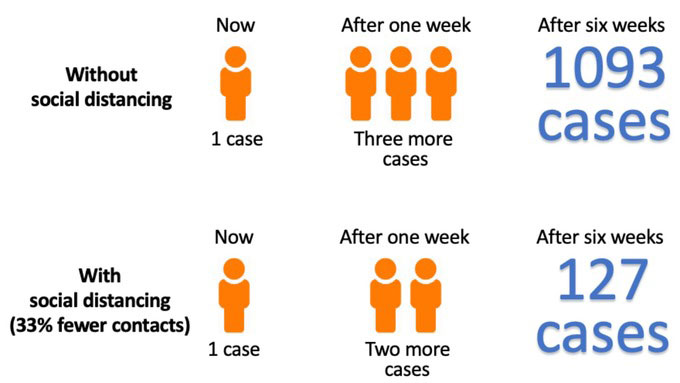
A graphic which shows how social distancing can reduce the spread of coronavirus. Credit: Dr Robin Thompson/ University of Oxford, via itv.com
Individual tasks should also be assessed – and where it is not possible to follow the social distancing guidelines in full, consider whether that activity needs to continue for the site to continue to operate, and, if so, take all the mitigating actions possible to reduce the risk of transmission. I go in to suggestions below.
You need to give very clear guidance to all workers on who should and shouldn’t come to work – and if they do turn up, when to send them home. Anyone who meets one of the following criteria should not come to work:
If a worker develops a high temperature or a persistent cough while at work, they should:
I would err on the side of caution.
Typically we might have a driver and two passengers in the front of a van. Clearly this is not physical distancing. You will need to start thinking how you can achieve this. Can the workers arrive at site separately via their own transport (remembering that public transport is for critical workers now)? Many operatives don’t drive, so how do you mitigate the risk?. Can you limit the number, for example by carrying only one passenger? Maintain travelling companions (i.e. keep to the same passenger). Face away from each other and open the windows to increase ventilation. Daily disinfecting of the vehicle cabin by the site team, no eating, drinking or smoking (all of which increase the chance of touching the face).
It could mean donning RPE, but half-masks have a limit for how long you should wear them. For longer journeys you’ll need to factor in regular breaks.
As a back-up it would probably be prudent to do regular full decontamination of the vehicles back in the yard – treat this like an ‘environmental clean’ with full face RPE and dilute bleach (1:60).
Again, physical distancing! Keep two metres away from anyone that you don’t live with – i.e. everyone you work with.
Again, is it possible to do the work and obey physical distancing? The nature of the property may help or hinder this (very small flats vs larger areas). Again consider the risk hierarchy. Just as with a site posing a psittacosis risk, we would ordinarily disinfect surfaces before we start, increase ventilation, introduce strict eating, drinking and smoking procedures, and require PPE (gloves, RPE and overalls). We’d also increase our washing frequency.
The normal challenge on sites is welfare, and that’s even more the case now. Again, if we are imagining that the area is thoroughly contaminated with rat urine or pigeon guano, we would obviously wash our hands before any break. We need to be thinking along those lines – but even more so. Workers should wash their hands on arrival at the site and then regularly after that. How can our guys frequently wash their hands for the required 20 seconds? They can use hand sanitiser if you have it, but this must contain more than 60% alcohol. Possibly better is a killer spray, with one person spraying whilst the second washes their hands.
Home-brew Sanitiser Recipe
I understand that this will come out much stronger smelling and thinner than you would expect. The ingredients are expensive online – but as you apparently only need a few drops, it should last. Remember that the advice is to ‘wash’ hands for at least 20 seconds, ensuring that every nook is thoroughly rubbed clean.
I received a photo from a truck driver at one of the UK largest construction sites on the first day of the lockdown. It shows an enclosed canteen crammed with people just inches from each other – clearly madness.
The standard operating procedures published by Build UK – so hopefully this is a thing of the past.
It shouldn’t need saying, but DO NOT USE CANTEENS. Everyone should wash their hands before all breaks. There should be no crowding into the toilets – give everyone plenty of space and extra time if needed. Individuals should bring their lunch and drinking water from home – remembering that those working in a warm enclosure will need to drink plenty. There should be no eating together as a team. Stay at least two metres apart!
Clearly, we are very well protected in the enclosure, although possibly less so on semi-controlled jobs. It may be worth considering full-face powered RPE for all works as that also prevents people from touching their face. Similarly, full transit procedures for all works may be a good idea. You will also need to consider staggered use of the DCU – allow the first operative to exit, before the next one starts to transit.
Thorough external cleaning – again using the dilute bleach solution (1:60). This should be done at the end of the project and before issuing it to site.
It’s much easier at the office, but still a challenge – again, the primary focus is physical distancing, so how do you achieve this?
It may be possible to have an unmanned reception for visitors and deliveries, showing a number people can call (on their own phone) to let you know they’ve arrived. This ‘high risk area’ could be disinfected after every ‘exposure’.
It needs to be remembered that the virus can, apparently, survive on some surfaces for several days. Staff should be encouraged to wipe down surfaces with dilute bleach or a soap solution, and frequently wash their hands.
However (and it’s a biggie), the advice is still uncertain. I started by saying that the government advice is that construction can go ahead, but the Mayor of London, Sadiq Khan, has said: “My view is no construction work unless it is for a safety reason.”
If, after all of this, you decide not to keep operating and you have spare stocks of PPE – our medics are in desperate need.
Further reading:
Build UK Site Operating Procedures – Protecting Your Workforce
HSE: Coronavirus (COVID-19): latest information and advice
Thanks to all those that helped with this note.
Good luck, stay in touch and we’ll get through this together.
Written by Nick Garland on Tuesday March 10th 2020
We’ve long been admirers of the Asbestos Knowledge Empire – a series of podcasts run by Acorn Analytical Services’ Neil Munro and Ian Stone. Speaking to a cross section of health and safety and asbestos experts, the series is helping play an important role in spreading awareness and fostering asbestos expertise. So when Acorn asked if I’d like to participate I jumped at the chance.
In a wide-ranging hour-long chat, we covered subjects as diverse as how I got my start in the industry, the one-time ubiquity of asbestos, and the importance of analysts and removal contractors ‘wearing lots of hats’. We also talked in depth about the Health and Safety Executive’s new licensing regime, the problems it’s solved and the new challenges it’s created.
If you’re interested in what I had to say, or if you’d just like to hear from the industry’s other leading lights, head over to Asbestos Knowledge Empire. There you’ll be able to listen to the latest episode, and find links to follow the series on popular platforms including Apple Podcasts and Spotify.
I hope you enjoy listening as much as I enjoyed taking part!
Written by Nick Garland on Sunday February 23rd 2020
Established in 1983, Asbestech has grown to become one of the leading asbestos and hazard-removal businesses in the UK. With a nationwide presence, supported by five regional offices, Asbestech delivers the highest quality solutions for major clients in the public and private sectors. Originally focused only on asbestos removal, today Asbestech has extensive hazard-abatement expertise spanning specialisations including lead paint and ventilation cleaning. In addition, the company has expertise in reinstatement work to replace hazardous materials with modern alternatives.
Asbestech’s mission is to build a culture of safety, quality and performance that’s unmatched elsewhere in the hazard-abatement industry. A fundamental part of this commitment is an emphasis on exemplary health and safety (H&S) practice throughout every project, underscored and supported by regular auditing and analysis.
Previously, the company’s internal auditing tool was an 18-20 page document completed onsite, analysed, then filed away for quarterly review. While effective, Asbestech was seeking a way to do more with its auditing data, improving its analysis to provide fresher and more powerful insights that could further improve site safety and the quality of the work being done.
Through a longstanding professional relationship with Assure360 founder Nick Garland, Asbestech became an early customer for the Assure360 system, principally using its powerful auditing tools and personal exposure monitoring features.
Assure360 has enabled Asbestech to dramatically improve the way it audits, interprets and improves its performance on site. “The massive advantage with Assure360 is that it covers more than our previous audit form used to,” explains the Asbestech Operations Director, Phil Neville.“With Assure360 you can do a quick site inspection, you can just do a paperwork check, or you complete an in-depth site audit of all the H&S aspects which encompasses environmental practice, quality systems and everything else.”
“The data gets fed back to a central cloud-based system, so when I open it up the first thing I see is a screen with headline charts and graphs. It’s immediately apparent if there are any trends I need to look at, if there’s any particular processes that have gone awry, or if there are individuals we need to coach.”
Neville explains that the system’s visual reporting has proved an invaluable tool in providing direction and feedback during monthly meetings with contractors and supervisors. “We can bring up the visual charts and show the teams: ‘These are the kind of things that are being picked up on site so we need to concentrate on trying to improve those.’ Because it’s pie charts and bar graphs, it’s much simpler for people to understand – rather than us just showing them a big spreadsheet full of numbers.”
Crucially, rather than relying on the time-consuming analysis of paper records to spot safety trends, Assure360 provides Asbestech with a dynamic view of where to focus improvements in process, training or support. The benefits include real-time improvements to safety and performance, helping Asbestech protect workers and building users, and deliver to the high standards that it and its customers expect.
Asbestech prides itself on having continually held full asbestos-removal licences since licensing was introduced. It recently submitted its first application under the Health and Safety Executive (HSE)’s new evidence-based system.
“The licence renewal used to be that you’d send them information such as your standard procedures and H&S manuals, and then they’d come in and spend a day or two interviewing you and going through everything in great detail,” says Neville.
Under the new system, however, the emphasis is on asbestos-removal contractors to collate and send much fuller records and evidence via email. Neville explains that Assure360 helps demonstrate that Asbestech is managing its site auditing systems well. It also helps with the ‘hot topic’ of personal exposure monitoring.
“Assure360 makes it very simple to demonstrate to the HSE that we are collecting personal exposure information, that it’s all being stored on a cloud-based system, and that management see and review it regularly. We can show that we use the information from it to identify trends, but also to identify our anticipated exposure levels – which we need to draw up our method statements. Ultimately we use it to make sure we are keeping our team members safe.”
What the client said
“The HSE has stated that they expect licensed asbestos-removal contractors to be ‘exemplary’. Assure360 helps us demonstrate that we are.”
Client name
Phil Neville
Operations Director
Related links
Website: www.asbestech.com
twitter: @asbestech
Written by Nick Garland on Monday February 10th 2020
ACAD organises three rounds of regional meetings across six regions every year. They’re an opportunity for members to come together and benefit from the latest industry updates, and a brilliant way to catch up with old acquaintances – and of course make new ones.
We always try to get to as many events as possible, and we’re delighted to confirm that Nick and Rick Garland will be at the Manchester, Bristol and Kegworth meetings on the 3rd, 4th and 5th of March respectively.
At 8:00 on the morning of each event, we’ll be running informal, open forums for an hour or so to discuss the latest developments to the Assure360 solution. We’ll be presenting our road map – including the planned release of our apps for Android – and having a general Q&A.
Feedback from our customers has been instrumental in shaping Assure360, so we’ll be keen to hear any suggestions you have for how we can enhance or improve the solution. Please do come along – we’re looking forward to being there, and meeting as many customers as possible.
Event location details:
ACAD Regional Meeting North West: March 3rd 2020, ACAD at Novotel Manchester West, Worsley Brow, Worsley, Manchester, M28 2YA.
ACAD Regional Meeting South West: March 4th 2020 at Aerospace Bristol, Hayes Way, Patchway, Bristol, BS34 5BZ – NB this event will start at 10:00am
ACAD Regional Meeting Midlands: March 5th 2020 at Meetpoint Midlands, 26 & 28 High Street, Kegworth, Derbyshire, DE74 2DA
For full information on the ACAD regional events please visit the ACAD website here.
Written by Nick Garland on Thursday January 16th 2020
We all know that the job of asbestos removal is dangerous – that’s why it’s so tightly regulated. But while the most serious risks are often found inside the enclosure, they don’t stop there. The decontamination unit (DCU) presents its own hazards – from asbestos exposure, through electrical and gas hazards, to crush injury when setting up or decamping. So what guidance is available, and how can it help keep operatives safe?
Last year the Asbestos Leadership Council (ALC) made time in several meetings to discuss DCU safety. Unfortunately they’ve made slow progress in producing guidance, and the final version hasn’t been issued. That said, I wanted to take a look at what there is so far, as it’s good stuff. The focus is on electrical and gas safety, which is particularly welcome – working practice in much of the industry is still based on very outdated facts and guidance.
I’m also adding in some additional observations based on my experience of the biggest hazards, and the safe working practices designed to mitigate them.
The guidance starts predictably enough, instructing that gas boilers should meet the required BS EN standards, that they should be installed by an accredited gas fitter, and that each appliance should be fitted with an isolating valve and flame failure device. However, it then goes on to say that all boilers situated in the clean end – rather than a sealed cupboard – should be of the balanced flue type .
For those of us who aren’t gas engineers, in a balanced flue (also known as room-sealed) boiler, the entire combustion circuit is sealed off from the room that the boiler’s in. The fresh air supply, combustion chamber, heat exchanger and exhaust gases are open to the atmosphere only, meaning that if something goes wrong, any toxic or flammable gases should be vented out of the DCU.
Insisting on this type is wise, as they’re much safer than open flue boilers which draw their combustion air from the room they’re in, but following the guidelines might mean an expensive upgrade for any older DCUs.
There are some other issues to pick up on. If the boiler is mounted in a separate sealed cupboard it is best practice for that boiler to be room-sealed anyway, but regardless the cupboard door must be closed and sealed at all times. Many times I’ve seen cupboard doors left open, sometimes for convenience, but sometimes because there is otherwise insufficient ventilation in the cupboard for the boiler to work. If the boiler only works when you leave the cupboard door open, then it’s effectively in the clean end, and must be room-sealed.
It’s important to understand that a room-sealed boiler doesn’t guarantee that combustion products like carbon monoxide (CO) can’t leak into the room. Seals can fail, so there should always be a CO alarm fitted in the clean end, adjacent to the vent to the shower compartment. Correct positioning is important – I’ve seen random locations, not all of which will be effective according to the guidance.
The guidance here pretty much summarises existing standard guidance. In brief, the gas bottle(s) should be:
Note, too, that there should be a maximum of two 16kg bottles, and that nothing spark-generating should be stored with them.
So far, so standard, but then we get to areas where I’m not sure we have much compliance. Gas bottles should be:
There’s some welcome clarity here: DCUs require mandatory 12-monthly gas-safety certificates. Some HSE inspectors are still referring to a very old note that mandated six-monthly inspections for open-flued units. This detailed guidance supersedes and clarifies this.
In day-to-day use, the gas pipework needs to be checked daily and at the end of the project – not a job that I’ve seen on many supervisor checklists. There should also be emergency procedures to follow if gas is smelled. The advice states that gas should be isolated at the end of the shift, but it then goes on to contradict itself, suggesting that if there’s no oil-filled radiator the pilot light should be left running in cold weather. Presumably this will be cleared up in the final pre-publication checks.
All vents, clearly, need to be kept clear. If you have an open-flue boiler in a sealed cupboard, that cupboard needs to be kept closed and the seals must be in good condition. In all cases the CO alarm must be checked at least weekly.
This is usually the area that gets the most attention when a job is audited, but the justification for this seems patchy at best. To my knowledge there has never been a DCU electrocution, so the previous guidance has clearly been serving us well.
This guidance states that all DCUs must regularly be electrically inspected and tested – we rarely see units that haven’t been. In fact, the biggest risk is likely to come from using the client’s mains supply if it turns out to be faulty. The moment of greatest risk is brief – when an individual is standing on the floor, but touching the metal frame of the DCU.
The guidance offers some pointers on how to eliminate electrocution risks:
However the guidance really calls for better design of DCUs to ensure better electrical separation, along the lines of a bathroom. Generally there should be layers of insulation between electricity and people, and the power for recharging masks should come from two-pin, low-voltage sockets. Where there are concerns about the quality of the source electrical supply, it’s perhaps wisest to use a single-phase generator rated below 10kVA, which doesn’t need earthing at all.
The ALC’s guidance may be useful and comprehensive, but it overlooks the most pressing DCU safety issue: the risks relating to manual handling and vehicle movements when positioning them. DCUs are heavy beasts, and it typically takes more than one person to maneuver them by hand. It takes coordination and well-designed procedures to prevent workers being trapped or injured, yet it’s all too often overlooked.
I personally know of one serious injury that has occured due to lack of concentration when maneuvering a DCU. The following is the safe working procedure that was created after the event:
When positioning, re-positioning or removing a DCU from site it is critical that it is done so safely. DCUs are heavy pieces of plant. They can cause injury by trapping operatives against fixed structures, and can become unstable if moved over rough ground.
Where necessary – a traffic marshal will use a barrier to stop traffic when the DCU is to be moved into the road to be hitched onto the waiting van.
It’s a shame that the ALC’s guidance overlooks the risks from positioning the DCU, but apart from that it does help clarify what’s necessary to ensure safety as operatives finish shifts. Well-trained staff should already understand that the risks of asbestos removal don’t end until they’ve decontaminated and exited the DCU (and beyond) – following this guidance should help ensure they stay safe while they do so.
Written by Nick Garland on Tuesday January 7th 2020
There is something quite energising about the European Asbestos Forum (EAF) conference, and this year was no exception.
The theme for EAF 2019 was Asbestos and Innovation, and while asbestos is a given in our industry, innovation is not. Certainly in the UK, the asbestos sector is the most strictly regulated industry other than nuclear, yet for decades our main control measure has been polythene sheets and tape. Our main detection method is the near-century-old technique of phase contrast microscopy (PCM). And how do we dispose of our deadly material? We bury it in the ground!
For too long, technology has seemed to be something that happened to other industries, but in the past few years there have been vast strides in control measures and medical treatment. At EAF 2019, we were given a fascinating look at a range of technological advances.
Among the first was a breakthrough process with the potential to make denaturing asbestos a workable reality – making it safe, rather than burying it for another generation to worry about. Asbetter Acids’ fascinating process pits waste acids against asbestos cement waste, with the effect that they cancel each other out. It’s a really elegant solution: the acid eats away at deadly asbestos fibres, while the cement’s alkaline nature ultimately neutralises the acid. What’s more, the end by-product can be used to make new roofing sheets – useful to replace old ones made from asbestos cement. Genius.
Marvin the robot microscope provided another eye opener, as Frontier Microscopy explained a technology with the potential to dramatically improve the speed of air testing – and the quality of four-stage clearances. The robot essentially looks like a large PCM scope. Operators conduct air tests and prepare the resulting slides as normal, but then Marvin automatically moves the optics, while some clever AI counts the fibres. Marvin uses the same rules as human analysts, and in testing he has proved himself more accurate than an average human.
Frontier created the automated technology to cope with the vast distances in Australia, where samples have to be flown back to central laboratories for analysis. This can result in big delays between an air test and being able to strike the enclosure. Doubtless Marvin addresses that issue, but I expect it could also have huge benefits in the UK.
Here, analysts are often guilty of thinking that the air test (stage three) is the most important part of the four-stage clearance. In fact, their primary focus needs to be on stage two (the visual inspection). If we were to take analysis of the air test away from analysts, they would be able to focus their attention specifically on the part of the clearance that makes the most difference to the result.
Despite the promise of new technology and techniques, it’s sobering to be reminded of the scale of the public health challenge that asbestos still presents. Professor Jukka Takala, president of the International Commission on Occupational Health (ICOH), gave a dramatic review of the latest figures describing the asbestos disaster.
And disaster it is: each year asbestos causes 255,000 deaths worldwide, and the direct global costs for asbestos-related sickness, early retirement and death are estimated at an eye-watering $1.14 trillion (£880 billion). Taken across the EU and western European countries, it’s equivalent to 0.7% of gross domestic product (GDP).
For many of us, these sobering figures are a reminder of why we work in this industry, and the scale of the challenges that face us as we try to keep workers and the public safe from this deadly material. They’re also a reminder of the importance of focused and leading-edge events such as the EAF conference – a chance for all of us to learn from some of the very best sources there are.
This year’s event concluded with the customary thanks and awards. There was a focus on Professor Arthur Frank, one of the world’s leading experts, who has dedicated his life to researching and writing on occupational health, toxicology and asbestos. Arthur was deservadly given the EAF Recognition Award – a fitting acknowledgement of the importance of his work.
All that remained was a fantastic conference dinner. Within our small industry, among a group of like-minded specialists, experts and advocates, it felt more like dinner with friends.
Don’t miss out on the latest thinking in asbestos, construction and health & safety. Check out our regularly updated list of conferences, seminars and other events.
Written by Nick Garland on Tuesday December 10th 2019
2019 marked the 20th anniversary of the UK’s total ban on asbestos, and – perhaps – the first tentative signs that asbestos deaths have peaked. Much to celebrate, then, but the year also saw upheaval in asbestos management, with the HSE’s long-overdue overhaul of the licensing regime becoming a talking point for the wrong reasons. Here’s our review of the year.
Back on 24 November 1999, the UK’s ban on importing and using asbestos finally came into effect. This year marked the ban’s twentieth anniversary, but sadly our use of asbestos is far from a historic problem. For a start, it’s endemic throughout our built environment, so in February we asked various industry experts: Is an asbestos-free world possible?
As we discovered, the reality is that there is neither the capability nor the budget to remove asbestos from the entire built environment, but is there a case for selectively removing it? In particular, more than 85% of the UK’s schools contain asbestos. In April we asked whether in this unique environment the current ‘manage in situ’ approach was good enough – read our asbestos in schools article here.
Within the asbestos-removal industry, the ban’s anniversary was undoubtedly overshadowed by the Health and Safety Executive (HSE)’s plans to overhaul the licensing system. This permissioning regime controls who can perform most asbestos-removal work, and there’s no question that it needed an update – back in 2016 I was one of many calling for a move to a single, three-year licence term, backed up by formal reviews.
In March the HSE made a bold move, introducing a three-year only licensing system in which the onus is placed more fully on the would-be licensed asbestos-removal contractor (LARC) to prove their competence. Instead of inspections, there’s a detailed online form comprising 14 sections – you can read my analysis of it here.
While there were positive elements to the new system, it quickly became clear that LARCs had little guidance on how to complete the form, resulting in huge time overheads as they dug around for information that could be relevant. For the HSE, the form’s open-ended nature meant that no two applications were alike, and LARCs quickly reported a processing backlog in which renewals were taking many weeks to complete.
From the start, I’m proud to say that Assure360 could help LARCs retrieve the proof they needed to demonstrate their competence. We moved quickly to develop a custom module, specifically designed to provide the exact information the HSE needed for each section of the form – at the touch of a button. We’ve now helped multiple clients through renewal under the new regime, and as it begins to mature and improve we’re working with the HSE to further develop our support.
2019 was the first full year for the Assure360 Paperless app, and it’s a pleasure to hear from clients how it continues to help them work more efficiently on site, and eliminate paperwork back at the office. Below we’ve highlighted just some of this feedback below – for each you can click the link to read the full case study.
Already, some 15% of all LARCs use Paperless, and more than one in ten licence applications to the HSE are submitted using the Assure360 system, but we’re not sitting still. Unique to Paperless, we’ve introduced a new Personal Monitoring feature that helps LARCs develop real strategies for personal monitoring that reflect operatives’ true exposure levels. Aside from ensuring that monitoring is effective, it ensures that monitoring programmes adapt to reflect what’s actually happening on site, helping minimise and manage exposure risks.
And what of 2020? There’s already a packed event schedule for the year ahead – you can see many of the key dates in our frequently updated events calendar. We’ll be rolling out further improvements to Assure360 and, I’m delighted to announce, introducing Android versions of all three Assure360 apps: Audit, Paperless and Incident. There’s much to look forward to, but for now let me wish you a merry Christmas, and a happy and safe new year.
Written by Nick Garland on Wednesday November 6th 2019
While we eagerly await the start of the European Asbestos Forum conference, next week in Amsterdam, the second annual conference of the Faculty of Asbestos Assessment and Management (FAAM) will follow hot on its heels. The FAAM conference takes place on the 19-20 November at the Crowne Plaza in Nottingham.
After the success of last year’s debut, there’s every sign that FAAM has created another unmissable conference for 2019.Both EAF and FAAM seem closely aligned with speakers in Nottingham including European Asbestos Forum founder Yvonne Waterman, and another of the speakers from the EAF, Charles Pickles, tackling the conflict between safety and commercialism when it comes to asbestos.
While conferences organised by the British Occupational Hygiene Society, FAAM’s parent organisation, normally take a UK-centric view, FAAM 2019 looks to have a very global feel – joining Yvonne and Charles are speakers from Canada, America and Australia.
So, what am I most looking forward to? Day one features a talk on an issue with the potential to grow into a major health scandal: asbestos in talc. Jacob Persky will explore whether the recent headlines reflect evolving perspectives, or a paradigm shift.
One of the first unmissable talks will come from Gary Burdett of the Health and Safety Laboratory (HSL), on dust sampling. This is a vexed issue, with such tests widely considered discredited in all but the most niche applications. The problem is that sampling is too sensitive, offering only a yes/no indication of whether asbestos is present, rather than an indication of the actual risk. Gary is a world expert on the subject and will hopefully be able to shed some light on the when and where this technique should be used – and if there are any improvements on the way.
On the afternoon of the first day there’ll be workshops on developing best practice in surveys and clearances, led by Colette and Alan Willoughby of the National Organisation of Asbestos Consultants (NORAC). This has got to be the essence of what FAAM is all about – get the best minds on a subject in a room and challenge convention. For attendees, this has the potential to be a game-changing couple of hours.
Day two starts in a similar vein to the first, with a second talk on asbestos in talc. Fred Boelter will look at communicating the risk. I am particularly looking forward to both of the talks on this subject, as asbestos in talc has the potential to become ‘another smoking’. By that I mean it’s becoming understood among the industry as an avoidable risk, but one that so far remains totally unrecognised by the general public.
Day two continues with two very timely talks. Asbestos is the most regulated industry after nuclear, yet for decades its main control measure has been polythene and tape. Our main detection method is the near-century-old technique of phase contrast microscopy (PCM), and when it comes to disposing of our deadly material we bury it in the ground.
For too long, technology seemed to be something that happened to other industries. However, in the past few years there have been vast strides in control measures and medical treatment. Just before lunch, Sebastian Schmitt will explore asbestos detection instruments, promising to link history and potential future developments to give us a better picture of how detection is evolving. After lunch, Yvonne Waterman and Jasper Kosters will cover denaturation – changing the form or makeup of asbestos with the ultimate goal of eliminating it from the environment altogether.
All in all, the brilliant programme suggests the FAAM’s event will continue where the EAF leaves off, with leading speakers addressing both the key interests of, and the challenges facing our industry today. In fact, with EAF just the week before, the two feel much like a four-day conference split over two centres. I’d strongly recommend that anyone with a professional interest in asbestos should plan to attend both.
The FAAM conference takes place at the Crowne Plaza in Nottingham on 19-20 November. For full details and to download the programme in full, click here.
Written by Nick Garland on Thursday October 3rd 2019
The conference season got off to a cracking start last month with the Contamination Expo at Birmingham’s NEC. As we’ve come to expect, more than 3,000 delegates were spoiled by a large range of exhibitors, and a comprehensive programme of talks by the industry’s thinkers, movers and shakers.
I’m pleased to have played my own small part with my talk on the new licence assessment regime, and the challenges faced by LARCs and the HSE alike as everyone struggles to get to grips with the new evidence-based system. Applying for a licence is more time-consuming and complicated than ever, with more of the burden shifted onto applicants. In my talk, I discussed the causes, consequences, and why electronic record-keeping systems like Assure360 can reduce the risk of catastrophic delays in renewing your licence.
There were several other highlights for me, including Assure360 being named runner up in the asbestos category of the Contamination Expo Series Awards. Another was getting our developers together with some clients, in a session which produced some great ideas for the future development of the Assure360 suite. In particular, we’re now focusing on how to analyse the data we’re already collecting to give companies deeper insights into planning and costing jobs. Assure360 will allow management to analyse time spent on preparation and sheeting up – so that productivity strategies can be designed.
The next stop will be the European Asbestos Forum conference, which this year returns to its roots in Amsterdam. Yvonne Waterman has put together an amazing event on the 14th and 15th of November, with the theme Asbestos & Innovation.
The format will be familiar to those of us that have been before:
I’m honoured to be chairing one of the sessions on the second day.
For those of us concerned with asbestos and the threat it poses, this is an unmissable event: the conference features some of the world’s most eminent experts on asbestos and its impacts on human health. In the morning session of the second day, standout speakers include Sean Fitzpatrick, who has been the leading voice in the research surrounding asbestos in talcum powder in the USA. His talk has the disconcertingly simple title of ‘What is asbestos?’ – I’m sure the answers will surprise us all.
After the morning break we’ll hear from Professor Arthur Frank, who has been researching and writing on occupational health, toxicology and asbestos for decades. One of the world’s leading experts on the subject, he’ll be presenting a detailed examination of the link between chance exposure and the development of an asbestos-related disease.
That will lead us to the keynote speaker, the eminent professor Jukka Takala, president of the International Commission on Occupational Health (ICOH). Professor Takala’s talk will focus on the research paper he published last year, Global Asbestos Disaster.
Without giving too much away, the paper collected the latest evidence of the magnitude of asbestos-related diseases around the world and in particular in the developed Western world. It contains shocking statistics: 255,000 deaths annually worldwide, and direct costs for sickness, early retirement and death estimated at an eye-watering $1.14 trillion (0.7% of GDP) for Western European countries and the European Union alone.
The conference will explore two critical areas of technology in depth – denaturation of asbestos waste, and forensic methods to prevent asbestos fly-tipping. The first area addresses how we make asbestos safe, rather than perpetuating the legacy problem of simply burying it. Several speakers will discuss different methods of denaturation and how, as the technology improves, it is becoming increasingly economically viable.
At the other end, there’s discussion of an intriguing method of using the ‘traceable liquid’ SmartWater to mark asbestos, just as some property managers do with valuables. Tagging asbestos-containing materials with a unique chemical identifier might enable much more rigorous tracking of ACMs, and help establish exactly where dumped material came from.
Another example of why EAF is different is the exhibition – Tony Rich (or Asbostorama to give you his Flickr name), is an astonishing photography artist whose muse is asbestos. Tony is a friend of the show and you will be able to see some of his work at the conference.
These are just some of the highlights from the programme, and with 22 internationally regarded speakers, the biggest problem will be in deciding which of the fascinating talks to attend! EAF is always warmly welcoming and fascinating: the lessons we can learn from our international colleagues on how they tackle this global problem are invaluable.
All in all, this will be a conference with global standing, in a new and spacious setting, just a short hop from the UK. I can’t wait to see you there.
The EAF conference takes place at the Van der Valk Oostzaan Hotel, 20 minutes from Amsterdam Schiphol airport, on 14-15 November. Discover the programme in full, or click here to register.
Written by Nick Garland on Wednesday September 18th 2019
Over the summer it’s become clear that the Health and Safety Executive’s new asbestos licensing regime is, to put it mildly, challenging. With a switch in emphasis from interview to written evidence, the HSE has moved more of the burden of the licence application onto the companies applying. At the same time, the free-form way in which would-be LARCs can submit their evidence means that the HSE faces an increased and inconsistent workload.
So, for those seeking an asbestos-removal licence under the new scheme, the best advice I can give is to start now. The new process is incredibly time-consuming, labour-intensive and confusing, and to date there has been limited guidance on what and how much you should write. The application form has 14 sections, all of which require you to explain and provide evidence for how you comply with or exceed the HSE’s expectations. This can mean gathering, scanning and emailing off dozens of pieces of paper, but early applicants have complained that the email size limit has been set too low.
Because everyone is providing different evidence, in different ways, in different formats, it’s taking the HSE months to analyse the returns before the Asbestos Licensing Unit (ALU) makes a formal decision. All this delay is taking some decisions right to the wire, with licences coming through just in time – or too late.
It’s hard to overstate the frustration and stress this is causing, so start early when applying. Have all of your documents ready, know what you are going to provide, and organise yourself with folders for every section of the application form. Apply and pay the invoice at the earliest possible moment – and then monitor the HSE like a hawk until you have the licence in your hand.
But simply acting in good time and having your evidence prepared will only get you so far. With applications still very confusing, asbestos-removal contractors need smart ways to avoid the pitfalls, making the process smoother and simplifying the HSE’s task. That’s where Assure360 comes in: a suite of web services and apps integrated with a secure cloud database, our platform is the perfect tool for demonstrating your effective management of health and safety.
Several Assure360 features give its users a critical advantage in the licence application process. Designed from the ground up to support team working, it ensures that everyone participates in health and safety. Supervisors, contract managers and auditors audit, operatives contribute accident and near-miss information, and senior managers can use it all as the basis for sensible decisions.
Within Assure360, everything is simplified and streamlined. Our secure cloud approach means that everything can be accessed anywhere, by any member of the team, meaning you can enlist additional help when needed. With the powerful workflow feature, you can involve the full team in designing and closing out preventative actions, assigning and re-assigning tasks as you need to.
Assure360’s unique benchmarking reports also allow you to draw on the experience of the rest of the industry. We’re four years into the Assure360 project, and with more than 50 LARCs using the solution we’ve recorded nearly 8,000 audits and an astonishing 21,000 personal monitoring tests. This growing library of observations and the lessons learned are increasingly used to help inform your decisions.
All of these features are brilliant in themselves, but they’re particularly powerful when it comes to the licence application. Aside from demonstrating a deep and effective prioritisation of health and safety throughout your business, Assure360 feels like it was tailor made for the new licensing regime: all of the evidence for the complex application can be produced at the touch of a button.
In fact, we’ve even added a dedicated module to guide you through the process. For existing users here’s a link.This will guides you through section by section – with explanations and links to the areas of the system and reports that will help. There’s no more searching for the evidence – it’s all in one place. And because the HSE is very familiar with Assure360, having been through dozens of assessments already, its reports and data are instantly recognisable to those managing the applications, helping smooth the way through the process.
On top of this, Assure360 lets you grant the HSE direct access to your live data. Instead of sending dozens of printed reports, you can simply share links, allowing you to take the HSE on a journey demonstrating interconnected and layered health and safety management.
I’m not a software designer. I’m a health and safety professional, specialising in asbestos. I started in the industry in 1992, and have worked as an analyst surveyor and an embedded health and safety manager. Since then I’ve designed and implemented audit systems, trend analysis, competence systems and personal monitoring analysis for companies around the country.
Assure360 is the culmination of all the lessons I’ve learned. It helps reveal what your data has to tell you about your business. And when it comes to your licence application, it helps demonstrate to the HSE the professionalism and competency of what you do. For those fearing the chaos of licence renewal, it’s the perfect answer.
Written by Nick Garland on Friday August 23rd 2019
Founded more than 20 years ago, the Armac Group has grown to become one of the UK leaders in demolition, and land reclamation and remediation. Today the group comprises two companies – Armac Demolition and Armac Environmental – which together provide every service necessary to turn a derelict site into a cleared, safe environment ready for re-use.
Asbestos removal is a fundamental part of demolition work, and its proper management is essential to the safety of those working on a site, and those who’ll use it afterwards. Armac Environmental exists to manage asbestos removal to the highest standards throughout all Armac Demolition projects.
As one of the UK’s biggest demolition companies, Armac typically works on large-scale projects involving major buildings such as schools or hospitals, and infrastructure including road and rail. Complex projects will often run to three or four months, during which time mandatory asbestos paperwork previously remained on site. This presented the asbestos Project Support Manager and his team with a huge challenge as the completed paperwork was returned at the close of each job.
Aside from the significant time lost to carefully processing the paperwork, the team was aware that effective analysis and review of its asbestos removal projects was only possible after it had ended. While acute issues could be addressed through site visits and supervisor feedback, opportunities were being missed to identify and address training needs and improve performance across the job as they happened.
Armac had been an Assure360 customer for some time, using core features such as auditing and exposure monitoring. When Assure360 Paperless launched, the company realised that the new app could offer a solution to the shortcomings of a paper-based system. However, as a major contractor with multiple accreditations, it needed to be certain that any changes to its record keeping and safety-critical processes were appropriate and effective, and that they would constitute an improvement.
Armac began a limited introduction of Paperless on smaller projects, using it to replace conventional paper-based safety checks and record keeping. As a granular, data-based system, Paperless ensured that supervisors’ safety-critical checks were recorded digitally, and shared in real time with the office team. Supervisors were quickly freed from managing mounds of on-site paperwork, enabling them to spend more time supervising the safety and quality of the asbestos-removal work itself.
The benefits were immediately clear to the office team. Not only was it freed from hours and hours spent processing paperwork at the end of every job, it now had access to live data describing its teams’ performance on site. Able to perform analyses during jobs, rather than after them, the team could respond to emerging trends, ensuring that training and other resources could be directed to maintain quality, promote safety and ensure milestones were being reached.
Reassured that Paperless can replace on-site paperwork with a more streamlined and effective system, Armac is now deploying the app across all projects –
It’s saving me hours and hours and hours of going through paperwork. It’s a lot quicker, and everything’s visible, so we can see everything as the project’s ongoing.
Say the exposure monitoring is higher than it should be, we can deal with that at the time rather than three months later when we get the paperwork back. If there’s an issue on site that hasn’t been picked up yet, it gives us an extra way to spot it and act before it becomes a problem.
The team’s very helpful. Very quick to respond. We’ve only had one issue: a supervisor who couldn’t log in on site. I called Assure360 and within half an hour it was all sorted out and we were ready to go.
Written by Nick Garland on Thursday August 8th 2019
The first Contamination Expo event took place back in 2016, and Assure360 was proud to be among the founder exhibitors. This year a bigger, better Expo takes place from 11-12 September at the NEC in Birmingham, and it comes at a pivotal time for the asbestos industry.
The Health and Safety Executive (HSE) is in the middle of one of the biggest shakeups of asbestos licensing since the permissioning regime was introduced. To say that its changes have been either smoothly introduced or warmly received would be a gross exaggeration. So the 2019 expo represents the first big chance for the industry to get some much needed help and direction.
I’ve already talked about what’s changing, but it pays to focus on the new system itself.
The application form has 14 sections, all of which require you to explain how you comply with or exceed the HSE’s expectations. In the new regime you now need to provide evidence that you actually do what you say that you do. This, at its ‘simplest’, means gathering together dozens if not hundreds of pieces of paper, scanning them and emailing them off.
As multiple firms are finding, even then it is not so straightforward. The HSE’s incoming email size limit seems to be set at a rather low 10-12MB. Licensed asbestos removal contractors are finding they need to split their responses into multiple emails, relating to multiple sections, with all their answers carefully cross-referenced.
This is taking companies weeks of dedicated effort, but the problems don’t stop there. Because everyone is providing different evidence, in different ways, in different formats, when it lands on the HSE’s desk it’s taking it months to read, understand and analyse. And all this needs to be completed before the Asbestos Licensing Unit (ALU) can make a formal decision on the application.
This is a big problem. The resulting delay is taking licensing decisions right to the wire, with licences sometimes coming through the day before the existing one expires – and in some cases long after! The frustration and the stress this causes can not be underestimated: when your business depends on a licence to remove and handle asbestos, failing to receive that licence could lead to the end of your business.
How to avoid the pitfalls? What can you do to make your licence application smoother? And what could make the HSE’s task easier and quicker? These are the questions the industry will be asking at the Contamination Expo, and this is exactly where Assure360 can help.
The Assure360 solution long predates the new regime, but it feels like it was tailor-made for it. With Assure360, all of the evidence needed for the complex sections of the form can be produced at the touch of a button. As you’d expect, we’ve also responded quickly to the changing licensing environment: now we even have a dedicated module, split into the application form sections, which offers explanations, and links to the areas of the system and the reports that will help.
On the first day of this year’s Expo, 11 September, I’ll be speaking from 12:30 – 13:00 in Theatre 21. My subject – you guessed it – is the only one that matters right now: the New Asbestos Licencing system, and how electronic solutions can help. If you miss that, then we’re holding a networking event at 17:00 in Plaza Suite 3 on the main concourse.
I’d love to see you there, but if you can’t make it, please be sure to come and visit us during the event. We’ll be on stand J7, directly opposite ACAD. As the experts in the management of asbestos removal, we’re here to help. If you’re looking for guidance and insight into the new process, pitfalls to avoid, and strategies to succeed – there couldn’t be a better first port of call.
Written by Nick Garland on Tuesday July 23rd 2019
Amianto Services is fast growing to become one of the leaders in asbestos removal in North West England. Founded in 2017 as part of the Carroll Group, Amianto’s strategy is to achieve growth by building and maintaining a reputation for efficiency, safety, and excellence.
Key to this is the innovative and professional approach of Managing Director Tony Loughran, an 18-year veteran of the asbestos removal industry. Under Tony’s leadership, Amianto has already achieved milestones such as Alcumus SafeContractor accreditation, and a full Health and Safety Executive (HSE) asbestos removal licence, which for those who don’t know, enables the company to undertake high-risk asbestos removal work.
While many long-established asbestos removal companies struggle with outdated systems and legacy workflows, as a new company Amianto Services was able to begin with a blank slate. Given its ambitious strategy for growth, a core challenge would be to ensure that the company’s safety-critical checks and mandatory record-keeping could be managed in a streamlined and efficient way that would scale to support the growing business.
Tony Loughran was already familiar with the advanced auditing features of Assure360, and was keen to evaluate the system’s ability to help manage the workflows involved in running and growing the company. Specifically, Tony wanted to assess whether Assure360 Paperless could help him minimise the administrative overheads faced by his site supervisors and the back office team. Another key requirement would be that any system should help Tony and his team demonstrate their competence to the HSE during their initial asbestos removal licence application.
The Assure360 team was able to quickly demonstrate that Assure360 is an effective and streamlined management solution for today’s asbestos removal industry. Integrating auditing, trend analysis, competence and training needs with accident, incident and near-miss reporting, the suite provides the essential tools for effective asbestos removal and health and safety management. In addition, Amianto Services was quickly satisfied that the new Assure360 Paperless app was the tool it needed to help manage safety-critical checks and record-keeping, both at launch, and as the company grew and scaled up its operations.
Amianto Services became a full Assure360 customer, and the Assure360 team was quick to tailor the solution to support the efficient and thorough workflows Tony Loughran wanted to implement in the business. The team offered support in the run up to the critical licence application with the HSE, after which Amianto Services was immediately granted its first one year licence with no conditions. It remains on-hand to support Amianto as it further refines and improves its operations. In particular, using Assure360, Amianto will be able to provide all the evidence that the new licence regime could possibly demand – at the touch of a button.
I’d had previous good experience with Assure360’s auditing capabilities, and thought from the outset that the suite might prove an invaluable tool as we built an efficient and streamlined asbestos removal company. The results have been fantastic – the software ticks all of our boxes, and Assure360 continues to add new features that fit really well with the way we want to work.
One of the best things about the Assure360 system is that the people are available, and always willing to help. They’re very knowledgeable, both from a programming perspective but also with their experience of the industry we work in. They’ve helped tailor the system to suit some specific requirements we had, and if anything ever comes up the team is straight on it. They were very supportive ahead of our HSE licence inspection, and the system really helped us demonstrate our competence.
As we grow, Assure360 is on hand to help train up our new staff. Assure360 Paperless is really proving its worth here, too. For us it was essential to avoid a situation where hiring more supervisors and operatives resulted in a log-jam of paperwork on site and back at the office. Paperless has helped us build smooth processes around our critical site checks and record keeping, and the app will be a fundamental part of helping us maintain quality and efficiency as we scale up.
On a personal level, I’m made up with it – and excited to think about what I can do next with our business.
● Tony Loughran
● Managing Director
Written by Nick Garland on Monday June 24th 2019
The Health and Safety Executive (HSE) is in the middle of one of the biggest shakeups of asbestos licensing since the permissioning regime was introduced. I’ve already written about what’s changing, but I want to expand more on how Assure360 is better placed than ever to help customers through the whole licence application process.
The new electronic system of asbestos licence assessments is well into its trial, with multiple organisations already having experienced it. The whole process is radically different for applicants, with much more emphasis being placed on a review of the application and its supporting evidence than on the meeting itself.
When I first heard of the change I was very sceptical – and I know some HSE inspectors have had their doubts. There are obvious advantages to testing the mettle of a potential licensee whilst the asbestos licensing principle inspector (ALPI) looks them in the eye. But there have long been concerns over consistency in the current system, with some areas reputed to be much more rigorous than others. In the new regime, assessments are triaged by a central team, which should help in this regard.
The focus is now on providing evidence to support a licence application and, as at least one HSE inspector has observed, Assure360’s entire premise is to provide information to support sensible decisions. Its power is made even clearer with the new regime. The ability of Assure360 to support the bid – whether at the basic Silver or the fuller Gold and Platinum levels – is clear.
So what can you expect from the new application form? Here’s a brief overview of each section, with an explanation of how Assure360 can help both with your approach, and with providing the evidence that the HSE expects to see. It’s worth noting that the form comes with dire warnings to anyone tempted to use a consultant to complete it: there are grave consequences, potentially including licence revocation.
The first few sections of the application form are fairly broad, asking for details on who will be in the meeting and other key individuals who aren’t going to be present. It also asks what sources of information, legislation and literature you rely on. There are no ‘correct’ answers for any of these – they establish who the controlling minds are in your business, and how you stay abreast of changes and improvements in the industry.
So what helps here? Being a member of a trade organisation helps demonstrate a commitment to higher standards, while attending regional meetings can be an excellent opportunity to share experiences with like-minded professionals. I give out updates via my monthly newsletter (if you haven’t signed up – add your email at the bottom of this page). I also publish safety alerts.
By section four, the application form really starts to test your competence as an organisation by looking at plans of work. The HSE specifically asks for two different examples, and states that they should relate to jobs that you do.
What the form doesn’t say explicitly is that despite it being only two, they should cover all of the different types of job that you do. For example, if you have completed 100 asbestos insulating board (AIB) jobs and one pipe insulation removal, don’t submit two AIB jobs. What you do if your work extends beyond two types of job isn’t entirely clear.
After Section four, Assure360 becomes invaluable in your efforts to demonstrate and evidence your competence as a licensed contractor. Without it you’ll be scrabbling around for paper evidence, but with it, everything is at your fingertips. It’s up to you how you submit evidence, either printing it off or giving the HSE a read-only link to the correct page of the system. There is even a page dedicated to the licence application, in which we’ve mapped out the correct reports against each section in the application form.
These sections are all about site and equipment checks. Ordinarily you’d provide the site files – coffee stains, spelling mistakes and all, and you’d need to scan every page and save them as PDFs. A potential pitfall is the size limit on emails you can send to the HSE. The form states a maximum 25MB, but the real limit seems to vary – with some people reporting less than 12MB.
However, with Assure360 Paperless all of the plant, equipment and site checks are at your fingertips, and you can show them to the HSE. A few clicks will allow inspectors to see absolutely all the relevant checks completed on a site. The feature isn’t just restricted to plant and equipment – it covers enclosure checks and smoke tests too. All certificates completed in the Paperless app are uploaded directly to the project file and are time and date stamped. The App even helps with spelling.
Section seven deals with respiratory protective equipment (RPE), personal protective equipment (PPE) and air monitoring. Understanding and recording this has always been a problem for the industry, but it was one of the first things that Assure360 cracked.
Within two minutes, Assure360 users can provide detailed evidence of:
Just imagine trying to explain all of that with only an Excel spreadsheet!
This section covers health records and medicals. It’s an area that we don’t yet cover, but Assure360 is developing all of the time. Coming soon there will be a full personnel management system, which will be free to all subscribers.
These sections cover leadership and management – often difficult concepts to get your head around, never mind explain in writing. Again, Assure360 is there to provide evidence to backup your words. At the touch of a button you can display exactly what you are observing on site. You can show all of the non-conformances from all of your audits, including what you did to rectify on site and, critically, what you did to ensure they wouldn’t happen again.
With Assure360’s unique benchmark tool you can also spot what the entire army of Assure360 auditors are encountering, across the country. Being forewarned of developing problems allows you to plan to avoid issues and mitigate risk. This constitutes evidence of a proactive approach to health and safety management, and demonstrates your ability to look beyond just your company. Remember that this links in with one of the questions in the form’s early sections, on how you get your health and safety information.
Using Assure360 you can illustrate how many times your contract managers, senior management and even directors attend site. It’s seconds’ work to present the data in a colourful chart showing how many audits the entire team are doing, and providing direct evidence of senior management’s attendance on site and involvement in health and safety.
The final benefit is that you can remap all of the above information to reflect training needs for the individuals across your business. More on that in the next section.
Section 11 is all about training and competence. Assure360 is built around effective auditing, and the first thing we made the data do was drive competence. Providing evidence for all your assessments and training needs analysis is extremely straightforward. Within minutes you can present:
With Assure360 you can present a competence scheme that encompasses everyone in the organisation – not just supervisors and operatives. It is so comprehensive that it exceeds the HSE’s expectations.
The final section focuses on reviewing and measuring performance. As I said, auditing is the emotional home of Assure360. Auditing with the system saves about two hours compared to the traditional paper and Excel route. Add to this the fact that the database automatically interprets and re-interprets all of the observations and it’s the health and safety manager’s dream.
When it comes to the new licence assessment system, this section represents exactly what Assure360 was designed for:
Trend analysis – company as a whole, individuals, specific competencies and non conformances
Setting health and safety targets – you can move beyond the standard ‘no RIDDOR’ and ‘no enforcement action’ to set imaginative targets and evidence trends in performance at the individual level
What’s your strategy and are you hitting it? – evidence your success through simple one-click reports
This section also covers personal monitoring, through direct assessment of the method. Assure360’s personal monitoring module can be harnessed to show how you assess every aspect of each project. Users can generate reports to show only the personals that exceeded what was expected, along with links to reveal what was done about it, the assessed root cause, and any supporting evidence.
The HSE is still testing its new licence regime, with current developments officially regarded as a pilot scheme. Doubtless the system will be revised and refined before going ‘final’, but for LARCs renewing their licence it already requires a new approach.
For companies struggling with old, paper-based systems, the licencing regime’s increased focus on excellent record keeping, analysis and management competence is a challenge. However, Assure360 customers not only have the best tool for managing all aspects of asbestos removal, but the best tool for documenting, analysing and demonstrating their competence at doing so.
Written by Nick Garland on Thursday June 13th 2019
For some years, there’s been a question mark hanging over the Health and Safety Executive’s licensing regime for asbestos removal. With variable licence periods creating confusion among clients and an unintended hierarchy being created within the industry, attempts to overhaul the system are to be welcomed by everyone.
For those who don’t know, the existing system is a permissioning regime. Would-be licenced asbestos-removal contractors (LARCs) and those who want to renew must demonstrate to the HSE that they have the necessary skills, competency, expertise, knowledge and experience of work with asbestos, together with excellent health and safety management systems. The outcome is either no licence, a three-year licence, or any period between. Additional conditions are sometimes attached.
It sounds simple enough, but there are multiple problems. While nobody is meant to infer anything about competency from a company’s licence term, in practice customers choosing a LARC often treat the full three-year licence as a prerequisite. In addition, LARCs can’t notify a project that extends beyond their licence period – that means that bidding for complex, two-year-plus jobs is effectively restricted to the 35% or so of LARCs with a three-year licence.
Against this, in recent years the HSE has been less inclined to give out three-year licences. Among other things, that’s resulted in an increased workload for inspectors as they conduct more regular licence inspections. There’s a burden for LARCs, too, as there’s a considerable cost and administrative overhead to each licence application.
It’s no surprise that the HSE wants to shake things up. It’s already started to pilot a new regime that shifts the onus away from licence inspections, and more onto LARCs to provide evidence of their competency. In the new system, first-time applicants still get inspected, whereas existing LARCs re-apply via an electronic form.
A couple of years ago I called for an end to the fixed-term licence, and the introduction of monitoring visits. Essentially if you’re good enough, you get a licence. If not – you don’t. it’s recently emerged that in the pilot scheme the HSE are moving towards just that. As ACAD’s Graham Warren explains in a LinkedIn blog post:
“Some eagle-eyed people have been asking ACAD why all renewals [under the electronic pilot scheme] seem to be issued the full three-year term. HSE have confirmed this is not some chance occurrence, but actually how the new system works.”
At renewal, companies either won’t get a licence, or they’ll be licenced for the now-standard three-years. This doesn’t necessarily mean that LARCs that would previously have received a one or two-year licence will be turned down. In all cases where a company is judged competent, the HSE will issue a three-year licence, but it may require a formal review to ensure any improvements are fully implemented. Crucially, this review period will remain confidential, unless the LARC fails to make the required improvements, so it won’t affect the LARC’s ability to compete for contracts.
The change is virtually what I called for, and it’s a vast improvement. By settling on a single, three-year period, the HSE will reduce the confusion among clients who see one and two year licences as less of a vote of confidence. Moving the major work of re-licencing onto a three-year cycle will reduce the burden for LARCs, allowing them to concentrate on making the improvements the HSE wants to see at the review meeting.
For the HSE, it means less licence inspection work, and a relief from the commercial pressures to grant three-year licences to the biggest contractors, who may previously have needed them to bid for the most complex works. A more centralised approach by the HSE (all applications are reviewed by a single team) will mean much more consistency, too.
As Graham points out in his post, there may be some interesting consequences. With clients no longer able to select LARCs by licence duration, they’re likely to look for other ways to determine which companies are working to deliver the highest standards. Being able to demonstrate fastidious record keeping, management and analysis – for example through membership of a trade body such as ACAD – will become more of a competitive edge.
Assure360 can really help here, too. Our data-based system makes it easier not only for LARCs to manage asbestos removal, but for them to demonstrate the high quality of their training, competency, and analysis of key safety factors such as exposure monitoring.
In fact the new regime fits seamlessly with the Assure360 ethos. Being a health and safety system, specifically designed by asbestos industry experts for the asbestos industry, Assure360 has always allowed you to showcase your expertise. Vast quantities of evidence are now required in advance of the licence assessment, and Assure360 customers can simply provide it by running a series of reports. The database presents all the proof that the HSE could ever ask for. And with the new Paperless solution, even site files can be viewed with real date and time stamps on the certification.
We’ve got a great track record of helping clients prepare for, and excel at licence renewal: under the existing scheme our customers have consistently proven far more likely to achieve three-year licences. Under the new regime Assure360 will streamline the process even further, as our reports are mapped against the questions the HSE are asking.
So if you’re applying for a first-time licence, or preparing to renew an existing one, why not get in touch and see how we can help?
Assure360 will be at the Contamination Expo on the 11th and 12th of September – stand J7, directly opposite ACAD. So if you’re looking for guidance and insight into the new process, pitfalls to avoid and strategies to help – there couldn’t be a better first port of call.
I will also be speaking on the first day – 12:30 – 13:00 at Theatre 21 The subject – you guessed it is the only one that matters right now, the New Asbestos Licencing system and how electronic solutions can help.
Written by Nick Garland on Wednesday May 29th 2019
We’re not alone in having wondered whether the HSE’s asbestos licensing system was entirely fit for purpose. With three possible licence durations and multiple conditions that can be attached, clients often use a LARC’s licence as a shortcut to judging competence. Re-inspection as frequently as every year creates lots of work, both for the LARC and the HSE, and doesn’t necessarily result in raised standards.
A couple of years ago, founder Nick Garland called on the HSE to settle on a standard three-year licence, backed up with formal reviews. It’s recently emerged that’s exactly what’s happening in the HSE’s electronic licensing pilot – in this article, Nick explains some of the benefits and consequences.
Note: The post below was originally published by Nick Garland on LinkedIn in 2016. You can click here to read the original post.
The licence terms awarded to asbestos contractors have reduced year on year. I examine the latest data and offer an opinion on a better way forward.
A phrase every LARC will be familiar with, as it seems to be in all letters written by the HSE. One of the principle purposes of such a regime is to:
“…maintaining and improving standards of health and safety”
The Health and Safety Commission permissioning regime policy statement
Maintain and improve standards of H&S, presumably by weeding out the incompetent and promoting best practice. But why then are average licence terms shorter now than they were? I have been in the asbestos industry since the early 1990s, and I’ve definitely noticed the change. Can we infer that the HSE’s opinion is that the industry is less safe and less competent than it was?
Licence assessments can be a very unpredictable time. All of the companies that I work with have heard of, or experienced extremely intense assessment interviews, but at the same time hear of laissez faire ones with very little detailed examination. Requests (demands) from the ALPIs is often insightful but can also be bizarrely arbitrary, with little practical application. One licence assessment ended up insisting that filing cabinets be used (rather than the perfectly acceptable system the LARC already had) – resulting in the conversion of the one and only meeting room into an archive room.
We all know anecdotally that it has become harder and harder to get the ‘full’ three-year licence from the HSE, but the latest figures are quite stark.
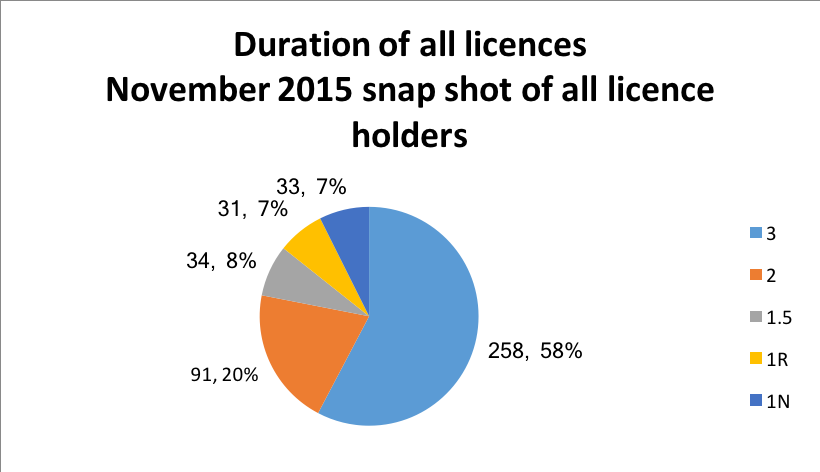
ALG figures, supplied by ACAD.
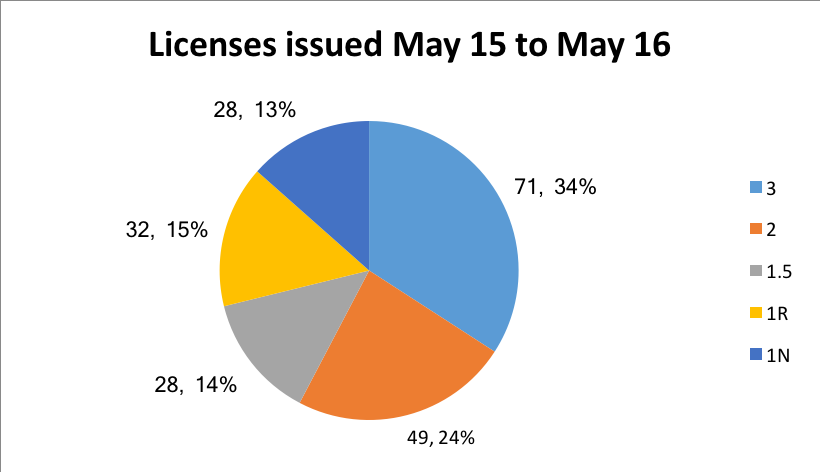
ALG figures, supplied by ACAD.
Excluding new licences (always one year) there has been an alarming drop of 23% in three-year licences issued in that period.
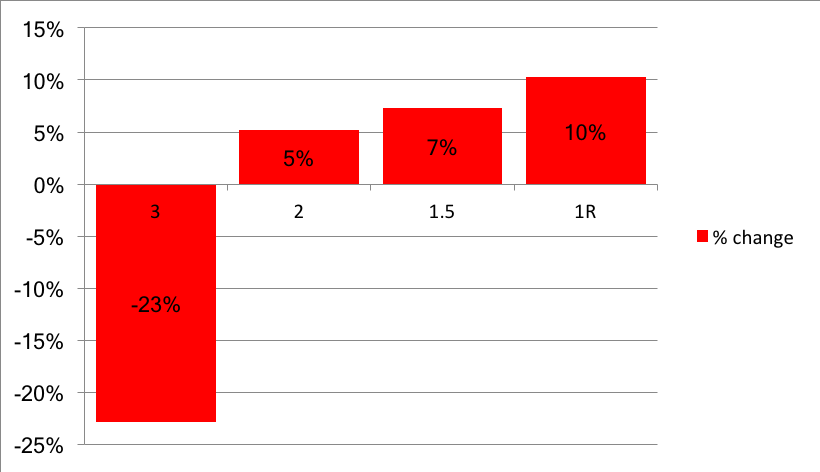
ALG figures, supplied by ACAD.
In my experience the industry, whilst there are some bad eggs, is getting much better. When I think back to the beginning of my career, where it seemed everyone had a three-year licence – the differences are remarkable. Now projects consider the wider job and recognise non-asbestos hazards. In fact, it seems a different industry with most of the stories of astonishing individual poor practice in the past.
So, if we are not getting any worse and the principle aim of a permissioning regime is to drive standards, why are the licence terms going down?
Could it simply be that there are less licensed contractors out there and the HSE want to exert more control. A tighter leash if you like? Certainly, the tone of some licence assessments and HSE visits indicate this.
The HSE tell the wider construction industry (and clients) that they shouldn’t use the licence term as a tool for selection. If the company has been given a licence (any licence) that indicates that they (the HSE) are satisfied and this should be good enough. The clients however (quite reasonably) take the view that well if you are concerned enough that you won’t give them a 3-year licence, then we are concerned too.
A licence holder can’t notify a project that extends beyond the licence expiry date.
We add then that the HSE publish the expiry date of licences – so if you track these things, you can plot a company’s standing. A client also instantly sees which companies can notify the project that they are considering. This might not seem a big concern, but very complex major works, might require 2+ years to complete – knocking out 65% of contractors.
With this in mind – are the HSE less inclined to reduce the term for a huge company? Do they back away when a downward tweak might stop a multi-million £ job in a power station? Certainly ‘the word’ is that they do.
The licence term is certainly a commercial driver.
In my opinion the HSE should remove the fixed term licence. The HSE should assess a company and give, or withhold a licence based on the interview and past performance during site visits. These licences should not expire (I hear howls of outrage).
What should replace it is a tailored review schedule for that specific contractor. Essentially, ‘Yes we are content for you to work with asbestos, but we want to see you again in 6 months, or 12 months or 3 years, just to make sure things stay on track’. A structured plan could therefore be put in place on what improvements must be implemented before the next monitoring visit.
The monitoring schedule would not be published and would not appear on the licence itself. This therefore could not be used for contractor selection. The pressure would be released from the HSE to grant 3 year licences for commercial reasons. There would be no issue of notifying jobs beyond the end of the licence expiry date – as there won’t be one. The HSE can concentrate on maintain and improving standards and do so in a much more structured way.
As I say this is an opinion piece, and I would welcome everyone’s thoughts and feedback.
I have been in the asbestos industry since the early 1990s, helping licensed asbestos removal contractors stay at the forefront of the industry.
Written by Nick Garland on Wednesday April 10th 2019
Schools are unique. In law, a school is a workplace, but the majority of people using them are children – sometimes as young as three. Despite the known vulnerability of children to pollutants, contaminants and other environmental hazards, when it comes to asbestos, schools are treated as just another workplace: they’re subject to workplace asbestos fibre limits, regulations and management approaches. And that’s a problem – both for our children, and the professionals who teach them.
Figures gathered by the National Union of Teachers’ Joint Union Asbestos Committee (JUAC) reveal that, since 1980, at least 363 of British school teaching professionals have died of mesothelioma, the cancer almost exclusively linked to asbestos exposure. An average of 19 school teaching professionals now die each year from mesothelioma – up from three per year in 1980.
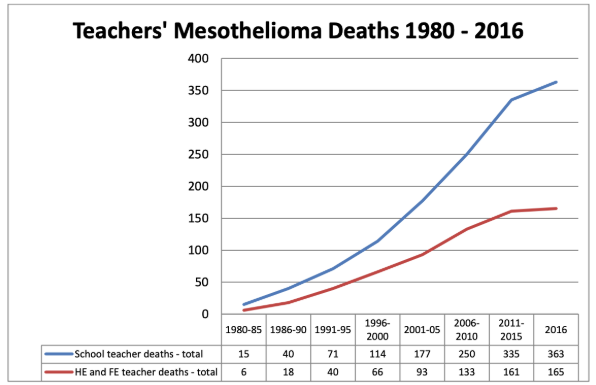
There are no equivalent figures for children, but we do know that each year around 2,500 people die in the UK from mesothelioma. Giving evidence to the Education Select Committee in March 2013, Professor Julian Peto – a leading expert in occupational carcinogens – estimated that around 200-300 of these deaths are the result of childhood exposure to asbestos in school.
The shocking figures are compounded by the fact that the onset of mesothelioma typically comes decades after the asbestos exposure which caused it. While the incidence of the disease in the general population is finally thought to be nearing a plateau – 20 years after the UK banned all asbestos imports and use – there’s no clear indication that the same applies to school-related cases.
The authorities can’t claim to be unaware of this risk. Back in 2011 the Asbestos in Schools Group – a multi-agency organisation chaired by MP Rachel Reeves – was damning, its report concluding:
Forty five years ago the Department for Education [was] warned about the increased vulnerability to children from asbestos, but for financial, commercial and political reasons the warnings were not heeded. Instead asbestos materials continued to be used in science and other lessons, and schools continued to be built using large amounts of asbestos.
Unfortunately it’s not just a historic problem. Scan the news for asbestos headlines, and on any given day you’re likely to find at least one story about asbestos being discovered, disturbed or removed at a UK school. Indeed, according to MP Meg Hillier, chair of the Parliamentary Public Accounts Committee, 85% of schools contain asbestos, and the risks become greater as those buildings age.
At present, the answer is not enough. Parliament says that the government doesn’t have enough information to address the problem, and it may have a point. The Department for Education’s first school property survey did not assess asbestos, and in 2016, when a second survey aimed to collect data on the issue, only a quarter of schools responded. When a third survey closed in 2018, 77% of schools had responded. Given the importance of the information, the survey was reopened and all remaining schools were urged to respond – the final results are due soon.
There’s no doubt the government needs more information, but there is a question over whether the survey will provide it. The safe management of asbestos-containing materials (ACMs) is a school’s legal duty, and the fact that they are hardly being forthcoming with high-level information about the presence and management of ACMs is concerning. Some multi-academy trusts (MATs) couldn’t even gather information about their private finance initiative (PFI) schools, which shows a worrying lack of accountability.
The detail of what is known isn’t especially reassuring, either. Of the 77% of schools which responded within the original deadline of the most recent survey, 68% were found to be “assured by the appropriate responsible body”. It’s a singularly woolly phrase, which means nothing to asbestos professionals.
According to the JUAC, “These latest findings show that many schools are unaware of the risk or the extent of asbestos in our schools.” With the poor response to the government’s latest survey, can we be confident that this has got any better?
But while the survey leaves us in the dark, we do know that most schools contain some form of asbestos. The UK outlawed the majority of the most hazardous asbestos types in the 1980s, but the final banning of all asbestos – including asbestos cement, floor tiles, artex and so on – only came in 1999. Any school built before 2000 could – and probably does – contain asbestos.
Sophie Ward sums up the fundamental issue: “The problem is that in many cases the asbestos is decades old and in a deteriorating condition, and when asbestos is in a poor condition, it’s more likely to release asbestos fibres.”
Children’s comparative vulnerability compounds the problem. Ward adds: “If a child is exposed at the age of five, they have five times greater risk [of developing mesothelioma] than an adult exposed at the age of 30.”
Against this background, it’s instructive to look at the Health and Safety Executive (HSE) advice to schools regarding asbestos, as follows:
The duty-holder’s responsibilities include:
Those most at risk of disturbing ACMs are tradespeople, caretakers, etc. The school’s plan needs to contain provisions to ensure that information about the location and condition of ACMs is given to anyone who might disturb these materials. The duty-holder should also ensure that staff likely to disturb asbestos are suitably trained.
As the Asbestos in Schools group pointed out back in 2011, aside from the addition of caretakers this is essentially the same advice that applies to any other employer. As with other premises, ACMs assessed as low-risk are managed in situ.
In an ordinary workplace, that can work very well. Surveyed, recorded and managed properly, ACMs should pose no risk – provided the management plan ensures that they remain undisturbed. Proper management starts with a management team that has the training and experience to properly understand the risk, and design and implement appropriate controls. Even in typical workplaces, that’s a big task.
A key component is identifying the people who might come into contact with any risk, and ensuring they know what that risk is. Anyone who might disturb the asbestos must have asbestos awareness training. In a normal workplace this would be the workforce, with tight controls for visitors and contractors. However, where the ACMs are in a classroom or a school corridor, the risk extends to children. The current rules require that this ‘workforce’ is trained – but clearly it’s hard to train away the risks of play, over-excitement, or a casually swung schoolbag.
Schools are essentially small businesses: employers, with all the duties of employment. Head teachers already have daunting responsibilities: is it reasonable to also expect them to manage asbestos for vulnerable building users? And yet, since The Control of Asbestos Regulations 2012, that’s become their duty. We have to wonder if heads are aware of this sea change in responsibility: have they been trained to take on the role, and are they properly resourced to fulfil it?
Again, the Asbestos in Schools group has been damning:
There has been a lack of asbestos awareness and a lack of resources so that schools have failed to adequately manage their asbestos. Numerous asbestos incidents have occurred and the exposure of the occupants has been widespread. The Medical Research Council concluded that it is not unreasonable to assume that the entire school population has been exposed to asbestos in school buildings. Teachers, support staff and children have subsequently died.
If our schools’ managers aren’t competent to manage asbestos, and the majority of our school population can’t be considered competent around it, and the government doesn’t know the scale of the problem anyway, managed removal would seem to be the only justifiable approach. Concerning a high proportion of the UK’s 32,000 schools it would be a big, expensive, time-consuming job, but our continued failure to act poses unacceptable risks to the most vulnerable in our society, and the professionals who teach and care for them.
Written by Nick Garland on Wednesday April 10th 2019
It is – or it should be – easy to identify when you’re working at height, but when does a work area constitute a confined space? You might think it’s equally obvious, but the seemingly subtle change in the regulations that occurred in 2014 has made some dramatic changes in what is and what isn’t a Confined Space.
For a workspace to be considered confined, there must be restricted access AND risk of one of five proscribed hazards:
A basement boiler house, for example, is largely enclosed and might have restricted access, but if the heat is turned off, it’s unlikely to be a confined space for the purposes of the Health and Safety Executive (HSE) guidance.
When the HSE updated its confined spaces ACoP (approved code of practice) in 2014, it specifically added asbestos-removal enclosures to the list of ‘largely enclosed’ areas which could be considered Confined under the guidance. Since then, all enclosures should have communication and escape procedures specific to that situation. Standard enclosures can be covered by standard procedures, but as soon as you add in a loft ladder it needs to be bespoke.
Because the first (enclosed) trigger is automatic for all enclosures, the risk of stale air, hot conditions, or fire will qualify many more asbestos projects. If the hazards can’t be avoided – for example by isolating heat sources or using different equipment – the confined space code of practice needs to be followed. That does not mean escape kits and tripods on all sites – but it does mean you need to specifically address the identified hazard, eliminate or mitigate it and factor it into your emergency procedures.
Some unusual work areas will now count as Confined, whereas others that were considered to qualify do not. An open air enclosure, in the height of summer – will be Confined because of the risk of heat exhaustion. A subterranean duct might not be!
Written by Nick Garland on Wednesday March 13th 2019
What is the point of the four-stage clearance (4SC)? It’s a serious question. If the point of removing asbestos-containing materials (ACMs) is to make an area safe for the people who want to live or work there, then the 4SC isn’t just boxes to tick on a form – it’s the final, critical part of ensuring that the area is actually now safe.
As a legally mandated check, the 4SC is there as an independently executed analysis of the licensed asbestos-removal contractor’s (LARC’s) removal and cleaning processes. If we can’t trust it to work, we can’t have faith in any of our asbestos-removal framework.
The Health and Safety Executive (HSE) knows this only too well, which is why in 2014/15 it conducted a thorough study into analytical practice in the industry. Finally, the report is out – although the November 2018 publication is still marked as a draft. What does it say, what can we conclude, and what comes next? Here’s my analysis.
First, some background. The 4SC is a legal requirement after any licensed asbestos removal work. It must be conducted independently, by a qualified analyst working either for the LARC (contractually, rather than directly), or the client themselves. It’s a test of the enclosed area within which controlled asbestos-removal has taken place and, obviously, it comprises four elements:
The second stage is widely accepted as the most important part: if there is no visible asbestos (including dust of any kind) then the air test is likely to pass.
Previous studies and anecdotal evidence indicate that audited 4SCs fail more asbestos-removal work than unchecked ones, strongly suggesting that a watched analyst is more diligent. While that may only be human nature, our primary interest here is in establishing a reliable quality standard. With something this safety critical, training and procedures need to work together to ensure consistent standards across all 4SCs.
The HSE’s investigation sought to explore if and where the current systems were failing, and establish how to rectify any problems. Its first step was high-level information gathering in the form of a questionnaire sent to all (as of 2013) asbestos labs. This was followed up by 22 head office visits, and 20 site inspections during 4SCs. The very first thing this tells us is that if not actually volunteers, all of the participants had at least some warning before they got involved.
In all, approximately 70% of analyst organisations gave information, and 15% of organisations received a head office and inspection visit. When in 2017 the HSE’s Dr Martin Gibson revealed some of the early findings, he made it clear that avoiding the questionnaire did not reduce the chance of getting a visit – quite the reverse, I would hope!
The HSE reports some raw stats:
Three-quarters (75%) of the companies reported that less than 20% of all 4SCs were not up to the required standard at the first time of asking. Just to clarify, that’s a LARC’s cleanup work being found inadequate in less than one in five cases. That sounds promising, but the extremes of the scale were astonishing. Two percent of labs stated that they failed over 80% of site enclosures the first time round, whereas about 10% of analysts said that they never failed clearances!
That’s a big spread, suggesting a big variation in standards, and the HSE is keen to address it. The report insists that analysts should provide photographic evidence in clearance certificates to back up their decisions. It’s a move that has long been telegraphed – and is becoming increasingly common practice.
Nearly all laboratories reported that some remedial work was always required to allow enclosures to pass at stage two (the critical visual check). Often, where this extra cleaning was ‘minor’, it was done by the analyst. But what is ‘minor’? One analyst reported cleaning, without the LARC, for over an hour.
THe HSE makes it clear – cleaning an enclosure is licensed work, and if an analyst does it they’re breaking the law.
Let’s not mince words here: the enclosure should be clean before the analyst gets to it. Not only should the operatives have cleaned it thoroughly, but the supervisor should have done their own visual inspection – just as diligently as the analyst is about to do. If it’s not clean, the LARC didn’t clean it properly, and every time this happens it should result in a failure. Only then can work standards, and those of the individual supervisor, be tracked and rectified.
The competency, or otherwise, of supervision was questioned by several of the labs, with some questioning whether supervisors had even completed their own pre-analysis visual inspection. Looking at the situation from the other side, I know that top-quality, diligent supervisors are recognised within the industry as the gold they are.
To address these process failures, the HSE is introducing two new measures:
Together these will constitute valuable management tools for LARCs who seek to monitor and improve their processes. By tracking how many HFs are issued before an area passes the 4SC, the LARC can assess the effectiveness of its own cleaning and supervision. The percentage of enclosures passed first time could even become a target for supervisors. At the same time, analysts need to be able to back up their decisions – hence the call for photographic evidence in clearance certificates.
At Assure360, we’re keen to support these processes. In Assure360 Paperless, all enclosures are formally passed (signed on the tablet) by the supervisor, and this data is emailed to management and the analyst. Once the analyst has completed their 4SC, they also sign for a pass or a fail. Because we deal in data, not ‘smart’ forms, the team can track progress in real-time, and we can report on trends at the touch of a button.
The HSE found that the understanding of personal protective equipment (PPE), primary and full decontamination was approximate. Some analysts wore normal clothing under their coveralls, and decontamination was often found to be poor, with analysts having no written procedures or training on the subject.
The report stresses that detailed written procedures must be in place for all analytical companies. These should insist that domestic clothing must not be worn inside enclosures, and they should include clear decontamination instructions – explaining when full and preliminary decontamination procedures are appropriate. They should also be followed by practical training on decontamination procedures.
What does the HSE think is suitable in this area? Read the draft report on the ACAD website, or read my Asbestos Analysts’ Guide white paper.
The HSE didn’t generally find fault with quality control, and found that in some cases QC systems were highly sophisticated. However, there were multiple flaws in the work in practice. The HSE noted incidents including:
In some cases, the HSE’s observations led to enforcement action.
Air testing procedures also showed some poor practice – predominately where analysts rushed the counting of fibres, potentially leading to under-recording of asbestos. The HSE observed this on site, but also by studying 4SC certificates after the fact.
While some of these failings could be connected to the pressures to just get the job done, to my mind the trend reveals flaws in the auditing and implementation of the QC process. If these failings happened literally in front of HSE inspectors, then they’re likely to be normal behaviour that’s been missed or ignored by the analytical companies’ own audits.
In all, by my reading of the report there seemed to be significant questions in about a fifth of site inspections. The HSE has called for a strengthening of the processes including that:
The HSE found the practice of personal sampling to be very poor – a personal bugbear of mine. Tests were predominantly run for only 10-30 minutes and included very limited information on what the operative was doing at the time. Together this leads to such small sample sizes that the reported results are high, yet provides no information to understand the result. In short, it’s near useless. Some analysts stated that licensed contractors were only willing to pay for the minimum of testing, but my experience (backed up by the report) is that LARCs don’t know what to ask for.
The Analysts’ Guide, when we finally get it, will help massively in this area, but in the meantime you can read my white paper on what’s in the draft version.
In contrast, the HSE judged background monitoring to be good, with accurate counting of fibres, plus floor plans and contextual information that illustrated clearly what was going on.
But here’s the issue: the skill set for both of these areas is fundamentally identical, and yet one was found to be very poor and the other excellent. This reveals a level of ignorance that still amazes me, and which isn’t restricted to analysts and LARCs. I have been in licence assessments where an HSE inspector has stated unequivocally that the a flow rate of one litre per minute is critical, and that exceeded this will invalidate the test. Wrong, but too many people believe that the rate is set according to how lungs work.
Tracy Boyle (ex-president of the British Occupational Hygiene Society) pinned Martin Gibson down on this at November’s FAAM conference. Essentially, the higher the flow rate the better. The bigger the volume of air tested, the lower the limit of quantification you can establish. These are the most important factors, and thankfully we will get clarity on them with the new analysts’ guide.
Finally, the HSE also flagged up concerns about potential overwork and conflicts of interest within the 4SC system. Compared to when I started my career, 25-odd years ago, there seem to be fewer analytical companies working directly for the LARC. Similarly the days of multiple clearances per day are also reducing, though 30% of analysts still reported completing two 4SCs per day. While three or more 4SCs in a day was very rare, four organisations admitted that it happened on more than 20 days per year.
The HSE acknowledges that by working directly for the client, rather than the LARC, analysts will avoid conflict-of-interest problems. Its report also suggests a contractual clause specifying who pays for remedial work and retesting when an enclosure fails the 4SC, removing any pressure from the analyst on site. Whether the client is the building owner or the LARC, though, poor cleaning should mean the LARC pays.
A number of companies commented that coming to an asbestos-removal job ‘cold’ interfered enormously with their ability to make a positive impact on the project. The HSE underlined the legal duty on LARCs and their clients to cooperate with the analyst, and the report recommends that the analyst be involved from the earliest stages.
Ideally, analysts would undertake a pre-removal scoping visit to feed into the LARC’s method statement, but alternatively they’d at least receive a copy of the method ahead of time so that they don’t go blind into the job.
The report’s final recommendation is that the HSE repeats the whole exercise after it publishes the final version of the new analysts’ guide. I’ve got my fingers crossed that might finally happen this summer. In the meantime it’s worth restating that I’ve based this summary on the draft version of the HSE’s analyst report, dated November 2018. I’m given to understand that it’s essentially final, subject to a spell check.
If it helps, I didn’t find any typos.
Written by Nick Garland on Wednesday March 13th 2019
Late last year the Health and Safety Executive (HSE) revised its Plan of Work (PoW) guidance – its third attempt.
The first was pretty awful, littered with duplicated effort and illogical formatting. Unfortunately, a good slice of the industry dutifully tried to implement it.
The second, Asbestos Liaison Group (ALG) memo 04/12 (commonly referred to as the ‘aide memoire’), was a huge improvement. It concentrated the contract manager’s mind on the recognised primary focus: a PoW is a tool for the site team, to help them complete the project safely.
As the aide memoire was so effective, it was a slight surprise to me that with the backlog of other priorities, the HSE was taking another run at it. So what’s the current guidance? Here’s a link to Asbestos Regulation 7 plans of work – purpose and core principles, and here’s my attempt to summarise it, and interpret some of the more controversial elements.
The first thing to note is that the memo’s target audience is the HSE’s own inspectors, rather than licensed asbestos-removal contractors (LARCs) themselves. As an internal HSE guide, expect to read language like ‘have they considered’, rather than ‘have you considered’.
But clearly, as a document outlining the approach the HSE will take to assessing PoWs, the memo is also of huge importance to contractors. We’re also told that the guidance will appear in the the new HSG247 Licensed Contractors Guide when we get it – possibly in 2020 – so it’s doubly important.
Thankfully, item two in the introduction states that: ‘A PoW should be a practical and useful document describing a safe working method for staff to follow.’
We should keep this very much in mind, as clearly the PoW will be used by others, including managers, clients, auditors, regulators, and the analyst conducting the four-stage clearance (4SC). But if the document is produced just to please the client and the regulators, and not with your supervisor and operatives at the very forefront of your mind, then it will have failed its primary purpose.
Before we get into the specifics, it’s worth drawing attention to the HSE’s guidance on making PoW documents readable and readily understood. Sensibly, it encourages the use of diagrams, flow charts and photographs as ways to provide key information and break up pages of text.
The guidance recognises different styles of the Plan of Work, from the fully self-contained, to those that make extensive reference to standard procedures. However, it cautions against the inclusion of very standard procedures, such as the bagging of waste and enclosure materials. The HSE’s logic here is that, presented with lines and lines of text covering the mundane, the site team could miss the one line of crucial detail.
The advice here is sensible, but I’d stress that a balance needs to be struck that finds the right level of detail for the team in question. Skills and experience can vary tremendously, and some workers need more guidance on basic procedure than others. If a project will involve new starters, agency staff or short-term workers (STWs), they’re going to need fuller descriptions and more information.
The guidance is structured into appendices:
All seven contain a mix of text and simple bullet points detailing what should be considered where relevant. Remember that I’m pulling out some highlights for you to consider, rather than duplicating everything: you can find the full text here.
There is a full page of bullets in this appendix, which are mostly things that a LARC would expect as standard. There are a few however, that some might have missed in the past.
While most methods include an upper maximum, the guidance is actually calling for the number of staff that will work, both within the enclosure and in support or supervisory roles outside. This is clearly much harder to put a reliable number against, and may vary as a project proceeds.
While the guidance is still only new, I’ve already seen instances where this is being requested by the HSE inspectors. The reason is the impact on how you intend to remove the waste. Will a 1m baglock be large enough to double-bag? Are other solutions to be used – e.g. passed as part of the 4SC process?
I’m going to allow myself to go slightly off topic here because I don’t think some LARCs always understand the double-bagging process. The two bags have to add up to 1,000-gauge polythene, and the outside of the outer bag can’t have been inside the enclosure. It’s this last bit that seems to pass some by. A single wrap made from 1,000-gauge polythene fulfills the first element, but not the second – so it’s not sufficient.
This is a key point. Removal of an asbestos insulating board (AIB) is different when done from a scaffold tower than it is at floor level. The method must detail all of the elements that are different – including getting that waste to the floor.
Welfare is key, and the guidance calls for it to be detailed in the method. It doesn’t matter whether it’s a one-month or one-day job, you need to consider it, make provision and detail those arrangements. This could be temporary cabins that you or the principle contractor (PC) provide – but for very short jobs it could be the use of onsite or nearby facilities.
The biggest impact in this section is where the guidance states that a PoW should detail how long the 4SC is expected to take. If we look at the analysts’ guide (which is still in draft at the time of writing): where timings are mandated, the visual inspections alone are very lengthy. The visual for a single AIB panel is predicted to take up to an hour, and as the supervisor also needs to do this before the analyst can start – a small enclosure can easily take 3-4 hours to sign off. Boiler rooms could be days.
Contractors must essentially agree in advance with the analysts the details and duration of the personal monitoring. As readers will know this is not always easy. Often the analyst is working directly for the client and not the LARC. But it is crucial to know what you want, and to train the supervisor in what to ask for.
What will the HSE’s analyst report change? Read my analysis
Identical projects in a nursing home, an empty warehouse or a demolition site will all be very different. They’ll throw up different answers to questions such as how you segregate your works from moving traffic, or vulnerable adults and children, and whether there are special hazards such as gas vents or live plant which will need to be made safe by specialists.
You will doubtless have a standard approach, but as soon as there is a working-from-height confined-space element, the standard approach won’t fit anymore. There is rarely one answer that fits all situations, and you may have to get imaginative. Sometimes, something as simple as having harnesses on hand that you can use to assist an incapacitated worker may be enough. Remember, too, that the confined space rules changed in 2015 – you can read my analysis here.
The HSE reminds its inspectors of the minimum requirements for all drawings:
In short, this appendix is all about sequencing. It is the raw planning, unique to every site, that the HSE expects to see. It involves answering questions relating to the order in which the job will be tackled. For example, if there are multiple enclosures, are they to be run simultaneously or one after the other?
The timeline needs to include hold points – very important elements of a job such as an electrical isolation, without which work cannot start, or cannot progress to the next stage.
In the case of longer jobs, the guidance also calls for a sensible breakdown of what is expected each day. If management, or the regulator, attend site on day 10, for example, they should be able to tell if the work is on target. The HSE may compare actual site progress against the schedule to draw conclusions about the standard of planning, the efficiency of the site team, or even the quality of its work.
The Timeline should contain the method proper – i.e. “We’ll do this, then this, then this” – so the HSE acknowledges that a PoW might not need a separate control measures section. Control measures could be in the timeline, in standard procedures, or even in site drawings. However you cover control measures, the following are key elements to keep at the front of your mind.
In our industry it is very easy to be blinkered. We’re experts in asbestos, and most contract managers can draft an excellent method to deal with it. But what about other hazards? Sometimes asbestos is the least of our worries. The risk assessment should always be done first, and the control measures included in the PoW.
It’s worth stressing this because it’s simply so important. Say we are dismantling an asbestos cement roof below overhead power lines: it would be very easy to design the perfect asbestos job, which endangers the lives of everyone on site. And while that’s clearly an extreme example, we commonly do work at height, in confined spaces, or near unprotected drops and other hazards. The core thing to remember is to always keep the risk assessment in mind when designing the whole project.
Beyond this critical issue, the HSE focuses on specific areas including the following:
Most of the material in the final appendix is relatively standard: it’s common to most load lists and I won’t repeat it here. There is however one unusual nugget: just listing ‘stepladder’ or ‘tower scaffold’ is not clear enough. The plan writer should specify how many treads the ladder should have, or the size and width of tower scaffolds and their working platform height. The idea is so that the right equipment can be hired, or the site crew know to load enough components.
Overall, this is a very useful document that helps focus the Plan of Work author’s mind on what is important – putting together a comprehensive plan to ensure asbestos removal work is safe and effective.
Together with the analysts’ guide it should help bring best practice situations into the mainstream, raising the standard of the PoW, and with it the quality and safety standards we can achieve across our industry.
Written by Nick Garland on Wednesday February 20th 2019
Assure360 Paperless is a powerful tool that transforms the way asbestos removal contractors work. Like most tools, the best way to see the difference it makes is with a hands-on demonstration. That’s why we’re holding free monthly webinars, where we explore and explain all the product’s brilliant features. If you’re interested, great – you can sign up here.
At the same time, we know not everyone in our industry considers themselves technical. If you’re wondering what a webinar is – let alone how the app works – don’t worry, check out our one-minute explainer video:
Sign up for the webinar and we’ll send you a link you can follow to join in from any browser. You can sit back and watch as we walk you through the product, and if you have any questions, simply type them in as they occur to you. The Assure360 Paperless webinars usually take an hour: although we stick around for as long as there are questions, you’re free to leave whenever you like.
So why not join us for our next webinar? Just click the link above to get started.
Written by Nick Garland on Wednesday February 20th 2019
More than 19 years since it was banned in the UK, asbestos remains widespread in our private and public buildings. It’s still there because removing it all presents a huge, hazardous and expensive challenge, but also because in most cases, managing it in place has been thought to be an effective safeguard.
However, despite strict rules, lapses and disturbances are common, and both workers and members of the public are still exposed to deadly fibres. There have been calls for asbestos to be removed altogether from the built environment, but such large-scale removal would inevitably involve challenges, not least of which would be the sheer cost of safely extracting and processing millions of tonnes of highly carcinogenic materials.
Asbestos is a naturally occurring mineral which we’ve used extensively: the two together mean that there’s a background atmospheric level. It raises the question: Is an asbestos-free world possible? Would it be worth the effort? Who would foot the bill? We spoke to industry experts.
The UK banned the use and import of all asbestos under the Asbestos (Prohibitions) (Amendment) Regulations 1999. Under the Control of Asbestos Regulations 2012, parliament created a legal ‘duty to manage’ asbestos in all non-domestic premises. Duty holders must:
There’s no explicit legal requirement to remove asbestos-containing material (ACM) if it can be safely managed and contained.
The current controls – backed up by Health and Safety Executive (HSE) enforcement – have been working to reduce asbestos exposure, but it hasn’t been eliminated.
In the light of ongoing incidents, in 2013 the European Parliament called for the removal of asbestos from all European public buildings by 2028. Two years later, the All-Party Parliamentary Group on Occupational Safety and Health said that UK workplaces should be made asbestos-free by 2035.
Despite this, UK and European law remains unchanged. To explain why, industry experts point to what we’ve already learned in more than 30 years of removing ACMs: it’s a risky, expensive business. Jon Chambers, QSHE compliance manager at Interserve Environmental Services, explains that the cost of removing all asbestos from all UK public buildings would run to many billions of pounds. But there are other fundamental concerns.
“The asbestos industry would not be able to cope at its current size and scope,” says Chambers. “The current UK industry standards are very high, but with increased workloads and short timescales, it’s foreseeable that standards of work would drop, [and this would directly] affect the safety of those involved in the works, and building users.”
These concerns are shared by many in the industry, including Martin Stear, a chartered occupational hygienist and fellow of the British Occupational Hygiene Society (BOHS) Faculty of Occupational Hygiene. “Removal would need to be done properly,” he says, “otherwise we would have massive problems, and years later find out that the standards [of work] were shoddy.”
There is, however, another major problem. With up to six million tonnes of asbestos thought to remain in UK buildings, removing it all would clearly overwhelm the current landfill system’s capacity to cope.
“If we remove all the asbestos, where are we going to leave it all?” asks Dr Yvonne Waterman, founder and president of the European Asbestos Forum. “Asbestos fibres do not degrade, so putting it back into the ground and covering it up is not a long-term solution.”
For Dr Waterman, the wholesale removal of asbestos would require “the policy and regulations, the manpower, the designated areas for storing asbestos, and many innovations to remove asbestos more effectively and cheaply.”
“In this context,” she warns, “2028 is practically tomorrow.”
Dr Martin Gibson, principal specialist inspector (Occupational Hygiene) at the HSE, has underlined the problem faced by the UK specifically. Speaking at the October 2017 BOHS asbestos roadshow, he noted that the UK’s industrial revolution was the world’s first. The UK was the first country to start importing asbestos on a large scale, and it imported the most: in the 1960s and 70s the UK imported 40% of the world’s capacity to produce amosite asbestos. The UK has so much asbestos that removing it all would be uniquely difficult, perhaps impossible – that’s why it has had to become so good at managing the problem.
Clearly, the safe removal of asbestos on this scale is a considerable challenge, which begs the question of whether it’s necessary. In the UK, around 5,000 people die each year from asbestos-related illness, but it’s forecast that the incidence of mesothelioma will halve between 2014 and 2035 as the UK’s 1999 ban begins to finally impact the disease.
The HSE position relies heavily on this analysis, which plots the weight of asbestos imported against the incidence of mesothelioma over time. If it’s correct, we’re at or near the peak for mesothelioma deaths, which will begin to fall in the next few years.
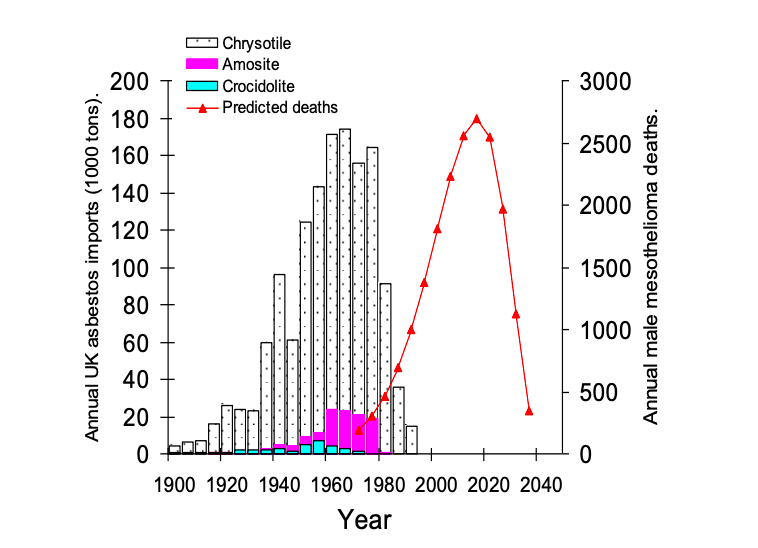
However, if we look at previous versions of this chart, we find that the peak has been repeatedly pushed back as death rates continued rising. Worldwide, mesothelioma mortality is showing the same kind of stubbornness, which some argue is due to increased environmental exposure despite increasingly widespread bans.
Despite effective management, continuing environmental, occupational and accidental exposure is likely to have consequences, and removing asbestos from buildings will only have an impact on the latter two. Generally, experts agree that removal is the ideal option, but only where the process is thorough, and safe for those undertaking the work.
In Europe many countries are actively pursuing ambitious programmes of removal from the built environment. In 2009, Poland embarked on a 23-year programme of asbestos abatement which includes widespread removal. In the Netherlands, the government is moving to ban – and require the removal of – all asbestos roofs by 2024. Meanwhile, the regional government of Flanders, Belgium, is implementing an ‘accelerated asbestos elimination policy’ to remove an estimated 2.09 million tonnes of high-risk ACMs by 2040.
Although none of these quite aim for ‘asbestos free’, it could be argued that they’re the necessary precursors to more widespread and complete action. In particular, despite the earlier European Parliament call, the EU is unlikely to act for some time.
“In the near future, more efforts are to be expected from individual countries than the European Union,” thinks Dr Yvonne Waterman. “The EU will, I expect, not regulate further on asbestos until its newest members have had a chance to catch up on the existing asbestos regulations – that’s a big job already.”
As pioneering and ambitious programmes, it’s not surprising that the Dutch, Belgian and Polish schemes described above face hurdles. In Poland, environmental organisations have already criticised the slow pace of asbestos removal, complaining that inventorying was incomplete and claiming that removal – theoretically due by 2032 – would drag on until 2080 at the earliest.
Even the Netherlands’ more modest scheme shows that the experts’ concerns are well-founded. Working flat-out, the Dutch asbestos removal industry lacks the necessary capacity to deal with all asbestos roofing by 2024. Not all homeowners can afford to replace their roofs, but grants are only available for roofs above a certain size – and many of these have run out already, way ahead of 2024. For others, the only option may be DIY-removal, which is permitted with some restrictions, but which may come with a counter-productive risk of greater contamination and exposure.
Holland has targeted asbestos cement roofs – because the erosion of the roofs has been found to allow asbestos fibers to be released into the air as the cement matrix deteriorates after thirty years. Also, over the years, weathering and water runoff leads to contamination of the surrounding soil. The Dutch scheme shows a potential pitfall of removal legislation: unintended consequences. Without adequate funding, this may lead to an increase in DIY roof replacement that may make the situation worse.
There are other key issues in any large-scale removal programme: cost, safety, the lack of capacity, and the need for safe disposal of ACMs. So, aside from the insights gained in these countries’ more narrowly focused attempts, what would be needed to support a national or international scheme?
For occupational hygienists like Martin Stear, it’s about setting appropriate risk-based surveying and removal standards, then ensuring they’re properly executed. “We’ve been removing asbestos on a large scale since the 1980s, but we keep going back to the areas we’ve stripped and re-cleaning them,” he says. “Areas are found to still be contaminated due to poor removal works – and sometimes even this is wrong. Sometimes an area is clean, but a surveyor has used an over-sensitive test and found some fibres.”
For compliance managers like Jon Chambers, any talk of a 10-year programme is completely unrealistic. He stresses that the industry would need guidelines and plans in place at an early stage to allow time for the necessary growth, and the required training and investment.
Addressing the problem properly would require a structured approach, he says: “I would suggest a risk-based programme where only hazardous materials are removed. Low-risk items can safely stay in situ for longer, and be removed further down the line.”
Unavoidably, any wide-ranging asbestos-removal programme would need to be enacted through legislation, and enforced and regulated by government bodies such as the HSE. As an example, Chambers suggests mandatory asbestos management plans for all public and private non-domestic buildings. “Make it a legal requirement that plans must specify the removal of all ACMs with a risk rating above a certain level, or any damaged or friable material,” he suggests.
Yvonne Waterman suggests that the key is to look at ways of making asbestos waste harmless – “We need a safe, effective and affordable denaturisation method. I am studying several quite different ones, because that is where the future of asbestos lies – being made into safe brick fillers in the circular economy. No more waste, no more dangers for future generations.
“The legislator and the asbestos-removal sector would need to work very closely together, each supporting the other. Additionally, we would need to find a safe, effective and affordable eradication method.”
In addition to the need for political will and the inherent complexity, there’s no getting away from the fact that removing all asbestos would be a colossal expense. “It is only money that could really make it work,” says Jon Chambers. “There would be a huge cost to any large-scale removal, and I have no idea where the money could come from.”
Yvonne Waterman agrees. “Eradication is hugely expensive, and we are hardly in a flush economic period. We would all like to have an asbestos-free country, but let’s be realistic: who will pay for it all?”
In a sense, however, we are – slowly – removing asbestos from the built environment. Managing in place is only possible for so long, and as ACMs reach the end of their life, or the buildings that contain them are refurbished, gradually they’re being removed. Older asbestos-containing properties are being demolished altogether. Provided the work is done with the proper controls, to the appropriate standards, the process is constantly reducing the amount of asbestos still ‘out there’, and lowering the risk of exposure. “Over the past decades, we can see that the air quality in terms of asbestos fibres in the Netherlands is improving considerably. This proves that the asbestos ban and regulations are effective.”, says Yvonne Waterman.
We’d all like to see faster progress, and perhaps in different times there will be the political will to pay for it. In the meantime, Jon Chambers reminds us of the simple, vital reason for the industry to carry on with its work: “The removal of asbestos safely will save lives in the long run.”
Header image by Flickr user Chilanga Cement, Creative Commons
Written by Nick Garland on Sunday December 23rd 2018
Horizon Environmental Ltd is a private, independent company led by a management team with many years of providing asbestos removal and environmental services to the domestic, commercial and industrial sectors. Horizon has grown rapidly over the past five years, routinely undertaking very large complex projects. Horizon is dedicated to maintaining the highest standards in all dealings with employees, customers, suppliers and the public. It believes in upholding practices that create long-term value, and which enhance Horizon’s reputation for safety, integrity, and professionalism.
The team had grown significantly in recent years and alongside this expansion came additional asbestos removal auditing paperwork for everyone. In particular, the burden of site specific paperwork fell to the supervisors and leadership team, who were tasked with overseeing multiple asbestos removal audits and large amounts of related auditing paperwork and admin.
As an extremely competent and experienced team, with a three-year licence, they were always looking for ways to improve and be more efficient. They knew their paper system, whilst laborious was essential, but felt that there had to be an alternative.
Horizon were keen to get some support from an expert provider and find a solution that could save their supervisors time, while being easy to roll-out across the business without requiring large amounts of training. The also wanted something that could be installed without spending large amounts of money on new equipment.
Horizon decided to rollout the Assure360 Paperless app in Autumn 2018 and, following advice from the technical support team, assigned a few of their supervisors to get training and support the roll-out across the organisation. This rollout took just a matter of days.
With the introduction of Assure360’s Paperless App, the team had a digital support tool that meant Horizon’s supervisors could eliminate all their asbestos removal paperwork and record safety critical checks including everything from site registers, times sheets and inductions to exposure, RPE checks and site diaries through the app.
Not only did the team become more efficient and productive, they were able to get rid of their bulky folders with reams of paper and use their iPads instead. It was a perfect asbestos removal solution for the team and one that the supervisors believe has been transformative for the business.
One supervisor, Craig Toomer, who had over 12 years in the industry, was one of the super-users appointed to get Paperless set up. He was an ideal superuser, as he knew first-hand the amount of paperwork, rigorous tracking and time the auditing process entails. Despite how time consuming and inefficient their existing paper system was, he knew that a lot of people in the organisation were familiar with it and might be reluctant to change.
He also knew that a lot of the team were technophobes and were not 100% confident when it came to software and apps; himself included.
‘At first I was very daunted when I heard what was going to happen. I’m not very technical. I can use my iPhone but that’s about it,’ Craig said. ‘I have to say I was taken aback by how simple it was. I picked it up very quickly and now I much prefer it to paper.’
‘The extra time it gives me to supervise them makes my life so much easier. I’ve been using the Gold version, which deals with all of the personnel checks, RPE checks, timesheets, site register and exposure and can’t fault it.
‘It’s also means I have everything on an iPad rather than a huge site folder. Even on a short project it saves me a huge amount of time. I can’t wait for the full Platinum version, which will take care of plant and enclosure checks as well. I am confident it will be absolutely superb.’
Craig Toomer
Supervisor
Want to see how Assure360 Paperless could cut through paperwork and unlock efficiencies in your business? Discover more in our free monthly webinars“.
Written by Nick Garland on Thursday November 29th 2018
The inaugural FAAM (Faculty of Asbestos Assessment and Management) conference on 8 – 9 November lived up to expectation. Not just a one day seminar, this was a rigorous academic conference with internationally recognised speakers.
The asbestos conference opened with the inspiring Mavis Nye, the first mesothelioma patient to enter remission and the founder of the Mavis Nye Foundation. Her and her husband Ray, and others just like them, are the reason we do what we do and they certainly keep me going.
The keynote speaker on Friday, Dr John Moore-Gillon, shared the other side of that same story, the diseases and their treatment. He talked about his 42 years as a doctor: the first 37 years saw incremental change in treatment but the last five have seen extraordinary progress. ‘Today, there is no point in writing a textbook on cancer treatment’, he said. ‘It will be out of date before it gets to the publisher’. This was one of the stand out moments for me at conference.
We were all plunged early into a fascinating talk on how to understand raw data and translate it to actual risk. As professionals, we may believe that we can do that already – but the reality is typically that we go from the readings to an assessment via opinion and experience. Some of us may go back to WHO figures – but there is a great deal of ‘us’ in the end result. Andrey Korchevskiy and Andrew Darnton brought us back to published research. They presented a simplified method of using this data to produce lifetime risk answers and the probable extra cancer cases that would result from that exposure.
Next came three related presentations:
All three had enormous detail and on the surface were very different, but they had a common thread running through them.
Talc.
The scandal in the US has, ridiculously when we think about it, seemed so far away, almost not real. But running through all of these talks was the fact that the mineral talc is formed by exactly the same geological conditions as asbestos is. This means that most, if not all talc mines, also contain asbestos to a greater or lesser degree. The risk is recognised to an extent by the mines and quality control put in place to eliminate the contaminant. However, the techniques used are woefully inadequate resulting in an erroneous clean bill of health.
If we look as Sean Fitzgerald does with transmission electron microscopy (TEM), or scanning electron microscopy (SEM) the story is very, very different. He illustrated that with a modified preparation technique, the very fine fibres that are invisible to the standard technique are revealed.
All three talks discussed the global nature of the talc mining industry and consequently how much of the talcum powder in the world is contaminated with asbestos.
David De Vreede talked about his campaign to highlight the dangers of asbestos in talc. He was instrumental in alerting the EU to asbestos found in some of Claire’s products. The EU subsequently sent out a recall of those products back in April.
Yvonne Waterman and Jasper Kosters continued the theme of the inadequacy of standards and testing of talc used in Europe.
I guarantee everyone there was thinking about the cosmetics in their hotel room and back home.
John Addison (the John Addison) came next with his talk on amphiboles. This left me with more questions than answers – as a 30 minute talk on such a broad subject will inevitably do. Rather than there only being five amphibole species – there are in fact over 100 – and these are just the ones catalogued by Mindat.com. All of these can cleave, causing elongated fibres in the respirable range. But does this make them asbestos?
Asbestos or ‘asbestiform’ is a term we use to describe the capacity to produce hazardous fibres. The definition is as follows:
Then comes birefringence. Summarised brutally – when we pass light through a mineral suspended in special fluids, we see different colours depending on the direction that light passes through it. When specific colours are observed this is the final evidence we need for identification. Here would be a ‘positive result’ for chrysotile (Taken from HSG248).

John argues that the key test that is not always performed in the lab is durability – can the fibres be bent without breaking them – or does it splinter like bamboo? If it can’t, then even if the birefringence indicates ‘asbestos’ then John would argue that it isn’t.
However regular analytical laboratories would not have the skills, never mind the accreditation, to positively identify these rare species.
He also added that most of the soil in the midwestern states of the US contain amphibole minerals (from the last ice age). John posed the question – if they all qualified as asbestos,- where are the bodies?’
I’m not sure where that leaves us, but I am certainly going to look further.
The morning of the second day ran through analytical techniques – Phase Contrast Light Microscopy (PLM), Scanning Electron Microscopy (SEM) and it’s big brother Transmission Electron Microscopy (TEM). In talk after talk we had been told how inferior PLM was to either of the two electron methods. But, the speed of the test and the relative cheapness means that many more instant tests can be made.
Building on this, Jean Prentice reminded us all of why PLM was selected in the first place and where it sits in the analyst’s toolbox. I started my career in the early 90s. My mentor at the time still referred to visual inspections as being relatively new, before that the analyst only had an air test to pass or fail some work. Unsurprisingly, as all enclosures were dripping wet, many filthy enclosures (in the absence of a visual) would pass first time. The HSE’s position is that the most important part of the Four Stage Clearance (4SC) is the visual. Get that 100% right and the air test will probably be OK. A key feature of the airtest is therefore the speed of response. Within an hour or two of starting a PLM test, the analyst knows whether there is a problem or not. Being secondary, it is merely a final indicator on whether something has been missed in the cleaning process.
What is the purpose of the 4SC? Jean reminded us that it is in reality a quality control check on the LARCs cleaning. It is not intended as an absolute measure of how much asbestos has been left in the area – there should be none. She asked the question – would increasing the sensitivity of the air test improve standards? Would lavishing more time and money by moving to SEM analysis help? Or would this distract us from the more important stage – the visual? Something I had lost track of and represented a moment of clarity for me.
Dr John Moore-Gillon, the keynote speaker, who closed this asbestos conference, was truly inspirational. He built up his presentation, giving us real insights into the various asbestos-related diseases and the seemingly insurmountable challenges they present. The sheer scale of a developed mesothelioma tumour is daunting.
Written by Nick Garland on Friday November 9th 2018
There’s no getting around it: construction is a high-risk industry, and specialist fields such as licensed asbestos removal especially so. In the UK, the ground-breaking 1974 Health and Safety at Work Act has gone a long way toward creating a culture of safety: fatal workplace accidents have fallen six-fold in the intervening 44 years, while employer-reported non-fatal injuries fell by 58% over the 30 years to 2016/17.
Yet the nature of the industry is that accidents, incidents and near-misses still happen, with their associated toll on workers’ health and wellbeing – not to mention the emotional, financial, regulatory and reputational fallout for employers. As a licensed asbestos removal contractor, the most important assets you have are your employees and your license. What should you do to help manage and minimise the risks inherent in your work?
It’s imperative to identify the strengths, weaknesses and skill levels across your employees, at all levels in the organisation. Not only will it allow you to ensure that projects are staffed with appropriately experienced and qualified employees, it will allow you to support any identified weaknesses with corresponding strengths.
Audit, audit and audit again: only with direct observation can you truly understand behaviour. You shouldn’t just focus your efforts on the supervisors, even though they are the easiest. It’s vital to include the full workforce in a comprehensive health and safety auditing scheme – contract managers, operatives, the admin team, stores and even the SHEQ (safety, health, environment and quality) department all have enormous impacts on the smooth running of a project.
Clearly this increased observation – not to mention the analysis of the extra data – is a task in itself, so significant thought should be put making the process as effortless as possible. If the solution is complex or time consuming, it will impose barriers and won’t be implemented effectively.
Once you know in great detail what you are facing, where the weaknesses of the team are and where you need to add extra support, you can do something about it.
You are now faced with a huge opportunity. If your team is great at A, B and C – but weaker at D and E – then you don’t need to waste time on training the first three. Having a clear idea of current skills lets you plan and deliver more focused and effective training, effectively improving skills and optimising your staff development budget.
We’re back to auditing – but now we look at the same data from a different angle. All the audits you did to get a comprehensive understanding of your team are an excellent basis from which to learn valuable lessons. Say that X, Y and Z went wrong on a site. Ask Why? What can we do to make sure it doesn’t happen again? Are there any trends building up? Are there any linked underlying causes?
Having a dashboard or high-level view that allows you to see your projects globally – or all of your team at a glance – will unmask seemingly discreet linked issues. Strategies can then be designed to get ahead of these issues before they become a major headache.
Everything I’ve been saying so far should be the standard approach for any industry, but the next is particular to asbestos removal. Measuring the exposure to asbestos is another way to test the success of a project. When removing asbestos, it is inevitable that there will be some exposure for the workers you task with the job. As employers it is our moral and legal duty to measure and minimise this.
You can’t be specific enough when it comes to monitoring exposure. And with this detail – so long as it’s recorded correctly – you will be able to directly measure the success or failure of a particular method. Treat any spikes in exposure as an accident. Investigate immediately, find the cause, and change the method. Success can be rolled out to other projects, failure can be learned from to drive change.
The key is that – just like audits – a simple but clear system needs to be designed that allows you to do all of this at the touch of a button. Any obstacles means that at best it is a task that will be delayed. At worst it could be put off entirely.
The HSE tells us that the average cost per non-fatal injury is £8,200. If you include litigation (private or regulatory), the financial and reputational cost rise exponentially.
Near misses are the accidents and incidents that didn’t quite happen. Rather than a collective sigh of relief and a ‘let’s forget about that…’ we should be gathering and analysing this health and safety gold.
There is considered to be a direct relationship between the number of near misses to the number of minor and major accidents. Heinrich, Bird and the HSE have all produced accident triangles: here’s the HSE’s one:
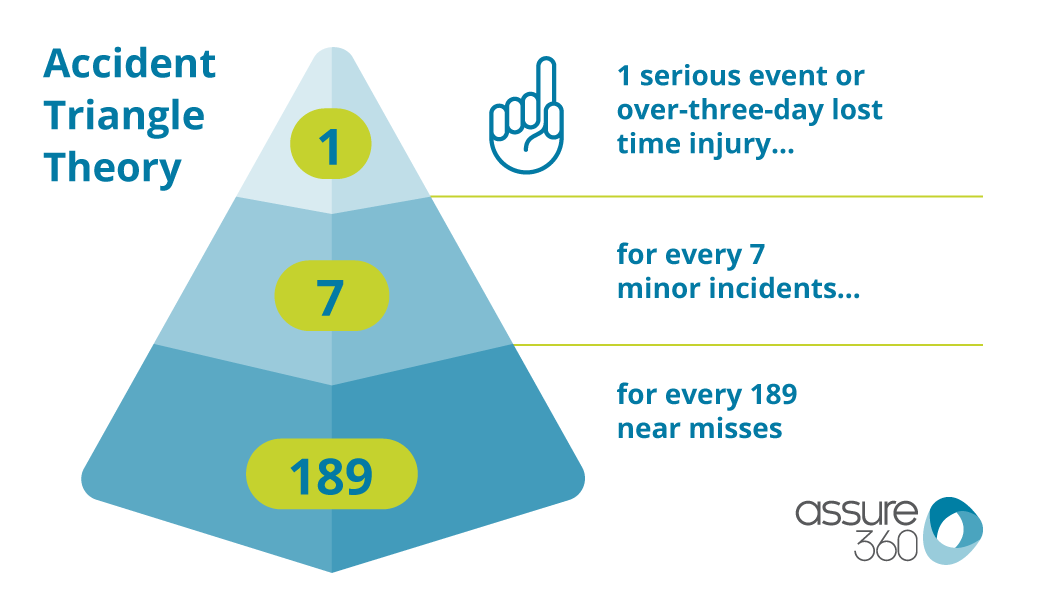
Any accident that didn’t happen is a warning of what might have happened. If we can learn and implement change before something has occurred… well, I don’t need to labour the point.
We first have to get over the natural human response of ignoring a near miss. Who would want to get someone into trouble when no one actually got hurt? However, the correct way of looking at this is: “That was close. Right, what can we do to make sure it can’t actually happen?” It’s an education process. Encourage the reporting of all near-misses through talking, explanation and rewards: regular analysis of the data you receive will allow you to preempt accidents.
One huge advantage that every licensed asbestos removal project should have is the supervisor. You have someone on site whose primary role is to ensure the job runs safely and to plan. There are obvious competence questions here that I have dealt with earlier, but the other unavoidable issue is paperwork.
Certainly with asbestos projects there are a multitude of safety-critical checks that have to be completed every day. No one would argue with that. Importantly though, the supervisor has to record that these checks have been done. Whilst this is unavoidable, it does take time away from supervising the works, reducing the supervisor’s impact in helping to prevent accidents.
Streamlining this paperwork will release the supervisor so that they can supervise – shifting their focus more towards overseeing and ensuring workplace safety.
Asbestos removal combines many common construction dangers with the specific risks of handling a highly toxic material. You can’t entirely remove the risks from such an inherently hazardous activity, but:
Get all five nailed and you have the fundamentals of how to de-risk your business.
That’s exactly what has driven the development at Assure360. With the combination of intuitive apps and a powerful database, our entire solution is directed at streamlining and simplifying H&S effort. Audits are made easy – and the legwork required for analysis largely eliminated. Exposure monitoring is instantly analysed to allow a constructive review of the success of each method. Incidents, accidents and – importantly – near-misses can be reported directly without adding to the paperwork.
All of this gives you unparalleled understanding of your people and your projects, but in a fraction of the time. Now, with the introduction of Assure 360 Paperless – the first out-of-the box solution for the supervisor – we free them to get back to what they do best: supervising.
Want to discover more? Get in touch today to book your free demo.
Written by Nick Garland on Friday October 5th 2018
Here are some dates for your diary – Nick Garland has put together his list of upcoming events for asbestos and construction safety professionals. We’ll update this page regularly.
27 February 2019
Join our February webinar and find out why more and more supervisors and managers in the asbestos removal sector are using our latest Paperless app to streamline on-site paperwork. Created by our expert team, Nick Garland will take you through everything you need to know about the system and demonstrate how it saves teams time and money. If you’d like to register for our February webinar simply sign up and we’ll send you more information.
18 February 2019
University of Reading, Agriculture Building, Whiteknights Campus
In this free evening event chaired by IOSH vice president Michelle Muxworthy, the IOSH addresses the role and significance of asbestos in workplace cancer.
1-4 April 2019
Hilton Brighton Metropole
Occupational Hygiene 2019 is the leading conference in the field of worker health protection in the UK, focusing on occupational hygiene and the prevention of occupational ill-health and disease. The conference programme combines inspiring and thought-leading plenary sessions with scientific and technical sessions, as well as a range of interactive workshops and case studies. The conference will bring together researchers, practitioners, regulators and other experts from around the world to discuss the very latest in issues that affect health at work.
9-11 April 2019
The NEC, Birmingham
The Health & Safety Event provides the perfect networking and educational opportunity to anyone responsible for running a safe and efficient workplace, anywhere in the UK. The CPD-accredited seminar programme will feature over 130 speakers from across the world of safety, fire and facilities.
6 June 2019
Location to be confirmed
Save the date for the annual ACAD golf day and awards dinner.
11-12 September 2019
The NEC, Birmingham
Registration for the Contamination Expo Series 2019 is now live. Claim your complimentary tickets to the Hazardous Materials Expo with seven events making up the Contamination Expo Series. The Assure360 team will be on stand J7, opposite ACAD.
If you’re hosting or attending an event you’d like us to list here, please get in touch.
Written by Nick Garland on Tuesday October 2nd 2018
It’s been a fortnight since Contamination Expo 2018, and those of us that attended, exhibited or spoke have had time to decompress. I say that because, for those who haven’t done an Expo yet, it is something to behold, and leaves you somewhat dazed.
The 2018 event was a big change on previous years. Relocated to the NEC in Birmingham, it was significantly larger, having been merged with the established RWM (Recycle and Waste Management) Expo. Both changes together meant we had to plan our visit a bit more carefully, and had me wondering – would Assure360 be invisible in such a large show?
I needn’t have worried. The whole event was a great success, with our Expo Fringe meet and greet session a particularly positive highlight. Here we got the chance to share drinks, nibbles and a Q&A with customers and new contacts, and the evening evolved into some free-flowing customer feedback. The fact that we’re now in discussions with some potential new customers is a welcome bonus.
We officially launched our new app and database solution, Assure360 Paperless, which addresses one of the industry’s biggest challenges. Asbestos removal is hazardous and highly regulated, so licensed contractors need to complete – and record – a vast number of safety-critical checks. Once a project is finished, checking the associated paperwork can take the admin team days or weeks.
The onsite admin consumes hours of valuable supervisor time, but until now the only alternatives have been expensive bespoke solutions usually built on ‘smart’ forms. And while these may save time on site, they’re effectively bits of electronic paper: they don’t reduce admin.
Assure360 Paperless is the Holy Grail for the asbestos industry, solving the admin problem by applying our granular, data-based approach. When any check is converted to data, we can instantly report on just that tiny element – not an entire form. Also, as it’s data, we can automatically sense-check it – massively reducing the admin time required afterwards.
Whilst we are a data company, I am asbestos and H&S, so when we create a solution it’s with a fundamental understanding of the industry. Assure360 Paperless applies our insight, freeing the supervisor to supervise, and increasing productivity throughout all aspects of your asbestos removal projects.
Interested? Discover more about going Paperless.
At the event itself there were numerous fascinating talks, but two that stood out for me were by Graham Warren from ACAD, and Yvonne Waterman and Jasper Koster of the European Asbestos Forum (EAF).
In their talk on hidden asbestos, Yvonne and Jasper presented frankly shocking revelations of just how much of the material still comes into Europe, despite national prohibitions.The list of sources went on and on, and included items such as children’s toys, electrical goods and jewellery. My jaw dropped at the revelation that China permits products to be described as ‘asbestos free’ if they contain less than 10% asbestos.
If you get any chance to hear Yvonne and Jasper speak, you should take it. I’ll be sure to highlight any future events they’re attending in our events calendar – roll on the next EAF conference, in 2019!
In his talk, ACAD’s Graham Warren had some startling figures for the ‘average’ licensed contractor. By dividing the number of supervisors and operatives in the industry by the number of licence holders, he revealed that the average LARC has about 14 operatives, and seven supervisors. If we accept that NVQs are the industry’s baseline competence qualification, and that going through the Construction Industry Training Board (CITB) costs about £1,000 per operative and £2,000 per supervisor, the average qualifications bill works out at a minimum £28,000 per company.
But ACAD has driven through changes in how NVQs are delivered – first and foremost by creating a dedicated training centre, open to all. ACAD provides the centre and the internal QA, but anyone suitably qualified can take candidates through. The new structure looks like this:
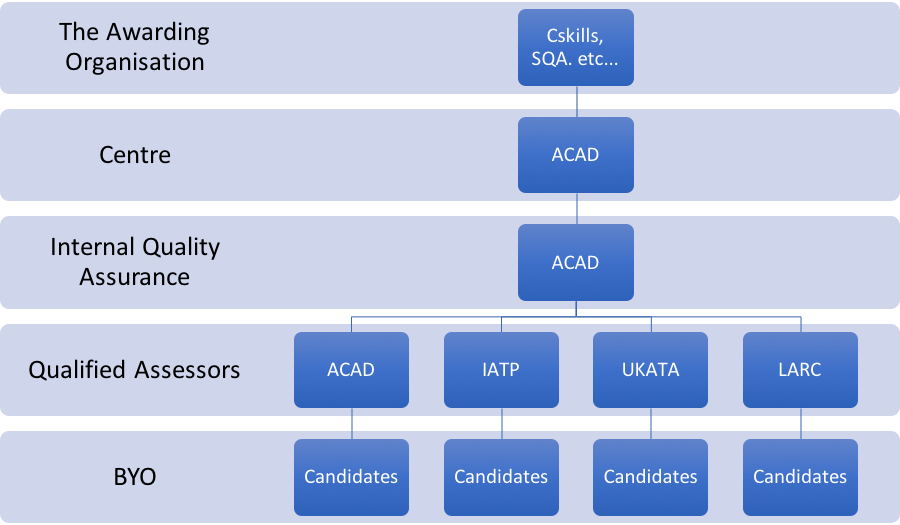
This egalitarian structure is a striking change, and it should address the fears of traditional training providers that the big boys will steal their lunch. It also introduces another interesting angle: there is nothing to stop a LARC getting suitably qualified at a local college and taking its own folk through the process. For this to be practical, of course, that LARC would need a detailed and comprehensive competence assessment system – all Assure360 users have this by default.
If an average LARC takes its own staff through the ACAD centre, that scary £28,000 training cost comes tumbling down to only about £7,000. And if that company is a CITB levy payer, it could benefit from grants to the tune of £15,000 – potentially netting an £8,000 ‘profit’ on the process.
All in all, then, the Expo was exhausting, useful and very interesting. We’ve booked again for 2019 – see you there!
Written by Nick Garland on Thursday September 27th 2018
The data collected by Assure360 gives us unique insight into the issues our peers in the safety industry tackle during site audits and tech reviews.
Assure360 is the only community audit and compliance tool available for the asbestos removal and construction industry. With over a hundred safety professionals using the system – so far they’ve completed 4,355 audits – we are developing real insight into the challenges and issues our clients and peers face and overcome. As a result, Assure360 has the power to genuinely improve the construction industry.
It’s been a great year so far. More than 10% of all licensed asbestos removal companies now benefit from our system. The 4,000th audit was completed by one of our Gold subscribers, and in July we hit a record of 159 audits and competence assessments in a single month.
If you’re familiar with these posts, and the Assure360 system in general, you’ll know that the data not only incorporates site audits, but records tech reviews during the planning stage. This allows managers to learn from common issues picked up by their peers – before the project goes live.
We regularly share the community’s findings with our army of independent auditors through our customer newsletter (scroll down to sign up). Let me walk you through highlights from the most recent findings, covering audits and site reviews in June and July.
If we look at the overall top 10 we see that it is very much method statement focused. However, if we look a little deeper I think there are some interesting trends developing, notably around risk assessments – both during the planning and on-site phases.
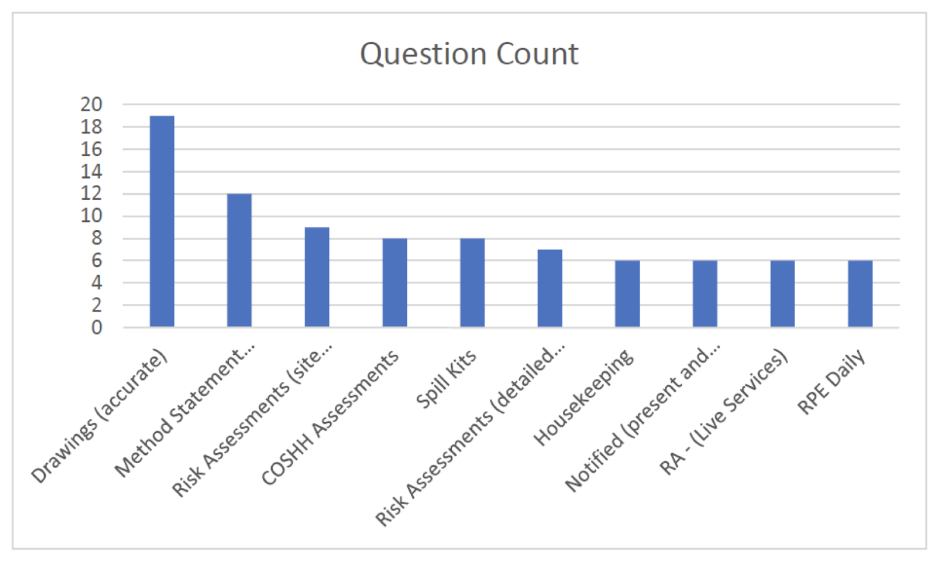
The top 10 looks like this:
I’ve long championed thorough risk assessment, and the latest results see a comparative surge of issues around them. Appearing mid-table, Risk Assessments (detailed in method proper) relates to assessments at the project planning stage. Risk Assessments are all-too-often an afterthought in the asbestos industry, where in fact they should be the first thing written. Logically if you have identified, say, that there’s a noise and vibration issue involved in a asbestos removal project, the method should detail precisely how all three of these challenges are to be overcome.
A familiar example might be where asbestos insulation removal is detailed, with the detail for the actual cutting restricted to “…cut out with reciprocating saw to 1m lengths.” Methods should state the trigger time, task rotation, and when to wear hearing protection.
Risk Assessment (live services) continues to get the attention it deserves. Interestingly this relates to the site level, i.e. where site teams have not followed procedure, rather than where issues haven’t been considered in the plan.
Happily, there’s a new Assure360 development that will help supervisors. All existing Gold subscribers now get access to our new Paperless solution free of charge.
Quite simply the holy grail of the asbestos removal industry, Assure360 Paperless is a secure and powerful system for recording checks. It’s designed to save time for the supervisor, allowing more time in which to actually supervise. Why not contact us to arrange a demo?
Assure360 is not a dumb ‘smart form’ or isolated tablet application – it’s linked to a powerful cloud database. Its sophisticated system of automatic reminders and dashboards, ensures the right people deal with the issues at the right time. Meanwhile, the system encourages you to always examine the data to ask ‘what could we do to prevent this happening again?’. Everything is dealt with – root and branch, and this month’s results suggest that the approach is working.
How does this data compare with your own audits? Do you have a tool that can help you monitor and tackle these issues, saving you time and money and keeping everyone on the project up to speed?
Let us know what kind of data you’d be interested in seeing, and if you’d like a demo, please get in touch.
Written by Nick Garland on Wednesday July 18th 2018
The Grenfell disaster was, among many other things, a failure of building regulations to protect residents. It’s clear to me that the Hackitt Review had to re-learn the lessons of work health and safety, and with Dame Judith a previous head of the HSE, I awaited her review with some optimism. Here’s why I believe she has grasped the opportunity. (more…)
Written by Nick Garland on Friday April 13th 2018
The HSE’s assessment process for asbestos licences is rigorous – rightly so. Find out why so many of our clients at Assure360 are being granted three year licences, and how we could help you to get yours.
Becoming a licensed asbestos contractor (a LARC) is no easy thing. The HSE’s assessment is rigorous. They grant licenses for up to three years, but only a third of LARCs have this kind of licence – most have licences granted for periods of two years or less.
The last statistics widely shared by the HSE show the split for asbestos licences to be:
Licensed asbestos contractors (LARCs) produce method statements and documentation far more detailed and considered than their construction counterparts. They spend vast sums on training staff, and ensure levels of supervision beyond what other industries would even consider. Exposure monitoring has been a challenge, but the tests are done in line with guidance and by skilled analysts.
But when asked in the assessment:
too often the answer is a jumble of files, hard-to-decipher Excel spreadsheets, and in the worst case scenarios un-actioned paper audits. All these solutions are labour intensive – and as such tend to slip when workloads increase.
So why is assessment so challenging? Well, it’s meant to be. Asbestos is the most regulated industry after nuclear and as a ‘permissioning regime’, only the best companies should be given the stamp of approval.
With Assure360 Audit – our easy-to-use solution – all of these key tasks are made easy, and streamlined. With this treasure trove of time handed back to the team, they can focus on managing the projects. And better managed projects are more likely to be completed safely and on program. Simple.
Let’s look at the data on licences again, and this time compare all licence terms with the terms given to Assure360’s clients.
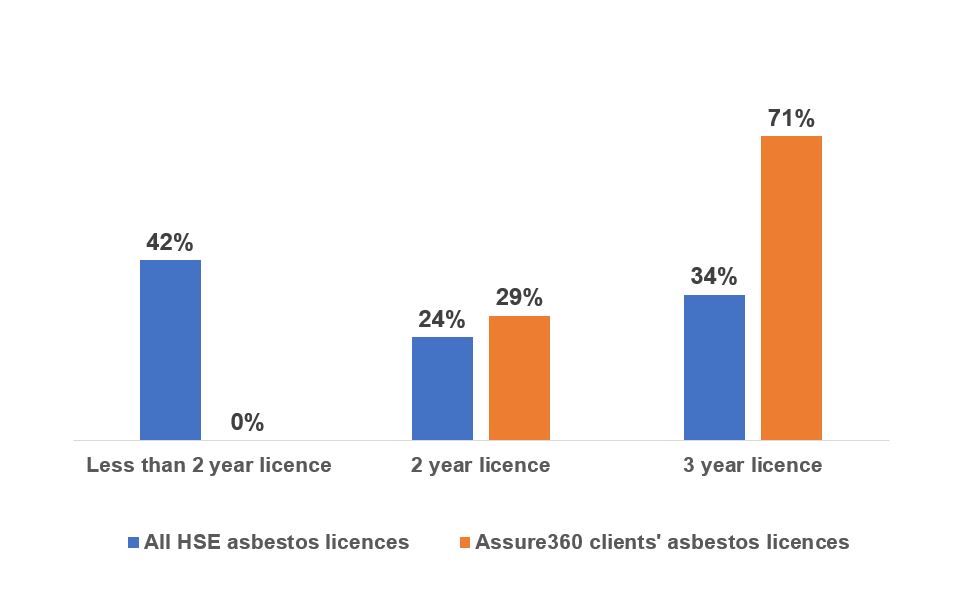
While we’re certainly not claiming all the credit for our clients’ high standards and competence – a great deal of expertise, hard work and dedication is needed from the entire team to perform to these high standards. But we feel there’s a relationship between the high proportion of three year licences amongst our clients and their ability to demonstrate competence and effective H&S management. We’re helping them to ensure that their efforts are directed at the right areas, and come licence renewal – they are able to demonstrate this fundamental understanding to the HSE.
There are other systems out there that help manage commercial aspects of projects from cradle to grave, but Assure360 is the only one designed specifically for the rigors of the asbestos licensing regime. Its effectiveness is born out by the figures and feedback from our clients and the HSE.
“The system the company has for assessing competence, conducting appraisals and supporting staff development is impressive and far better than seen elsewhere in the industry” HSE – LAR’s Licence Assessment
“We went from a new one-year licence to the full three years. Assure360 was invaluable in helping us demonstrate what we do best.” Peter Soltau SAS’ Licence Assessment
“What is particularly impressive about the system is the fact that it doesn’t just collect numbers. It presents information that allows you to make sensible decisions about the business” HSE at an Assure360 user’s recent Licence Assessment
Find out more about what our client’s think about Assure360 in these case studies.